Understanding paylines in slot games is one of the most practical things a player can do before spinning for real money — because paylines control three things that directly affect your wallet: how wins form, how much each spin costs, and whether reducing your bet also reduces your chance of triggering a bonus. This guide covers how paylines in slot games work mechanically, the critical difference between fixed and adjustable systems, how paylines compare to modern ways-to-win formats, how the payline count interacts with RTP and volatility, and how to use this knowledge when choosing games and setting bet sizes.
Payline cost quick answer: lines, stake per line and payout eligibility
Paylines in slot games decide which symbol paths can be paid. The cost question is simple: total spin cost = active lines × stake per line. A 20-line slot at €0.05 per line costs €1 per spin; a 10-line slot at €0.10 per line can also cost €1, but the win paths and feature rules may feel different.
| Format | What changes | Player check before spinning |
|---|---|---|
| Fixed paylines | All listed lines are active every spin. | Confirm the minimum total bet and whether bonus symbols require active lines. |
| Adjustable paylines | You may choose fewer lines or lower line stake. | Check whether reducing lines can make some symbol positions ineligible. |
| Ways to win | Wins use consecutive reels rather than fixed line shapes. | Compare with the ways-to-win guide before assuming more paths means better value. |
| Cluster pays | Adjacent symbol groups replace line-based patterns. | Use the cluster pays guide to understand cascades and expanding grids. |
The practical boundary: more active lines usually creates more chances for a paying pattern to be checked, but it also changes cost. It does not automatically improve RTP, reduce volatility, or guarantee a higher hit rate.
What Are Paylines in Slot Games?
A payline is a predefined pattern across the reels where matching symbols must land for the game to register a win. When you press spin, the RNG determines which symbols appear on each position. The game engine then checks every active payline to see if matching symbols appear on adjacent positions from left to right (in most games). If they do, you win. If they do not, you lose. Paylines in slot games are the mechanism that separates a winning spin from a losing one.
Paylines in Slot Games — Quick Reference
In the earliest mechanical slot machines, there was a single payline — one horizontal line across the middle row of three reels. If three matching symbols landed on that line, you won. Modern video slots expanded this concept to dozens or even hundreds of paylines running in complex patterns across the grid. The principle is the same — symbols must align on a valid pattern — but the number and shape of those patterns has changed dramatically.
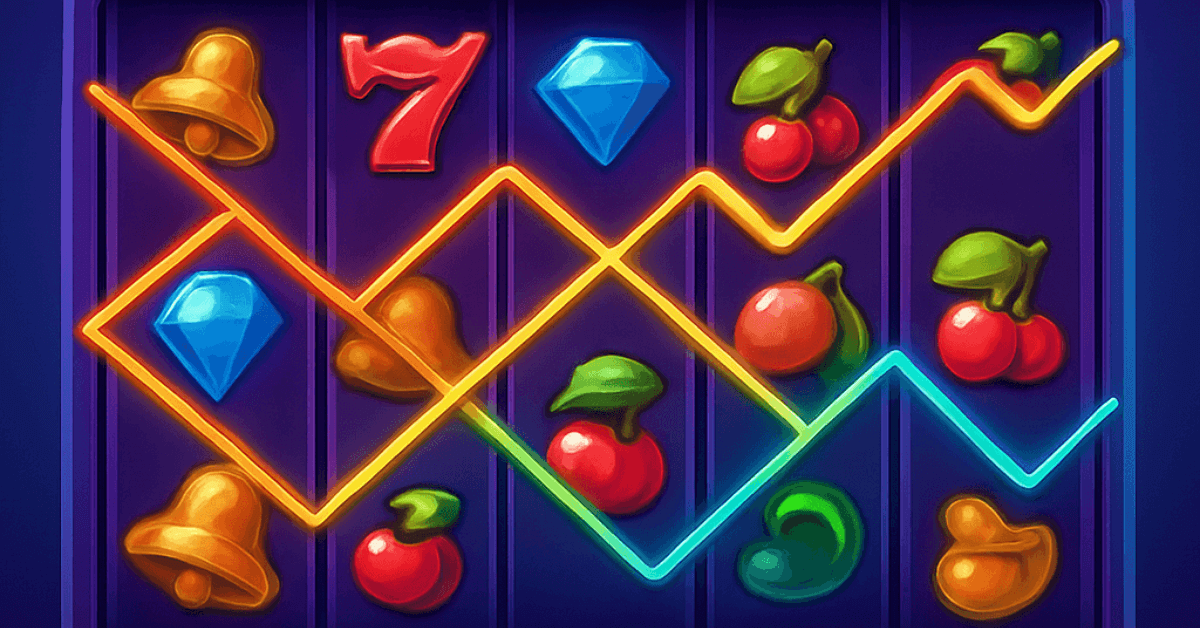
Payline Patterns: How Wins Actually Form
Paylines in slot games follow specific geometric patterns that are defined in the game’s paytable. Understanding the common patterns helps you visualize how wins form as you play.
| Pattern Type | Shape | Where It Appears | Example |
|---|---|---|---|
| Straight horizontal | Flat line across one row | Classic 3-reel slots, rows 1, 2, and 3 of 5-reel games | Top row: positions 1-1-1-1-1 |
| Diagonal | Runs from top-left to bottom-right (or reverse) | Standard on 10+ payline video slots | Positions 1-2-3-2-1 (V-shape) |
| Zigzag | Alternates up and down across reels | Common in 20–50 payline games | Positions 2-1-2-3-2 |
| W-shape / M-shape | Double peaks or valleys across the grid | 25+ payline games | Positions 1-3-1-3-1 |
| Scattered positions | Complex patterns using all three rows | 50+ payline games | Positions 3-1-2-1-3 |
How to see payline patterns: Every slot displays its payline map in the info/paytable screen. Click the “i” or “?” button, then look for numbered lines drawn across a grid diagram. Each numbered line shows exactly which positions on which reels constitute that payline. In most modern games, you can also click the payline number during play to see the pattern highlighted on the reels — useful for understanding why a spin that looked like a near-miss was actually not on any active line.
Fixed vs Adjustable Paylines in Slot Games
The most important distinction in paylines in slot games is whether they are fixed or adjustable — because it determines how much control you have over your cost per spin and your win coverage.
Fixed Paylines
- All paylines are always active — you cannot deselect them
- Your total bet is divided equally across all lines
- Every possible winning pattern is covered on every spin
- You control bet size only by adjusting the total stake, not the line count
- Standard in most modern video slots (2020s onward)
Adjustable Paylines
- You choose how many paylines to activate before each spin
- Fewer active lines = lower cost per spin but also fewer winning patterns
- Some bonus triggers require symbols on specific lines — deactivating those lines disables the trigger
- More common in older video slots and Novomatic/EGT titles
- Gives direct control over bet size and effective volatility
Why the Industry Moved to Fixed Paylines
Adjustable paylines created a problem: players who reduced their active lines to save money unknowingly reduced their bonus trigger rates, missed winning combinations, and experienced a different game than the math model was designed for. Fixed paylines in slot games solve this by ensuring every player experiences the full mathematical profile the studio intended — the same hit rate, the same feature frequency, and the same RTP regardless of bet size. The trade-off is that you cannot lower your cost per spin by deselecting lines; the minimum bet covers all lines.
Fixed vs Adjustable Paylines: Direct Comparison
| Factor | Fixed Paylines | Adjustable Paylines |
|---|---|---|
| Player control over active lines | None — all lines always active | Full — choose 1 to max |
| Cost per spin | Controlled by total bet slider only | Controlled by bet per line × active line count |
| Win coverage | 100% of winning patterns covered every spin | Only active lines are covered |
| Bonus trigger access | All triggers always available | Some triggers may require specific lines to be active |
| Effective hit rate | As designed by the math model | Drops proportionally with fewer active lines |
| RTP impact | RTP is constant regardless of bet size | RTP remains the same per line but effective return per spin decreases with fewer lines |
| Best for | Players who want consistent, full-coverage play | Players who want granular bet control (and accept the coverage trade-off) |
How Paylines in Slot Games Affect Your Cost Per Spin
The number of active paylines in slot games directly determines how much each spin costs — and understanding this relationship is essential for bankroll management.
Total Bet = Bet Level × Number of Fixed Paylines
Example: €0.05 per line × 20 fixed lines = €1.00 per spin
Adjustable paylines:
Total Bet = Bet Per Line × Number of Active Lines
Example: €0.10 per line × 5 active lines (of 20) = €0.50 per spin
Same game, all 20 lines: €0.10 × 20 = €2.00 per spin
This is where the adjustable payline trade-off becomes concrete. Playing 5 lines instead of 20 cuts your cost by 75% — but you are also covering only 25% of the winning patterns. A jackpot combination landing on payline 17 when you are only playing lines 1–5 is a valid game outcome that returns nothing to you. The Session Risk Analyzer models how bet sizing affects your survival probability across a session — enter your bankroll, bet size, and the game’s volatility to see how long your balance is likely to last.
Important: In ways-to-win and Megaways games, all ways are always active. There is no option to play fewer ways. The minimum bet covers the full grid. This means the cost-per-spin model is fundamentally different from traditional paylines in slot games — you cannot reduce your exposure by deselecting patterns.
Paylines in Slot Games: Hit Rate and Win Frequency
The number of active paylines directly affects how often you experience a win. More active lines = more patterns checked per spin = higher probability that at least one pattern contains a winning combination.
| Active Paylines | Patterns Checked Per Spin | Relative Hit Rate | Session Feel |
|---|---|---|---|
| 1 line | 1 | Lowest — wins are very rare | Long droughts, occasional returns |
| 5 lines | 5 | Low — some activity but sparse | Noticeable dead stretches |
| 10 lines | 10 | Moderate | Regular small wins, manageable variance |
| 20 lines (full coverage) | 20 | As designed by math model | Intended session rhythm and feel |
| 243 ways | 243 (all positions) | Higher than fixed paylines | Frequent small wins, more LDWs |
| 117,649 Megaways | Up to 117,649 | Variable per spin (ways change) | Extreme variance in both frequency and size |
The hit rate published in a game’s specifications assumes all paylines are active. If you play fewer lines on an adjustable-payline game, your effective hit rate drops proportionally. A game with a 25% hit rate on 20 lines might feel like a 6-7% hit rate on 5 lines — significantly changing the session experience. This is one reason the industry shifted toward fixed paylines in slot games: to ensure every player experiences the intended math model, not a degraded version of it.
Paylines vs Ways to Win vs Cluster Pays
Traditional paylines in slot games are one of three major win systems used in modern slots. Understanding how they compare to ways-to-win and cluster pay formats helps you choose games based on mechanics, not just theme.
| Win System | How Wins Form | Typical Win Count Per Spin | Cost Model |
|---|---|---|---|
| Fixed paylines (10–50) | Matching symbols on specific predefined line patterns | 0–3 winning lines per spin | Bet per line × line count |
| 243 ways | Matching symbols on any position on adjacent reels | 0–5+ winning ways per spin | Fixed total bet (all ways active) |
| Megaways (up to 117,649) | Variable reel heights × adjacent reel matching | 0–20+ winning ways per spin (varies) | Fixed total bet (all ways active) |
| Cluster pays | Groups of 5+ matching symbols touching horizontally/vertically | 0–1 cluster per spin (larger clusters = larger wins) | Fixed total bet |
Ways to Win in Slots covers the full comparison. Megaways vs Classic Slots compares the most extreme ways-to-win format against traditional payline games. Cluster Pays, Expanding Reels and Ways to Win covers the alternative formats that replace paylines entirely.
The Trend Away from Paylines
The majority of new slot releases in 2025–2026 use ways-to-win or cluster-pay systems rather than traditional paylines. The reason is mechanical: ways-to-win systems produce more winning events per spin (maintaining player engagement) while concentrating larger wins in feature rounds (maintaining volatility). Studios like Nolimit City and Pragmatic Play rarely release payline-based games anymore. The few studios that still use adjustable paylines — primarily Playson and EGT-influenced developers — target regulated European markets where those formats remain popular.
How Paylines in Slot Games Interact with Bonus Features
The relationship between paylines and bonus features depends on the game’s trigger mechanism — and this is where deactivating paylines on adjustable games can cost you more than just wins.
Scatter symbols — In most modern games, scatters trigger regardless of payline position. Three scatters anywhere on the grid activates the feature whether you are playing 1 line or 50. However, in some older adjustable-payline games, scatters must land on active paylines to count. This means reducing your active lines can literally disable your ability to trigger the bonus round — the most valuable event in most high-volatility slots.
Wild symbols — Wilds substitute for regular symbols on active paylines only. A wild landing on a deactivated payline contributes nothing. In fixed-payline and ways-to-win games, wilds contribute to every possible combination they can form — their value is maximized when all patterns are active.
Multiplier progression — In cascading/tumble games (which typically use ways-to-win, not paylines), multipliers increment with each consecutive win. More active winning patterns = more frequent cascades = faster multiplier growth. This interaction is core to how features affect RTP in modern titles.
Jackpot triggers — Some progressive jackpot games require the jackpot combination to land on the maximum payline or a specific payline. Playing fewer lines can disqualify you from the jackpot entirely — a critical detail that is documented in the paytable but easy to miss.
Paylines and RTP: Does the Number of Lines Change Your Return?
This is one of the most misunderstood aspects of paylines in slot games. The answer is nuanced and depends on whether the game uses fixed or adjustable paylines.
Fixed Paylines: RTP Is Constant
In a fixed-payline game, the RTP is the same regardless of bet size. You cannot change the number of active lines, so the mathematical profile is identical at €0.20 and at €100. The RTP was designed and certified for the full payline configuration.
Adjustable Paylines: RTP Per Line Is Constant, Effective RTP Shifts
The RTP per individual payline remains the same whether you play 1 line or 20. But your effective return per spin changes because you are covering fewer winning patterns. Statistically, you are playing a subset of the math model — the RTP of that subset is technically the same, but your hit rate, bonus access, and session variance all change.
The house edge remains constant per line regardless of how many lines you play. Playing 1 line out of 20 does not give the casino a bigger edge on that line — it gives you fewer opportunities per spin. The distinction matters: you are not being cheated by playing fewer lines, but you are experiencing a game that the math model was not optimized for.
How to Choose the Right Payline Format for Your Play Style
| If You… | Recommended Format | Why |
|---|---|---|
| Want full feature access, no trade-offs | Fixed paylines or ways-to-win | All patterns active, all features accessible, intended math model |
| Need granular control over bet size | Adjustable paylines | Direct control over cost per spin by choosing active lines |
| Want the highest possible win ceilings | Megaways / high-ways | Variable ways produce the most extreme multi-way win potential |
| Are bonus hunting with buys | Ways-to-win (Megaways) | Bonus buys are standard; cascading multipliers provide ceiling |
| Prefer simple, readable gameplay | Fixed paylines (10–20 lines) | Visible patterns, predictable cost, easy to follow |
| Want the longest session per bankroll | Adjustable paylines at reduced lines + low bet | Lowest possible cost per spin (accept lower hit rate) |
| Are new to slots | Fixed paylines (10–20 lines) | No configuration needed, full access, learn the mechanics cleanly |
Practical advice: Unless you have a specific reason to play fewer lines, play all available paylines or choose a ways-to-win game. The cost difference between 10 lines and 20 lines is usually small relative to the value you lose by deselecting winning patterns. If budget is a constraint, reduce your bet per line instead of your line count — you keep full coverage at a lower total cost. Use the Slot Volatility and RTP Calculator to see how different bet sizes distribute outcomes across a session.
How to Read Payline Maps in Any Slot
Every slot provides a visual payline map in its information screen. Reading it takes 30 seconds and tells you everything you need to know about how wins form in that specific game.
4-Step Payline Map Reading Method
Step 1 — Open the paytable. Click the “i”, “?”, or menu button in the game interface. Navigate to the section labeled “Paylines” or “Win Lines.”
Step 2 — Count the lines. Each payline is numbered and drawn across a small grid diagram. Note the total count — this is how many winning patterns exist per spin.
Step 3 — Trace the patterns. Follow lines 1, 10, and the highest-numbered line to understand the range of shapes. Line 1 is usually the middle horizontal row. Higher-numbered lines use progressively more complex zigzag and W-shapes.
Step 4 — Check win direction. Most games pay left to right only. Some games (like Starburst) pay both ways — this effectively doubles the winning potential on every pattern. The paytable specifies the direction.
For a broader guide to reading paytables — including symbol values, feature rules, and RTP verification — the Slot Symbols Guide covers the 5-step paytable reading method. The Slot Player Handbook covers paytable literacy as one of its seven core fundamentals.
To practice reading payline maps risk-free, use the free online slots library — open any game, click the info screen, and trace the payline patterns before you spin. This builds the habit of checking the game’s structure before committing money.
Practice reading payline maps and testing win patterns risk-free — 28,000+ free demos, no sign-up
Browse Free Demo Slots →Paylines in Slot Games: Pros and Cons Summary
✓ Fixed Paylines — Strengths
- Full coverage on every spin — no missed winning patterns
- All bonus triggers and jackpot conditions always active
- Simpler bet configuration — adjust total stake only
- Intended math model experience (RTP, hit rate, volatility as designed)
- No risk of accidentally disabling features
✗ Fixed Paylines — Weaknesses
- No line-level bet control — minimum bet covers all lines
- Higher minimum cost per spin than adjustable formats
- Less flexibility for extreme low-budget sessions
✓ Adjustable Paylines — Strengths
- Direct control over cost per spin via line count
- Can extend session length by playing fewer lines
- Useful for testing games at minimal cost
✗ Adjustable Paylines — Weaknesses
- Fewer active lines = lower hit rate and missed wins
- Some bonus triggers require specific paylines to be active
- Jackpot conditions may be payline-specific
- Players often unknowingly degrade their game experience
- Being phased out by most modern studios
Further Reading on Paylines in Slot Games
Paylines in slot games connect to several broader topics covered elsewhere on SlotDecoded. How Online Slots Work covers the complete framework that paylines sit within — RTP, volatility, RNG, and the math model that governs it all. Ways to Win in Slots covers the modern alternatives to paylines. Max Win Slots Explained covers how the win system (paylines vs ways) affects the theoretical ceiling. Gambling Math Explained ties paylines, RTP, hit rate, and volatility together into a single mathematical framework. And the Paylines & Wins hub page links to every related guide on the site.
Frequently Asked Questions — Paylines in Slot Games
What are paylines in slot games?
Paylines are predefined patterns across the reels where matching symbols must land to form a winning combination. They can be straight horizontal lines, diagonal patterns, zigzags, or complex multi-row shapes. The number of active paylines determines how many winning patterns are checked on each spin.
What is the difference between fixed and adjustable paylines?
Fixed paylines are always active on every spin — you cannot deselect them. Adjustable paylines let you choose how many lines to activate, which reduces cost per spin but also reduces your win coverage and may disable some bonus triggers. Most modern slots use fixed paylines or ways-to-win systems.
Do more paylines mean more wins?
More active paylines increase the number of winning patterns checked per spin, which raises your hit rate. However, more paylines also means a higher cost per spin, and many of the additional wins may be smaller than the total bet (losses disguised as wins). More lines means more activity, not necessarily more profit.
Can I win a jackpot with fewer paylines active?
It depends on the game. Some jackpot triggers require the winning combination to land on the maximum payline or a specific payline. If that payline is not active, the jackpot combination is not valid. Always check the paytable for jackpot conditions before reducing your active lines.
Do Megaways slots use paylines?
No. Megaways slots use a ways-to-win system where matching symbols on adjacent reels form wins regardless of position. The number of ways changes per spin based on how many symbols appear on each reel (up to 117,649 ways). There are no payline patterns — every symbol position contributes to potential wins.
Does reducing paylines change the RTP?
The RTP per individual payline remains the same. However, your effective return per spin changes because you are covering fewer winning patterns. The game’s math model was designed and certified for full payline coverage — playing a subset means you experience different hit rates and feature frequencies than the published specifications indicate.
Should I always play all paylines?
In most cases, yes. Playing all paylines ensures full coverage of winning patterns, full access to bonus triggers, and the intended volatility profile. If budget is a concern, reduce your bet per line rather than your line count — you keep full coverage at a lower total cost. The exception is deliberate low-cost testing of an adjustable-payline game in demo mode.
What are the best payline formats for bonus hunting?
Ways-to-win and Megaways formats dominate bonus hunting because they offer bonus buy options and high max win ceilings. Traditional fixed-payline games (10–20 lines) can serve as “floor” slots in a hunt — providing more consistent returns alongside the high-ceiling ways-to-win titles that provide upside potential.
Responsible Gambling: Understanding paylines in slot games confirms that every outcome is determined by a random number generator with a built-in house edge. No payline configuration changes the long-run cost of play. Set limits before you spin using the Responsible Gambling Planner. Help is available at BeGambleAware.org and GamCare.org.uk.