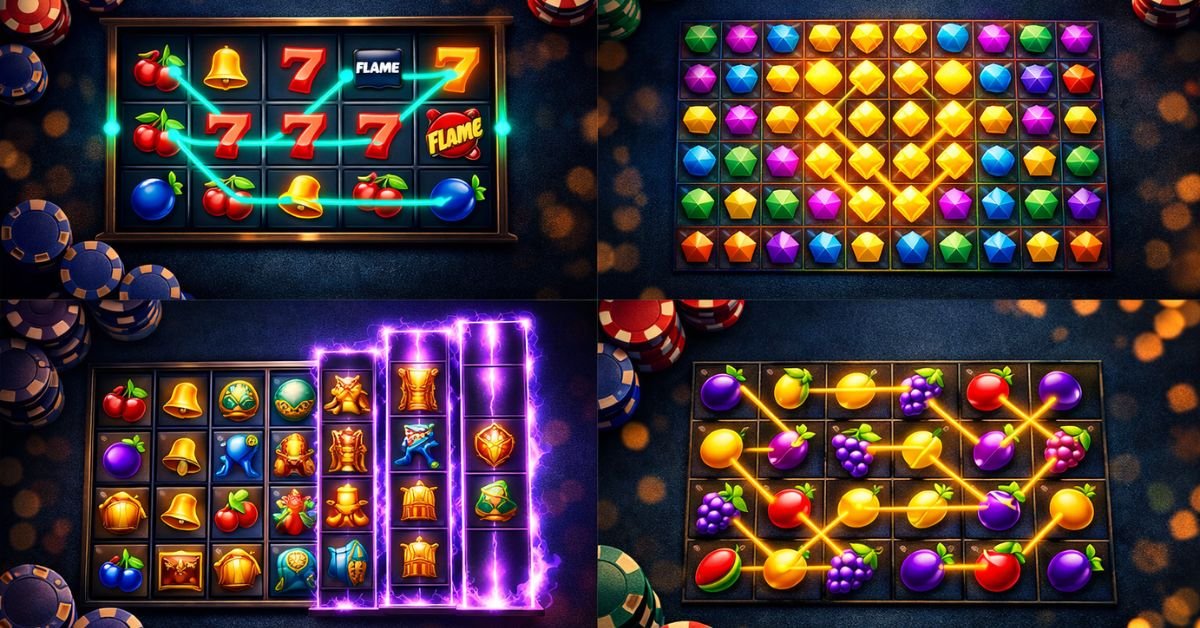
Traditional paylines defined how slots worked for decades — matching symbols on predefined line patterns, left to right. But the modern slot landscape has moved far beyond that model. Today, the dominant ways to win in slots include cluster pays, expanding reels, pay-anywhere systems, and grid-based formats that abandon reels entirely. Each system changes how wins form, how volatility is distributed, and how the math model delivers its RTP. This guide goes deep on the four systems that have reshaped modern slot design — and explains what each one means for your bankroll, your session, and your decision-making.
4 Modern Ways to Win in Slots at a Glance
Each of these ways to win in slots replaces the fixed payline model with a fundamentally different approach to win formation. The broad overview of all win systems — including traditional paylines, both-ways pays, and Megaways — is covered in Ways to Win Slot Games Explained. This guide goes deeper into the four systems that most players encounter in modern releases and explains the mechanical differences that matter when choosing games.
Adjacent-Reel Ways to Win in Slots: 243, 1,024 and Beyond
The adjacent-reel ways system is the most common alternative to paylines. Instead of requiring symbols on specific line patterns, it awards a win whenever matching symbols appear on consecutive reels from left to right, regardless of which row they occupy on each reel. There are no lines to trace — every position on each reel is a potential part of a winning combination.
Total ways = Positions on reel 1 × Positions on reel 2 × … × Positions on reel N
5 reels × 3 rows each: 3 × 3 × 3 × 3 × 3 = 243 ways
5 reels × 4 rows each: 4 × 4 × 4 × 4 × 4 = 1,024 ways
6 reels × 7 rows each (Megaways max): 7 × 7 × 7 × 7 × 7 × 7 = 117,649 ways
The key advantage of this system over paylines is that you can never “miss” a win because of line selection. Every possible left-to-right combination is checked on every spin. The trade-off: all ways are always active, so you cannot reduce your bet by deselecting some — the minimum bet covers the full grid.
Adjacent Ways — Key Metrics
Megaways — where each reel randomizes the number of symbols per spin — is the extreme end of this category. Megaways vs Classic Slots covers that specific format in full. Standard 243-ways games like Thunderstruck II and Immortal Romance sit at the other end: simpler, lower volatility, and closer to the traditional payline feel.
Cluster Pays: How Grid-Based Ways to Win in Slots Work
Cluster pays is the most radical departure from traditional slot design. There are no reels, no paylines, and no left-to-right win direction. The game uses a grid — typically 5×5, 7×7, or 8×8 — and wins form when clusters of 5 or more identical symbols touch each other horizontally or vertically (not diagonally).
How a Cluster Win Forms
Imagine a 7×7 grid filled with symbols. After the grid fills, the game checks whether any group of identical symbols forms a connected cluster of 5 or more. A cluster of 5 matching symbols touching in an L-shape pays the base value. A cluster of 15 touching symbols pays dramatically more. A cluster of 25+ is where the game’s big wins originate. After a cluster win is paid, the winning symbols are removed, remaining symbols drop (cascade), and new symbols fill from above — creating the possibility of chain reactions.
| Cluster Size | Typical Payout Multiplier | How It Feels |
|---|---|---|
| 5–7 symbols | 0.5×–2× bet | Minimum win — frequent, keeps the grid active |
| 8–12 symbols | 2×–10× bet | Mid-range hit — visible cluster, satisfying cascade potential |
| 13–20 symbols | 10×–50× bet | Large cluster — multiple cascade chains likely to follow |
| 20+ symbols | 50×–500×+ bet | Grid-dominating cluster — where max win approaches begin |
The cascade mechanic is integral to cluster pays. After every winning cluster is removed, the grid compresses and refills. This creates chain reactions where one cluster leads to another as symbols reposition — and in many games, a multiplier increases by +1 with each cascade step. A cascade chain of 8 with a progressive multiplier means the 8th win is paid at ×8 the base value. This is the same compounding engine that drives Megaways games, applied to a grid format instead of a reel format.
Cluster pay and symbol interaction: In cluster pay games, wild symbols count as part of any adjacent cluster. A wild sitting between two separate groups of matching symbols can merge them into one large cluster — turning two small wins into one massive one. This makes wild placement on grid games far more impactful than in traditional reel-based formats. Some cluster pay games also include collector symbols that absorb all multiplier values on the grid before calculating the win.
Notable Cluster Pay Games and Their Mechanics
| Game | Provider | Grid Size | Unique Mechanic |
|---|---|---|---|
| Reactoonz 2 | Play’n GO | 7×7 | Energoonz charge meter, Quantumeter features, Gargantoon wild |
| Jammin’ Jars 2 | Push Gaming | 8×8 | Jam jar wilds carry multipliers, move randomly each cascade |
| Aloha! Cluster Pays | NetEnt | 6×5 | Sticky win respin, free spins with extra wilds and higher payouts |
| Fruit Party 2 | Pragmatic Play | 7×7 | Random multiplier symbols (2×–100×), tumble with multiplier reset |
Expanding Reels: Dynamic Grids That Grow Mid-Spin
Expanding reels are a modifier applied to other ways to win in slots — they change the grid size during play, adding rows, reels, or both. The result: a game that starts with a compact grid and expands to a much larger one under specific conditions, dramatically increasing the number of winning combinations available.
How Expanding Reels Work
The base game uses a standard grid — for example, 5 reels × 3 rows (243 ways). When a trigger condition is met — usually a cascade chain, a specific symbol landing, or a bonus round activating — one or more reels gain extra rows. A reel expanding from 3 to 7 rows changes the grid from 243 ways to 16,807 ways. If all reels expand, the ways can climb to 100,000+. Some formats add entirely new reels: a 5-reel game might expand to 6, 7, or 8 reels during a feature, multiplying the grid capacity exponentially.
| Expanding Reel Type | How It Triggers | Effect on Grid | Example |
|---|---|---|---|
| Vertical expansion | Cascade chains, bonus round entry | Reels gain additional rows (3 → 5, 6, or 7) | Bonanza Megaways — variable per spin |
| Horizontal expansion | Special symbol, feature trigger | New reels added to the right side of the grid | Infinity Reels (ReelPlay) — no upper limit |
| Combined expansion | Bonus round stages, progressive unlocks | Both rows and reels increase | Nitropolis series (ELK Studios) |
| Periscope / targeted | Specific mechanic (e.g., NLC Periscope Up!) | Single reel expands to 8 positions | Das xBoot 2wei! (Nolimit City) |
The volatility impact of expanding reels is significant. During the base game, the compact grid produces modest wins. During the feature, the expanded grid creates the possibility of massive multi-way combinations. This is the same base/bonus split pattern described in How Slot Features Affect RTP — the base game bleeds slowly, and the feature is where the return concentrates. Expanding reels amplify this concentration because the expanded grid is only available during the most valuable moments of the game.
Pay-Anywhere and Scatter-Pays: Ways to Win in Slots Without Adjacency
Pay-anywhere systems — sometimes called scatter-pays or tumble-pays — take the simplification even further. Wins are based purely on the total count of a matching symbol anywhere on the visible grid. No adjacency, no reel-by-reel matching, no line patterns. If 8 matching symbols appear on the grid, it pays — regardless of where they are positioned.
How Pay-Anywhere Differs from Cluster Pays
In cluster pays, symbols must touch each other to form a win. In pay-anywhere, they do not — the position is irrelevant, only the count matters. Five matching symbols scattered randomly across a 7×7 grid is a valid win in pay-anywhere but would not qualify in cluster pays unless the five symbols happen to form a connected group. Pay-anywhere systems typically pair with tumble/cascade mechanics and random multiplier symbols that appear on any position and multiply the total win for that cascade. The most prominent example is Pragmatic Play’s Gates of Olympus, which uses this exact system.
| Game | Provider | Grid | Multiplier Mechanic | Max Win |
|---|---|---|---|---|
| Gates of Olympus | Pragmatic Play | 6×5 | Random multiplier symbols (2×–500×), persist through cascades | 5,000× |
| Sweet Bonanza | Pragmatic Play | 6×5 | Random multiplier bombs (2×–100×), tumble | 21,175× |
| Starlight Princess | Pragmatic Play | 6×5 | Random multiplier symbols, cascade multiplier stacking | 5,000× |
Pay-anywhere is arguably the simplest win system for players to understand: see enough matching symbols, win. But the mathematical depth comes from the multiplier interaction — random multiplier symbols landing during a cascade chain compound with each other, turning a modest symbol count into a large payout. This mechanic has made pay-anywhere slots among the most popular formats globally.
Full Comparison: All 4 Ways to Win in Slots vs Traditional Paylines
| Factor | Paylines | Adjacent Ways | Cluster Pays | Expanding Reels | Pay-Anywhere |
|---|---|---|---|---|---|
| Win formation | Fixed line patterns | Any position, adjacent reels | Touching symbol groups | Variable (ways increase) | Total count anywhere |
| Grid type | Standard reels | Standard reels | Grid (no reels) | Dynamic reels | Grid or reels |
| Cascading wins | Rare | Common | Standard | Standard | Standard |
| Volatility range | Low–medium | Low–extreme | Medium–high | High–extreme | Medium–high |
| Typical max win | 500×–5,000× | 2,000×–50,000×+ | 5,000×–20,000× | 10,000×–50,000×+ | 5,000×–21,000× |
| Bet control | Adjustable (some) | Fixed (all ways active) | Fixed | Fixed | Fixed |
| Complexity | Low | Low–medium | Medium | Medium–high | Low |
| Bonus buy | Uncommon | Common (Megaways) | Common | Common | Common |
How Ways to Win in Slots Affect Volatility and RTP
The win system does not change the published RTP — a 96% cluster pay game and a 96% payline game both return the same percentage over millions of spins. But the win system fundamentally changes how that return is distributed across your session, which is what volatility measures.
Why Alternative Win Systems Increase Volatility
Every modern way to win in slots that replaces paylines also introduces cascading wins — and cascading wins concentrate value into cascade chains rather than distributing it across individual spins. A spin that triggers a 6-step cascade chain with a progressive multiplier can return 100× or more. The spins between those chains return little or nothing. This concentration effect is why cluster pays, expanding reels, and pay-anywhere games feel more volatile than traditional paylines even at the same RTP. The Slot Volatility and RTP Calculator simulates this distribution across 200 sessions so you can see the real range before committing money.
The base/bonus RTP split reinforces this. In a traditional payline game, 75–85% of the RTP comes from the base game. In a cluster pay or pay-anywhere game with cascading multipliers, the bonus round often contributes 30–45% of the total RTP — meaning the base game returns less per spin, and the bonus carries disproportionate value. How Slot Features Affect RTP covers this redistribution in detail.
Cascading Wins: The Engine Behind Modern Ways to Win in Slots
Cascading wins (also called tumble, avalanche, or collapse) are the connective mechanic that makes all four modern ways to win in slots work differently from paylines. After a winning combination forms, the winning symbols are removed from the grid. Remaining symbols drop down (or in grid games, collapse inward), and new symbols fill the vacated positions. If the new arrangement produces another win, the process repeats.
| Cascade Feature | What It Does | Win Impact |
|---|---|---|
| Symbol removal | Winning symbols disappear after payout | Creates space for new symbols and potential new wins |
| Progressive multiplier | +1 multiplier per consecutive cascade | Cascade chain of 5 = 5th win paid at ×5 |
| Multiplier persistence | Some games carry the multiplier into the next spin (bonus only) | Builds session-wide value during free spins |
| Wild generation | Some cascades produce wilds in place of removed symbols | Each cascade increases wild density on the grid |
Without cascading wins, cluster pays and pay-anywhere systems would produce only modest returns — the initial cluster or symbol count would determine the payout and the spin would end. Cascading wins transform a single spin into a multi-step event where value compounds with each step. This is why a “good spin” on a cluster pay game can return 200× from what started as a moderate 8-symbol cluster — the cascade chain that followed is where the real value accumulated.
Which Providers Use Which Ways to Win in Slots
| Provider | Primary Win System | Signature Mechanic |
|---|---|---|
| Pragmatic Play | Pay-anywhere (tumble), Megaways, hold-and-spin | Random multiplier symbols; Gates of Olympus format widely copied |
| Nolimit City | Adjacent ways with xMechanics | xBomb, xNudge, xWays — symbols that are mechanics, not just icons |
| NetEnt | Mixed (paylines, cluster pays, ways) | Aloha! Cluster Pays pioneered the format; Gonzo’s Quest popularized cascades |
| Playson | Paylines + Hold ‘n Link | Traditional formats for regulated markets; money collection mechanics |
| Shady Lady | Meter-pay / accumulator | Unique fill-the-meter systems distinct from standard cluster or ways formats |
| EXCO | High-ceiling engineered systems | 100,000× max win cap; pushing boundaries of what win systems can deliver |
| Play’n GO | Cluster pays (Reactoonz series) | 7×7 grid, meter-based features, cascading cluster chains |
| Push Gaming | Cluster pays (Jammin’ Jars series) | Multiplier wilds that move with each cascade |
| Big Time Gaming | Megaways (creator) | Variable reel heights = variable ways per spin; licensed to other studios |
For full studio profiles, see the Slot Providers section. Each profile covers the studio’s preferred win systems, volatility range, and math model characteristics.
Ways to Win in Slots for Bonus Hunting
If you use bonus hunts as your primary play format, the win system directly affects which games belong in your hunt list and what role they serve.
Hunt construction principle: Cluster pays and pay-anywhere games with tumble multipliers serve as mid-range slots in a hunt — they deliver consistent 50×–200× returns with occasional spikes. Megaways and expanding reel games provide the ceiling — the 500×+ results that turn a losing hunt into a profitable one. A balanced hunt includes both. The Best Slots for Bonus Hunting guide ranks specific games by hunt-relevant metrics.
Bonus buy availability varies by system. Pay-anywhere games (Gates of Olympus, Sweet Bonanza) almost universally offer bonus buys. Cluster pay games usually offer them too. Traditional payline games often do not. This makes the modern ways to win in slots the practical backbone of bonus buy hunting — you can purchase features at known costs and track results systematically with the Bonus Hunt Tracker.
Track cluster pay, pay-anywhere, and Megaways results side by side — find which systems deliver for your hunts
Open the Free Bonus Hunt Tracker →How to Choose the Right Win System for Your Play Style
| If You… | Best Win System | Why |
|---|---|---|
| Want the simplest experience | Pay-anywhere | Count matching symbols anywhere on the grid — no patterns to learn |
| Enjoy chain reactions and combos | Cluster pays | Cascading clusters create puzzle-like chain events |
| Want the highest max win ceilings | Megaways / expanding reels | Variable ways + cascade multipliers = exponential ceiling |
| Prefer readable, traditional formats | Fixed paylines | Visible line patterns, steady returns, lower variance |
| Are bonus hunting with buys | Pay-anywhere or Megaways | Bonus buy standard, cascade multiplier provides upside |
| Want visual spectacle | Cluster pays (large grids) | 7×7 and 8×8 grids with explosive cascade animations |
| Want to test before committing | All — try demos | Play 100 spins of each system in free mode to feel the difference |
For comprehensive guidance on choosing games based on your bankroll and session goals, the Slot Player Handbook covers the seven fundamentals. The Session Risk Analyzer models how different volatility levels (driven by the win system) affect your bust probability. And for the mathematical framework behind all of it, Gambling Math Explained ties RTP, hit rate, and volatility into a single model.
Frequently Asked Questions — Ways to Win in Slots
What are the main ways to win in slots?
The four main modern systems are: adjacent-reel ways (243 to 117,649 ways), cluster pays (connected groups of matching symbols on a grid), expanding reels (grids that grow during play), and pay-anywhere/scatter-pays (total symbol count regardless of position). Traditional fixed paylines are the fifth format, though increasingly rare in new releases.
What is the difference between cluster pays and pay-anywhere?
In cluster pays, matching symbols must touch each other horizontally or vertically to form a win. In pay-anywhere, the position is irrelevant — the total count of matching symbols anywhere on the grid determines the payout. Both typically use cascading wins, but pay-anywhere is simpler because adjacency does not matter.
Do more ways to win mean better odds?
No. The RTP — not the number of ways — determines your long-run return. A 243-ways game at 96% RTP and a 117,649-ways game at 96% RTP both return the same percentage over time. More ways means more potential winning combinations per spin, but the payouts per combination are adjusted to maintain the same total RTP. The house edge is the same.
What are expanding reels in slots?
Expanding reels are a feature where the grid grows during play — reels add extra rows or new reels appear. This increases the total ways to win during the feature. Common examples include Megaways (variable reel heights per spin), Infinity Reels (new reels added with each cascade win), and targeted expansion (e.g., Nolimit City’s Periscope Up! expanding a single reel to 8 positions).
Which ways to win in slots are best for bonus hunting?
Megaways and pay-anywhere systems are the backbone of most bonus hunt lists because they offer bonus buys, high max wins, and cascading multiplier mechanics. Cluster pays games serve as solid mid-range inclusions. The Best Slots for Bonus Hunting guide ranks specific titles by hunt-relevant metrics.
What is the easiest win system to understand?
Pay-anywhere is the simplest: see enough matching symbols on the grid, win. No lines, no adjacency rules, no patterns to trace. Gates of Olympus (Pragmatic Play) is the most well-known example. For traditional formats, fixed paylines are also straightforward once you understand the line map.
Do cluster pays slots have paylines?
No. Cluster pays games use a grid format with no reels and no paylines. Wins are determined by groups of identical symbols touching horizontally or vertically. The concept of a payline does not exist in this format — it is purely about cluster size and position.
Why are cascading wins important for ways to win in slots?
Cascading wins transform a single spin into a multi-step event. After a win, the winning symbols are removed and new symbols fill in. If another win forms, the process repeats — often with a progressive multiplier that increases each step. This cascade-and-multiply mechanic is the engine that produces big wins in cluster pays, pay-anywhere, Megaways, and expanding reel games. Without cascading wins, these systems would produce much smaller returns.
Responsible Gambling: Regardless of the win system, every slot operates with a house edge. Cascading multipliers and expanding grids create exciting moments but do not change the long-run mathematics. Set limits before you play using the Responsible Gambling Planner. Help is available at BeGambleAware.org and GamCare.org.uk.