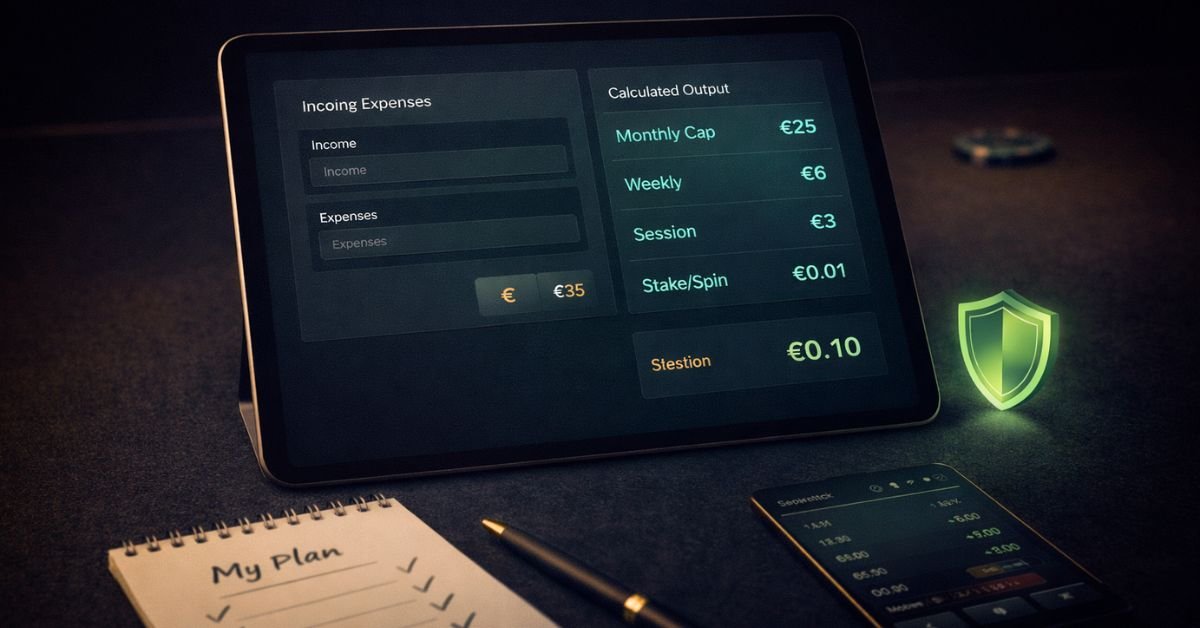
The responsible gambling planner is a free tool that calculates exactly how much you can afford to gamble — based on your actual income, not a guess. It combines two systems in one: an income-based budget calculator that derives monthly, weekly, and per-session limits from your disposable income, and a 9-question PGSI-style risk profiler that gives you an objective score of your current gambling behaviour. The responsible gambling planner produces deposit caps, loss stops, win-stop targets, and stake-per-spin recommendations — a complete plan you can apply to your casino account settings before you play. Everything runs locally in your browser. No account, no server, no data leaves your device.
Responsible Gambling Planner — What It Does
How to Use the Responsible Gambling Planner
1. Enter your monthly income and fixed expenses (rent, bills, food, debt payments).
2. Leave the cap at 5% of disposable income — or tighten to 2–3% if you want stricter control.
3. Set your typical sessions per week and average session length.
4. Click Calculate Budget to see your monthly, weekly, and per-session limits.
5. Review deposit caps, loss stop, win-stop, and recommended stake per spin.
6. Answer the 9 risk profiler questions and click Analyze Risk.
7. Copy or save your plan. Apply these settings to your casino account before your next session.
When to use this: Before your first deposit at a new casino. Before increasing your stakes. After a losing streak that felt uncomfortable. At the start of every month as a budget reset. The responsible gambling planner takes 3 minutes — and the limits it produces protect you during the moments when slot design is working hardest to override your judgment.
🎯 Responsible Gambling Planner
Build a safe gambling budget from your real income, size your stake, and set limits that fit your life. Runs entirely in your browser — nothing is sent anywhere.
Monthly Budget Calculator · Disposable-income based
📌 Divide your session budget by 200 to get your max recommended stake per spin.
Gambling Risk Profiler · PGSI-style (9 items)
Answer for the last 12 months. Be honest — this is private. 0 = Never · 1 = Sometimes · 2 = Most of the time · 3 = Almost always
Suggested Limits & Stake Sizing
Summary & Action Plan
Why the Responsible Gambling Planner Comes Before Everything Else
Every other tool on SlotDecoded — the Session Risk Analyzer, the Bonus Hunt Tracker, the Wager Bonus Calculator — assumes you have a budget. The responsible gambling planner is where that budget comes from. Without it, every other calculation floats on an ungrounded number. The responsible gambling planner turns "I think I can afford €200 a month" into "my income is X, my expenses are Y, my disposable income is Z, and 5% of Z is €W — that is what I can afford." The difference between a guess and a calculation is the difference between feeling in control and being in control.
Responsible Gambling Planner — How the Budget Math Works
| Example Input | Value |
|---|---|
| Monthly income | €2,000 |
| Fixed expenses (rent, bills, food, debt) | €1,500 |
| Disposable income | €500 |
| Cap rate | 5% (default) |
| Monthly gambling budget | €25 |
| Derived Limit | Calculation | Result |
|---|---|---|
| Weekly deposit cap | €25 ÷ 4.33 weeks | ~€5.77 |
| Per-session budget (2 sessions/week) | €5.77 ÷ 2 | ~€2.89 |
| Loss stop (per session) | 50% of session budget | ~€1.44 |
| Win-stop (per session) | 200% of session budget | ~€5.78 |
| Stake per spin (200 spins/session) | Session budget ÷ 200 | ~€0.01 |
What This Example Reveals
At €2,000 income and €1,500 expenses, the responsible gambling planner shows that the maximum sustainable gambling budget is €25/month — roughly €6/week. Many players deposit €50–€100 in a single session without realising that exceeds what their income can absorb. The responsible gambling planner makes the math visible: if losing your session budget would cause stress, it is too high. If losing your monthly budget would affect a bill payment, it is far too high. This is the conversation most players never have with themselves — and the responsible gambling planner forces it to happen before the first spin, not after the first loss.
Responsible Gambling Planner — The PGSI Risk Profiler
The second section of the responsible gambling planner is a 9-question self-assessment based on the Problem Gambling Severity Index (PGSI) — a clinically validated screening instrument used by researchers and support organisations worldwide. You answer each question on a 4-point scale (Never / Sometimes / Most of the time / Almost always), and the responsible gambling planner calculates a risk score.
Score 0–2 — Low Risk
Gambling is recreational and within control. The responsible gambling planner confirms your current behaviour is sustainable. Continue with the budget limits it calculated and review monthly.
Score 3–7 — Moderate Risk
Some behaviours indicate potential risk — such as chasing losses, gambling more than planned, or feeling guilty. The responsible gambling planner recommends tightening the cap rate to 2–3%, setting strict time limits, and reviewing your plan weekly. Consider the Take a Break options proactively.
Score 8+ — Problem Gambling Indicators
Multiple indicators of problem gambling are present. The responsible gambling planner strongly recommends stopping play and reaching out for support: BeGambleAware, GamCare, or Gambling Therapy. Self-exclusion tools exist to protect you during this period.
Two Weighting Factors
The responsible gambling planner adds two supplementary adjustments: playing 4+ sessions per week (frequency risk) and average session length above 90 minutes (duration risk). Either factor nudges the score upward because both are independently associated with escalating gambling harm — even when individual session losses are small.
Important: The PGSI profiler is a screening tool, not a clinical diagnosis. A high score does not mean you have a gambling disorder — it means your current behaviours are associated with elevated risk, and professional support can help you evaluate further. A low score does not mean you are immune — it means the current snapshot looks healthy. Re-screen monthly, especially after changes in play pattern, income, or emotional state.
Responsible Gambling Planner — How to Apply Your Limits at a Casino
The responsible gambling planner gives you numbers. The next step is applying them to your actual casino account settings — before you play, not during.
| Planner Output | Casino Setting | Where to Find It |
|---|---|---|
| Monthly deposit cap | Deposit Limit → Monthly | Account Settings → Responsible Gambling / Player Protection |
| Weekly deposit cap | Deposit Limit → Weekly | Same section — set both monthly and weekly for layered protection |
| Session time limit | Reality Check / Session Timer | Account Settings → set a popup every 30–60 minutes showing time played and net balance |
| Loss stop | Loss Limit (if available) or manual discipline | Some casinos offer automated loss limits. Others require self-enforcement. Log with the Win Per Session Tracker. |
| Stake per spin | Bet size setting in each game | Set before the first spin. Do not increase mid-session. The Session Risk Analyzer confirms whether the stake matches your bankroll depth. |
The activation gap: Most players who use the responsible gambling planner calculate their limits correctly — then do not apply them to their casino accounts. The planner is only useful if the numbers leave your screen and enter your casino settings. Deposit limits in particular should be set on the day you create the account — they take effect immediately but require a cooling-off period to increase, which protects you from impulsive adjustments during a losing session.
Responsible Gambling Planner — Connecting to Other SlotDecoded Tools
| Tool | What It Does | How It Connects to the Responsible Gambling Planner |
|---|---|---|
| Session Risk Analyzer | Models bust probability via Monte Carlo simulation | Takes the session budget from the planner as the "bankroll" input — then models whether that budget survives the planned session at your chosen volatility and bet size |
| Win Per Session Tracker | Logs actual session P&L | Compares your real results to the planner's budget. If your average session loss exceeds the planner's per-session budget, something is wrong — bet size, session length, or game volatility needs adjusting |
| Wager Bonus Calculator | Calculates real value of casino bonuses | A casino bonus should not tempt you to deposit more than the planner's monthly cap. If the bonus requires a deposit that exceeds your limit, decline it — the house edge on wagering will cost more than the bonus is worth |
| Bonus Hunt Tracker | Tracks bonus hunts with ROI | Your total hunt budget should not exceed the planner's monthly gambling budget. If a hunt requires €500 in buy costs but your planner says €100/month, the hunt is unaffordable regardless of expected ROI |
Responsible Gambling Planner — Further Reading
Responsible Gambling Guide — the full framework covering tools, warning signs, and the mathematical argument for limits. Take a Break from Gambling — cool-off periods, self-exclusion, banking blocks, and national registers. Chasing Losses — the behaviour pattern that the planner's loss stop is specifically designed to prevent. Player Psychology in Slot Games — the 8 design triggers that work to override the limits you set. Online Slot Addiction — clinical criteria and treatment paths. House Edge in Slots — why the planner assumes you will lose your budget (because the math guarantees it over time). RTP in Slots — the long-run cost rate that determines how fast the budget depletes. Session Risk Analyzer — model whether your budget survives specific sessions. Win Per Session Tracker — verify your actual results against the planner's budget. The Slot Player Handbook makes limit-setting Rule 5 of the 7 fundamentals.
Track every session after setting your plan — see if your actual results stay within budget
Open the Win Per Session Tracker →Frequently Asked Questions — Responsible Gambling Planner
What is the responsible gambling planner?
A free, browser-based tool that combines an income-based budget calculator with a 9-question PGSI-style risk profiler. It produces monthly, weekly, and per-session gambling limits based on your actual disposable income — plus deposit caps, loss stops, win-stop targets, and stake-per-spin recommendations. All data stays on your device.
Is the PGSI questionnaire clinically validated?
Yes. The Problem Gambling Severity Index is a peer-reviewed, internationally validated screening instrument developed by Ferris and Wynne (2001). It is used by responsible gambling organisations, regulators, and researchers worldwide. The responsible gambling planner uses a PGSI-style implementation — it follows the same 9-item, 4-point scale methodology.
How does the budget calculator determine my limit?
It subtracts your fixed expenses from your monthly income to calculate disposable income, then applies a cap rate (default 5%, adjustable to 2–3% for tighter control). The result is the maximum amount you can afford to lose per month without affecting essential financial obligations. This is then divided into weekly and per-session budgets based on your play frequency.
Is my data stored or shared?
No. The responsible gambling planner runs entirely in your browser using JavaScript. No income, expense, or PGSI data is sent to any server. You can save your plan locally or copy it to your notes — but nothing leaves your device unless you choose to share it.
Why should I use this before other SlotDecoded tools?
Every other tool — the Session Risk Analyzer, the Wager Bonus Calculator, the Bonus Hunt Tracker — requires a budget input. Without an income-grounded budget, those calculations are built on a guess. The responsible gambling planner provides the foundation number that makes everything else accurate.
What cap rate should I use — 2%, 3%, or 5%?
5% is the default — suitable for low-risk recreational players with stable income. 3% is recommended for moderate-risk players or anyone with variable income. 2% is the strict setting for players who scored moderate on the PGSI or who want maximum financial protection. If in doubt, start at 3% — you can always increase later, but reducing is psychologically harder once you have been playing at a higher level.
How often should I update my plan?
Monthly — at the same time you review your Win Per Session Tracker data. Update whenever your income changes, your expenses change, or your play pattern shifts (more/fewer sessions, different stakes, different game types). Re-take the PGSI profiler if you notice behavioural changes like chasing losses, playing longer than planned, or gambling to escape stress.
What if my PGSI score is 8 or higher?
A score of 8+ indicates multiple problem gambling indicators. The responsible gambling planner recommends stopping play and seeking support. This is not a diagnosis — it is a screening signal that professional evaluation would be beneficial. Free, confidential support: BeGambleAware, GamCare, Gambling Therapy. Self-exclusion tools can provide immediate protection while you evaluate next steps.
Responsible Gambling: The responsible gambling planner exists because the house edge guarantees that gambling costs money over time. The only question is how much — and whether that amount fits within your actual financial capacity. If the planner shows that your current gambling exceeds what your income can sustain, that is not a judgement — it is a mathematical fact. Reduce your stakes, reduce your frequency, or take a break. Help is always available at BeGambleAware.org and GamCare.org.uk.