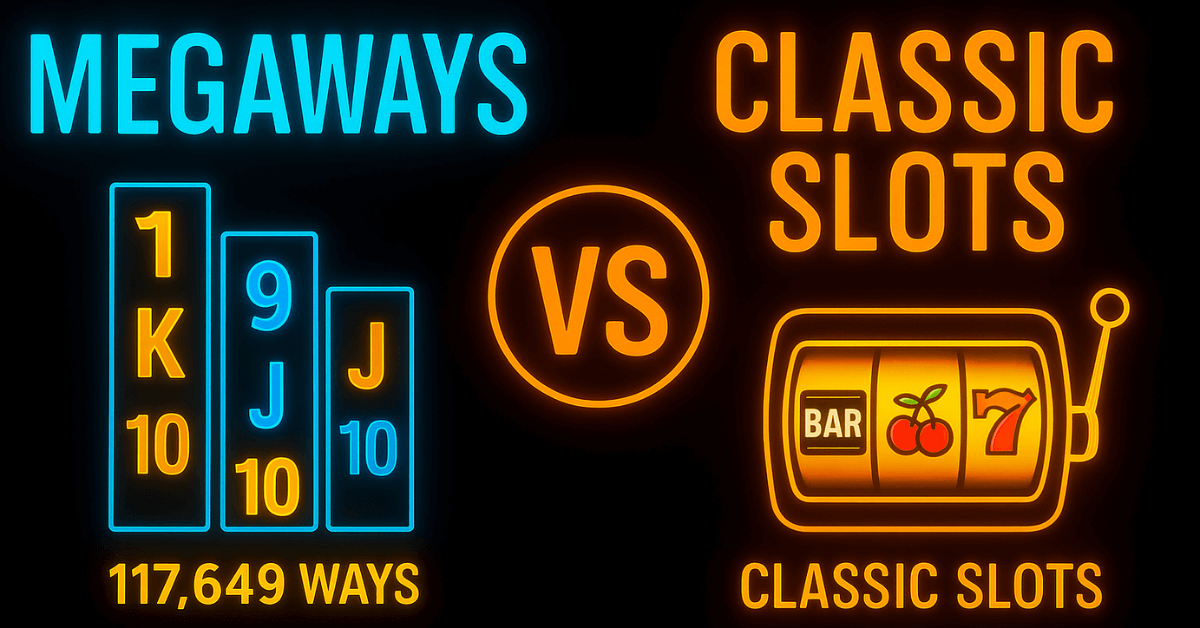
The Megaways vs classic slots debate is not a matter of opinion — it is a structural difference in how two types of games distribute risk, reward, and session experience. Classic slots use fixed paylines and predictable mechanics. Megaways slots randomize the number of symbols on each reel every spin, producing anywhere from 324 to 117,649 ways to win on a single spin. The result is two fundamentally different products that suit different players, different bankrolls, and different expectations. This guide breaks down every dimension of the comparison so you can choose based on mechanics, not marketing.
Megaways vs Classic Slots — Quick Comparison
| Mechanic | Classic Slots | Megaways Slots |
|---|---|---|
| Reels | 3 or 5 (fixed) | 6 (variable height per spin) |
| Win System | Fixed paylines (1–50) | Ways to win (324–117,649) |
| Symbols Per Reel | Fixed (usually 3 per reel) | Variable (2–7 per reel per spin) |
| Volatility | Low to medium | Medium-high to extreme |
| Typical Hit Rate | 1 in 3–5 spins | 1 in 4–8 spins |
| Max Win Range | 500×–5,000× | 10,000×–50,000+× |
| Cascading Wins | Rare | Standard (most titles) |
| Bonus Buy | Uncommon | Common |
| Feature Complexity | Simple (wilds, scatter, free spins) | Complex (cascades, multipliers, expanding reels) |
| Cost Per Spin | Lower (fewer active positions) | Higher (all ways always active) |
| Best For | Longer sessions, lower risk | High-ceiling hunts, feature chasers |
How Classic Slots Work
Classic slots — also called traditional slots or fruit machines — use a fixed grid (typically 3×3 or 5×3) with a set number of paylines. Each spin produces the same number of symbol positions, and wins form when matching symbols land on predefined line patterns from left to right. The mechanics are transparent: you can count the paylines, see every symbol position, and understand the paytable in under a minute.
Classic Slot Structure
A typical 5-reel classic slot with 20 fixed paylines shows 15 symbol positions per spin (5 reels × 3 rows). Every spin has the same grid size, the same number of paylines, and the same number of potential winning combinations. The only variable is which symbols land where. This consistency is what makes classics feel predictable — the game structure never changes from spin to spin.
Classic slots generally use straightforward symbol sets — standard pay symbols, scatters for free spins, and wilds for substitution. The feature set is minimal: a free spin round, maybe a gamble option, occasionally a pick-me bonus. There are no cascading wins, no progressive multipliers, no expanding reels. This simplicity is the point — it makes the game readable at a glance and keeps the session feel steady.
The mathematical profile of most classic slots reflects this design: lower volatility, higher base-game hit rates, and smaller maximum wins. A classic slot might cap at 1,000× to 5,000×, with the majority of the RTP returned through the base game rather than concentrated in a bonus round. This means your balance fluctuates less, sessions last longer per unit of bankroll, and the entertainment-per-spin cost is lower.
How the Megaways Mechanic Works
Megaways is a reel mechanic originally developed by Big Time Gaming (BTG) and licensed to dozens of other studios. The core innovation is variable reel height: on each spin, every reel independently randomizes how many symbols it shows — typically between 2 and 7. The total ways to win is the product of all reel heights. A spin where every reel shows 7 symbols produces 7 × 7 × 7 × 7 × 7 × 7 = 117,649 ways. A spin where each reel shows 2 produces only 64.
How 117,649 Ways Is Calculated
This variability means every spin in a Megaways slot has a different number of potential winning combinations — a mechanic with no equivalent in classic slots. The result is extreme variance in the win-frequency itself, not just the payout size. A spin with 117,649 ways can produce multi-line wins worth hundreds of times the bet. A spin with 64 ways has almost no winning potential. This is why Megaways games feel so different from classics: the game’s own structure changes on every spin.
Most Megaways titles also include cascading wins (also called tumble or avalanche) — after a winning combination forms, winning symbols are removed and new symbols fall into place. If the new arrangement creates another win, it cascades again. Many titles attach a progressive multiplier that increases by +1 with each cascade. A cascade chain of 5 or more in a bonus round with a growing multiplier is where Megaways games produce their largest wins.
Megaways vs Classic Slots: Paylines vs Ways to Win
The Megaways vs classic slots comparison starts here — the win system is the single biggest structural difference between the two formats, and it drives every other difference in volatility, cost, and session feel.
Classic: Fixed Paylines
- Wins form on specific predefined patterns
- You can count the lines and visualize them
- Some games let you choose active paylines (adjustable)
- Fewer paylines = lower cost per spin but lower hit rate
- Maximum winning combinations are capped by line count
Megaways: Variable Ways
- Wins form on any matching symbol on adjacent reels
- Number of ways changes every spin (64–117,649)
- All ways are always active — no line selection
- Higher cost per spin because all positions contribute
- Maximum winning combinations are orders of magnitude higher
For a deeper understanding of how these win systems work mathematically, Ways to Win in Slots covers the full range — from 243-ways through Megaways to cluster pays and expanding reels. The Paylines & Wins section has guides covering every format.
Megaways vs Classic Slots: Volatility and Session Feel
Volatility determines what a session feels like — how often you win, how much those wins are worth, and how much your balance swings between peaks and valleys. This is where the Megaways vs classic slots difference is most visceral.
| Session Characteristic | Classic Slots | Megaways Slots |
|---|---|---|
| Typical volatility range | Low to medium | Medium-high to extreme |
| Base game win frequency | Every 3–5 spins | Every 4–8 spins |
| Win size distribution | Many small wins, few medium | Many dead spins, occasional large |
| Longest expected dry spell | 15–30 spins without any win | 50–150+ spins without a meaningful win |
| Bonus round impact | Moderate (1.5×–10× total bet typical) | High (10×–500×+ possible per round) |
| Session survivability (100 spins) | High — bankroll draws down slowly | Lower — balance can drop fast between features |
Practical test: Play 100 spins of a classic slot and 100 spins of a Megaways slot in free demo mode. Do not look at the numbers — just notice how the two sessions feel. The classic session will feel steady with small regular paybacks. The Megaways session will feel like waiting, waiting, waiting — then a cascade chain that returns more than the previous 30 spins combined. That difference is volatility, and it is the core of the Megaways vs classic slots decision.
The Slot Volatility and RTP Calculator simulates this difference across 200 sessions — you can compare how a 96% RTP low-volatility game distributes results versus a 96% RTP extreme-volatility game. The RTP is the same; the experience is not.
Megaways vs Classic Slots: RTP and Where the Return Comes From
Both classic and Megaways slots can publish identical RTP numbers — a 96% classic and a 96% Megaways game both return 96 cents per dollar wagered over millions of spins. But where that 96% comes from is completely different, and this is the part most comparison guides ignore.
Classic: Base-Game-Heavy RTP
In a typical classic slot, 75–85% of the total RTP comes from base game wins and 15–25% from the bonus round. This means most of your return arrives through regular small wins during normal play. The bonus round adds value but is not the primary source of return.
Megaways: Bonus-Heavy RTP
In a typical Megaways slot, 55–70% of the total RTP comes from the base game and 30–45% from the bonus round. Some extreme titles concentrate even more in the bonus — the base game exists primarily to build toward the feature trigger, where the real value is delivered.
This RTP split matters because it changes the shape of your session. In a classic slot, you are being paid back gradually throughout play. In a Megaways slot, you are being paid back in bursts during bonus rounds, with the base game slowly draining your balance between triggers. How Slot Features Affect RTP explains this redistribution mechanic in detail — it is one of the most important concepts in understanding the Megaways vs classic slots difference.
RTP configuration warning: Many Megaways slots are available in multiple RTP configurations. The same game might run at 96.5% at one casino and 94% at another — the operator chooses, not the studio. Always verify the RTP in the game’s information panel before playing with real money. For the full explanation, read RTP in Slots.
Megaways vs Classic Slots: Feature Mechanics Compared
The feature set is where the two formats diverge most dramatically. Classic slots use features as supplementary events. Megaways slots use features as the primary value delivery mechanism.
| Feature | Classic Slots | Megaways Slots |
|---|---|---|
| Free Spins | Standard (fixed number, no multiplier growth) | With cascading multiplier, retriggers, expanding grid |
| Cascading Wins | Rare — wins pay once and the spin ends | Standard — winning symbols removed, new symbols fall in, repeat until no win |
| Progressive Multiplier | Uncommon | Core mechanic — +1 per cascade in most bonus rounds |
| Bonus Buy | Uncommon | Widely available (80×–500× typical) |
| Wild Mechanics | Simple substitution | Expanding, sticky, multiplier wilds, xNudge, etc. |
| Mystery Symbols | Rare | Common — all mystery symbols reveal as the same value |
| Feature Interaction | Features operate independently | Features stack and compound (cascades + multipliers + expanding grid) |
The cascading wins + progressive multiplier combination is the engine that produces Megaways’ signature big wins. In the bonus round, each cascade increments the multiplier by +1 (in most titles). A cascade chain of 8 means the 8th win is calculated at ×8 — and that win might itself be a multi-way combination across 50,000+ active ways. This compounding interaction has no equivalent in classic slot design.
For the specific mechanics that power these features, Slot Symbols Explained covers wilds, scatters, and bonus symbols. How Slot Features Affect RTP explains why features like bonus buys and ante bets redistribute RTP away from the base game. Addictive Slot Features covers the psychological design triggers that make cascading sequences so engaging — the anticipation of each new cascade is a deliberately engineered emotional response.
Megaways vs Classic Slots: Bankroll Impact and Cost Per Spin
The cost structure of each format affects how long your bankroll lasts and how much exposure you have per session. This is a practical concern that matters more than any theoretical comparison.
Why Megaways Costs More Per Spin
In a classic slot, you can sometimes choose how many paylines to activate — playing 10 lines instead of 20 halves your cost per spin. In a Megaways slot, all ways are always active. You cannot choose to play “half the ways.” The minimum bet covers all 117,649 potential ways, and the price is set accordingly. A Megaways slot at €0.20 minimum is covering a much larger grid than a classic slot at €0.20 minimum — meaning the per-position cost is different even when the per-spin cost looks the same.
The Session Risk Analyzer models exactly this: enter your bankroll, bet size, spin count, and the game’s volatility level. The tool shows your probability of going bust during the session. A €100 bankroll playing a classic slot at €0.50 per spin has a very different survival curve than the same bankroll playing a Megaways slot at €0.50 per spin — even if the RTP is identical. The volatility difference means the Megaways session has more downswing potential before a feature trigger rescues the balance.
For house edge context — the long-run cost of playing is determined by the RTP, not the format. A 96% classic slot and a 96% Megaways slot both cost you 4% of total wagered over time. But the path to that 4% loss is very different: the classic slot takes it in steady small increments, the Megaways slot takes it in deep drawdowns punctuated by recovery spikes.
Megaways vs Classic Slots for Bonus Hunting
If you use bonus hunts as your primary play format, the Megaways vs classic slots choice has specific implications for hunt construction and outcomes.
Classic Slots in a Hunt
- Bonus buy rarely available — must trigger naturally
- Lower bonus ceiling (1,000×–5,000× typical max)
- More consistent bonus returns — fewer dead bonuses
- Useful as “floor” slots that prevent total wipeout
- Longer collection phase if triggering naturally
Megaways Slots in a Hunt
- Bonus buy widely available (quick collection)
- Higher bonus ceiling (10,000×–50,000×+ possible)
- More volatile returns — some bonuses pay 5×, others pay 500×
- Provide the ceiling that makes a hunt profitable
- Cascading multiplier mechanic is the primary upside driver
Most structured bonus hunts include a mix of both. The Best Slots for Bonus Hunting guide ranks games by the metrics that matter for hunt construction — max win, bonus buy cost, and bonus RTP. The How to Plan a Bonus Hunt guide covers the full workflow from budget through slot selection to tracking. If you want to see the math in real time, the Bonus Hunt Tracker calculates your break-even multiplier, running ROI, and required average automatically.
Track your Megaways and classic slot results side by side — see which format delivers for your hunts.
Open the Free Bonus Hunt Tracker →Megaways vs Classic Slots: Which Format Should You Play?
The answer depends on four things: your bankroll, your volatility tolerance, your session length preference, and whether you use bonus buys.
| If You… | Recommended Format | Why |
|---|---|---|
| Want longer sessions on a smaller bankroll | Classic slots | Lower volatility, higher hit rate, steadier balance |
| Want the highest possible single-spin wins | Megaways | Cascading multipliers + variable ways = exponential ceiling |
| Are new to online slots | Classic slots | Simpler mechanics, readable paytable, no feature overload |
| Are bonus hunting with buys | Megaways (primarily) | Bonus buy availability + high ceiling = hunt construction core |
| Prefer minimal feature complexity | Classic slots | Features are supplementary, not the primary game loop |
| Find dry spells frustrating | Classic slots | Base game returns more frequently, fewer dead stretches |
| Want feature-driven excitement | Megaways | Cascades, multipliers, expanding grids — the feature IS the game |
| Want to understand the math first | Both — try demos | Play 100 spins of each in free mode before committing money |
The honest answer: Neither format is objectively better. A 96% RTP classic slot and a 96% RTP Megaways slot both cost you the same amount over time. The difference is entirely in how that cost is distributed across your session — and that is a preference, not a strategy. Anyone who tells you one format “pays more” than the other does not understand how RTP works.
Megaways vs Classic Slots: Pros and Cons Summary
✓ Classic Slots — Strengths
- Simpler mechanics — easy to understand and play
- Higher base game hit rate — wins come more frequently
- Lower volatility — bankroll lasts longer per session
- Faster spins — less animation and feature delay
- Lower effective cost per spin in many cases
- Better for entertainment-first, lower-budget sessions
✗ Classic Slots — Weaknesses
- Lower max win ceiling (typically 500×–5,000×)
- Limited feature depth — less variety between sessions
- Bonus buy rarely available
- Smaller bonus rounds with less upside potential
- Less interesting for experienced players seeking complexity
✓ Megaways — Strengths
- Massive win ceiling (10,000×–50,000×+)
- Cascading wins + progressive multiplier = exponential value
- Bonus buy option for controlled feature access
- Deep feature mechanics — every session is different
- Dynamic grid keeps gameplay engaging
- Core of most bonus hunt slot lists
✗ Megaways — Weaknesses
- Higher volatility — long dead spells are normal
- Base game can feel punishing between feature triggers
- Higher effective cost per spin (all ways always active)
- Bonus-heavy RTP distribution means base game drains faster
- Feature complexity can overwhelm new players
- RTP DX variants mean casino verification is essential
Providers Worth Exploring in Each Format
If you want to test the Megaways vs classic slots difference for yourself, start with providers whose games clearly represent each format.
For classic and low-to-medium volatility slots: NetEnt built the template for polished, accessible slot design. Playson focuses on regulated-market games with clean mechanics and localized themes. Both studios produce games with strong base-game returns and approachable features.
For Megaways and high-volatility slots: Pragmatic Play has the largest Megaways catalogue and offers bonus buys across most titles. Nolimit City pushes volatility further with proprietary x-Mechanics layered onto ways-to-win grids. See the full Slot Providers section for studio profiles.
To try any of these games for free, use the free online slots library — filter by provider, sort by newest, and play in demo mode to feel the difference before risking real money.
Further Reading
The Megaways vs classic slots comparison connects to several deeper topics covered elsewhere on SlotDecoded:
How Online Slots Work — the foundational guide covering RTP, volatility, and RNG for both formats. Gambling Math Explained covers the numbers behind everything in this article. Slot Game Math Models explains how studios design these games from the inside. Classic vs Modern Slots covers the broader evolution of slot design beyond just the Megaways comparison. Max Win Slots Explained breaks down what the ceiling numbers actually mean and how realistic they are. And the Slot Player Handbook covers the seven things every player should understand before their first real-money session — regardless of which format they choose.
Frequently Asked Questions — Megaways vs Classic Slots
What is the difference between Megaways and classic slots?
Classic slots use fixed paylines on a static grid — the same number of symbol positions and winning patterns every spin. Megaways slots use variable reel heights that change each spin, producing between 64 and 117,649 ways to win. This fundamental structural difference drives all the downstream differences in volatility, win ceiling, cost per spin, and session feel.
Are Megaways slots better than classic slots?
Neither is objectively better — they serve different preferences. Megaways slots offer higher win ceilings and more complex features. Classic slots offer steadier sessions, higher hit rates, and simpler mechanics. A 96% RTP classic slot and a 96% RTP Megaways slot both cost you the same over time. The difference is how the return is distributed, not how much you get back.
Which format pays more — Megaways or classic slots?
Over millions of spins, the RTP determines how much each format pays back — and both can have identical RTPs. Classic slots pay smaller amounts more frequently. Megaways slots pay larger amounts less frequently. The total return over time is determined by the game’s published RTP, not the win mechanic. Check House Edge in Slots for the math.
Can beginners play Megaways slots?
Yes, but the feature complexity — cascading wins, progressive multipliers, expanding grids, mystery symbols — can be overwhelming at first. We recommend starting with classic or low-volatility slots to understand fundamentals, then trying Megaways in free demo mode before playing for real money. How Online Slots Work covers the foundation.
Why do Megaways slots feel like they never pay in the base game?
Because Megaways slots concentrate a larger share of their RTP in the bonus round. The base game is designed to trigger the feature, not to deliver consistent returns on its own. This is the RTP redistribution effect — the total return is the same, but it arrives in fewer, larger events rather than steady small wins.
Are Megaways slots good for bonus hunting?
Yes — Megaways slots are the core of most bonus hunt lists because they offer bonus buy options and high max win ceilings. The cascading multiplier mechanic provides the upside that makes hunts profitable when it hits. Best Slots for Bonus Hunting ranks specific games by hunt-relevant metrics.
What are the best Megaways slots to try first?
Bonanza Megaways (Big Time Gaming) is the original and remains a good starting point. Gonzo’s Quest Megaways (Red Tiger/NetEnt) adds a familiar theme. Power of Thor Megaways (Pragmatic Play) is widely available and offers a bonus buy. Try them in free demo mode first.
Do Megaways slots have higher RTP than classic slots?
Not necessarily. Both formats can range from 92% to 97%+ depending on the game and the casino’s chosen configuration. Always check the game information panel at your casino — the RTP you play might not be the published headline figure. Read RTP in Slots for the full explanation.
Responsible Gambling: Slots are games of chance. The house edge means losses are the expected long-term outcome regardless of format. Never gamble more than you can afford to lose. Set limits before you play using the Responsible Gambling Planner. Help is available at BeGambleAware.org and GamCare.org.uk.