Short answer: the house edge in slots is the casino’s theoretical long-run advantage. If a slot has 96% RTP, the house edge is 4%. That does not predict your next spin, but it does describe the average cost built into the game over a very large number of spins.
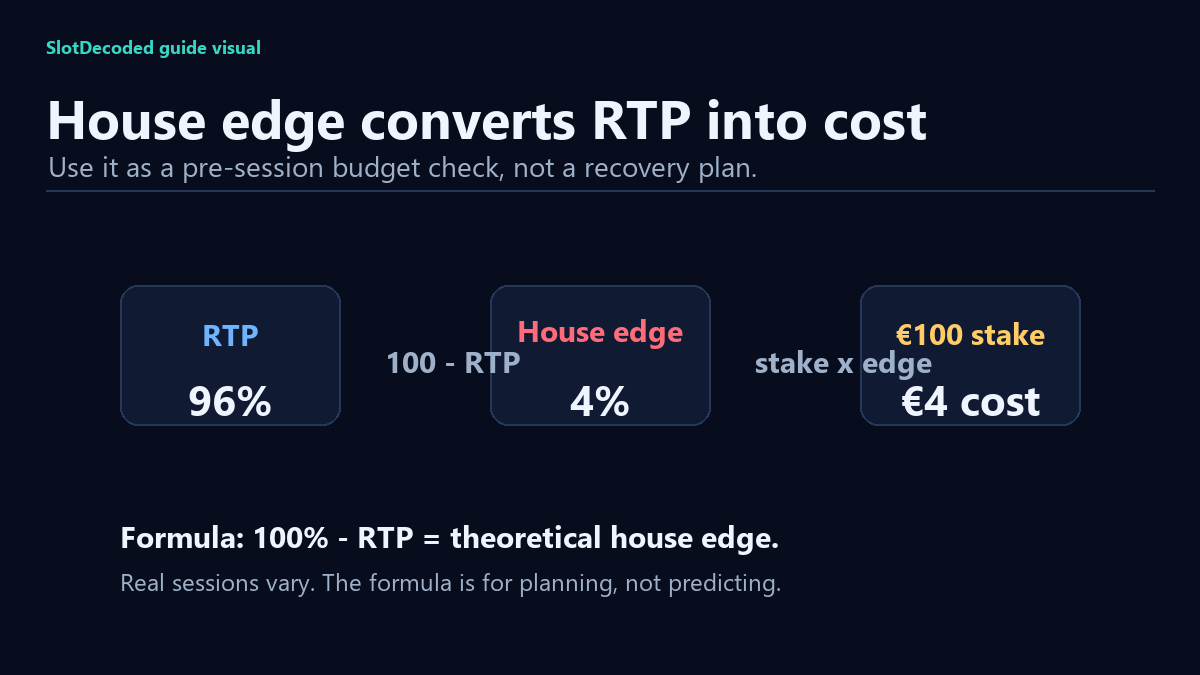
House edge formula for slots
The formula is simple:
House edge = 100% − RTP
| RTP | House edge | Meaning |
|---|---|---|
| 97% | 3% | Lower theoretical cost |
| 96% | 4% | Common online slot range |
| 94% | 6% | Noticeably higher cost |
| 92% | 8% | Expensive over repeated play |
For the RTP side of the formula, read Return to Player explained.
Why house edge is not your session result
The house edge is an average. Your session can be far above or far below it because slot results are volatile. A high-volatility game can return nothing for a long stretch and then recover a large part of its RTP through rare features.
That is why house edge should answer “what is the cost of this game?” while volatility and hit frequency answer “what might the session feel like?”
Worked cost example
If you stake £0.50 per spin for 400 spins, you have wagered £200 in total. On a 96% RTP slot, the theoretical long-run cost is 4% of £200, or £8. That does not mean your session will lose exactly £8. It means the game is priced so that repeated play trends toward that cost before promotions and variance.
If the same game is offered in a 94% RTP version, the theoretical cost on the same £200 turnover becomes £12. That £4 difference looks small for one session, but it compounds if you repeat the same choice often.
House edge vs volatility vs max win
- House edge tells you the theoretical cost.
- Volatility tells you how uneven the path can be.
- Max win tells you the ceiling, not the chance of reaching it.
- Hit frequency tells you how often the game returns something, including tiny wins.
Use all four. A game can have a reasonable RTP and still be a bad fit for a short, low-risk session if most value sits in rare bonus outcomes.
What changes the effective cost for a player?
- RTP variant: the same game may have more than one certified RTP version.
- Stake size: the percentage is the same, but the money cost scales with stake.
- Bonus terms: wagering, max bet, game contribution and max cashout can change the practical value.
- Session length: more spins expose you to the theoretical cost more often.
- Volatility: the path to the average can be extremely uneven.
How to use house edge before playing
- Find the game RTP.
- Subtract RTP from 100% to get house edge.
- Translate that edge into expected cost for your stake level.
- Check whether the casino uses a lower RTP version.
- Set a loss limit that does not depend on “getting back to RTP”.
When house edge is most useful
House edge is most useful before you start a session, when you are comparing two games, two casinos, or two bonus offers. It gives you a cost floor. If one game runs at 96% RTP and another at 94%, the lower-RTP game needs a strong entertainment reason or a better promotion to justify the extra theoretical cost.
It is least useful after you are already tilted. Once you are chasing a loss, the calculation can become an excuse to keep playing because the game “owes” you a return. It does not.
FAQ
What is the house edge of a 96% RTP slot?
4%. The formula is 100% minus RTP.
Can I beat the house edge in slots?
Not by timing spins or reading streaks. Slots are negative-expectation games for ordinary play. Your practical control is stake size, game selection, limits and whether you play at all.
Is house edge more useful than max win?
For cost, yes. Max win describes the ceiling. House edge describes the theoretical average cost.