
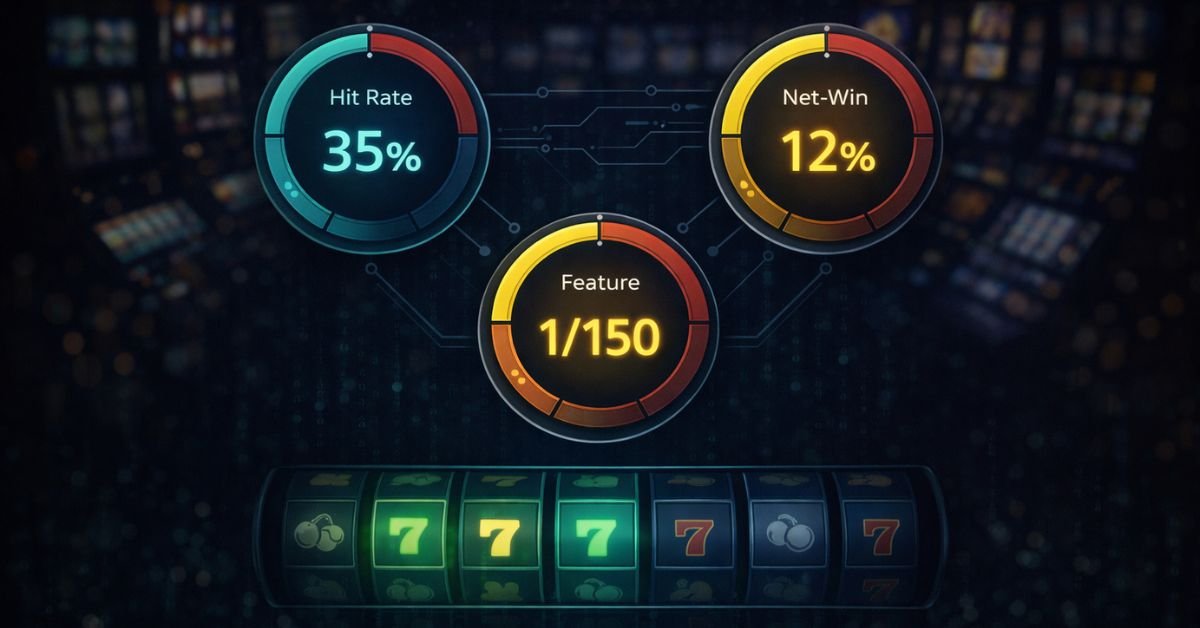
Slot hit rate tells you the one thing that RTP does not: how often you will actually see a win land on the reels. A game with 96% RTP and a 35% slot hit rate feels completely different from a game with the same 96% RTP and a 20% hit rate — the first pays something on roughly every third spin, the second goes through long stretches of nothing before concentrating its returns into larger but rarer events. This guide explains what slot hit rate is, how it is calculated, how it interacts with volatility and RTP, what different hit rates feel like in practice, and how to use this number to choose games that match your bankroll and session goals.
What Is Slot Hit Rate?
Slot hit rate is the percentage of paid spins that produce any return greater than zero. If a slot has a 30% hit rate, approximately 3 out of every 10 spins will show some kind of win — though many of those wins will be smaller than your bet. The RNG determines each outcome independently, and the slot hit rate is a statistical property of the math model — how the virtual reel strips and paytable distribute winning symbol combinations across the total outcome space.
Slot hit rate = (spins with any win ÷ total spins) × 100
Example: 1,000 spins, 285 produce a return > €0 → slot hit rate = 28.5%
Of those 285 wins, only 95 returned ≥ your bet → net-win rate = 9.5%
Bonus triggered 6 times → feature hit rate ≈ 1 in 167 spins
Slot Hit Rate — Key Facts
3 Types of Slot Hit Rate That Actually Matter
The standard slot hit rate number (any return > €0) tells you how “busy” the game feels. But two related metrics give you more actionable information.
1. Standard Slot Hit Rate
Percentage of spins that return anything above zero — including losses disguised as wins (bet €1, return €0.30). This is the number studios publish and the one most commonly referenced. It tells you how often the game shows activity, but not whether that activity adds to your balance.
2. Net-Win Rate
Percentage of spins that return at least your full bet — meaning the spin actually added money. Net-win rate is typically 8%–15% — dramatically lower than the standard slot hit rate. This is the metric that reveals how often you genuinely profit from a spin versus how often the game gives you back less than you wagered while celebrating it as a “win.”
3. Feature Hit Rate
How often the bonus or free spins round triggers — typically expressed as “1 in X spins” (e.g., 1 in 150). Feature hit rate matters because bonus rounds are where most of the game’s RTP contribution concentrates in high-volatility games. A game with a low base game slot hit rate but frequent features (1 in 100) feels different from one with the same base game rate but rare features (1 in 300).
What Counts as a “Hit”?
Any return > €0, including sub-bet returns. In cascade/tumble games, one paid spin that triggers 4 cascades counts as one hit (not four). In scatter-pay and cluster-pay games, any payout from the spin = one hit. The metric always measures spins, not individual win events within a spin.
What Different Slot Hit Rates Feel Like in Practice
| Slot Hit Rate Range | Session Feel | Typical Game Style | Bankroll Impact |
|---|---|---|---|
| 40%+ (very high) | Constant activity — wins on nearly every other spin. Small payouts. Steady, calm pace. | Classic payline slots with frequent low-value wins, some cluster-pay games | Bankroll drains slowly. Long sessions possible on small budgets. |
| 30%–39% (high) | Regular wins with occasional dry patches. Balanced feel — activity without monotony. | Low-to-medium volatility video slots, many Megaways variants | Moderate drain. Comfortable for most bankrolls and session lengths. |
| 22%–29% (medium) | Noticeable gaps between wins. When wins land, some are significant. The rhythm has tension. | Medium-to-high volatility games, most ways-to-win formats | Faster bankroll pressure. Requires bet sizing discipline during dry stretches. |
| < 22% (low) | Long dead-spin deserts. When wins arrive, they can be large. High emotional intensity. | High/extreme volatility slots, high max-win games | Aggressive bankroll drain. Small bankrolls get destroyed before features trigger. Must downsize bets. |
The sub-bet win illusion: A game with a 35% slot hit rate sounds active — but if 60% of those “wins” return less than your bet, you are losing money on most winning spins. The game feels busy because the sound design and animations celebrate every return, including sub-bet returns. Tracking net-win rate (wins ≥ stake) reveals the real frequency of spins that actually add to your balance. Addictive Slot Features explains how losses disguised as wins exploit this gap between perceived and real hit rate.
Slot Hit Rate vs RTP vs Volatility: How They Connect
Three numbers define a slot’s behaviour. Each measures something different. Confusing them is how players make poor game selections.
| Metric | What It Measures | What It Does NOT Tell You | Deep Dive |
|---|---|---|---|
| Slot hit rate | How often a spin returns anything (> €0) | How much it returns, or the long-run cost | This guide |
| RTP | The total percentage of wagers returned to players over millions of spins | How often you win or how wins are distributed | RTP in Slots Guide |
| Volatility | How unevenly the RTP is distributed — frequent small wins vs rare large wins | The actual RTP or the hit rate percentage | Slot Volatility Guide |
How the Three Numbers Interact
Two games can have identical 96% RTP but completely different experiences:
Game A: 96% RTP, 38% slot hit rate, low volatility → Wins are frequent and small. The RTP is delivered in many small portions. Your balance declines slowly and steadily. Sessions feel calm.
Game B: 96% RTP, 19% slot hit rate, extreme volatility → Wins are rare but can be massive. The same RTP is concentrated into fewer, larger events. Your balance drops fast between features. Sessions are emotional rollercoasters.
Both cost the same (4% house edge) over millions of spins. But the session experience is radically different — and slot hit rate is the metric that predicts this difference most accurately. Gambling Math Explained covers the complete framework.
How Game Mechanics Affect Slot Hit Rate
| Mechanic / Format | Typical Slot Hit Rate Impact | Why |
|---|---|---|
| Fixed paylines (10–25 lines) | Lower hit rate (20%–30%) | Fewer win paths → fewer matching symbol combinations per spin |
| Ways to win (243–4,096+) | Higher hit rate (28%–40%) | More valid win paths → more chances to land matching symbols per spin |
| Megaways (variable reels) | Medium-high (25%–35%) | High ways count provides frequent small wins; big wins require reel expansion |
| Cluster pays | Medium-high (28%–38%) | Clusters form more flexibly than lines; cascading removes keep extending hits |
| Cascade / tumble | Increases effective hit rate per spin | Each cascade is an additional win opportunity within one paid spin |
| Hold and respin | Lowers base game hit rate, concentrates value in feature | Base game stripped to fund the respin mechanic’s payout potential |
| Bonus buy | Does not change base slot hit rate | Skips to the bonus round — changes session structure, not the math model’s hit rate |
| Ante bet (+25% cost) | Increases feature hit rate, same base hit rate | Extra cost buys double scatter probability — makes bonus trigger more frequent |
How Slot Features Affect RTP covers how each mechanic redistributes the game’s total return between base game and features — which directly shapes how the slot hit rate translates into actual session behaviour.
How to Estimate Slot Hit Rate Yourself
Many studios publish slot hit rate in the game help panel or paytable screen. When it is not published, you can estimate it in demo mode — which uses the same RNG and math model as real-money play.
Demo Mode Estimation Method
Step 1: Open the game in demo mode. Set a fixed bet size.
Step 2: Play 200–500 spins. For each spin, note whether it returned anything (> €0). Auto-play at a set spin count helps — track total spins and count winning spins at the end by comparing starting balance + total wagered to ending balance.
Step 3: Calculate: (winning spins ÷ total spins) × 100 = estimated slot hit rate.
Accuracy: 200 spins gives a rough estimate (±5–7%). 500 spins narrows this to ±3–4%. For a confident number, you would need 2,000+ spins — but 200–500 is enough to tell you whether the game is high-hit-rate (active) or low-hit-rate (streaky). Log your result in the Win Per Session Tracker along with the game’s RTP and volatility for future reference.
Estimation pitfall: Short samples overweight variance. If you play 100 spins and hit 2 bonus rounds, your estimated slot hit rate will look artificially high because bonus rounds produce multiple wins within a short window. Always use at least 200 spins, and separate your base game hit rate estimate from your feature hit rate estimate for the most useful data.
Slot Hit Rate and Bankroll Planning
Slot hit rate directly determines how fast your bankroll depletes between winning spins — and therefore how many spins your budget can survive. The Session Risk Analyzer models this formally, but the principle is straightforward.
| Scenario | Slot Hit Rate | Budget: €50 at €0.50/spin | What Happens |
|---|---|---|---|
| High hit rate game | 38% | ~100 spins budget | Wins return small amounts frequently, extending play. Likely 150–250 total spins before bust. |
| Medium hit rate game | 26% | ~100 spins budget | Longer gaps between wins drain balance faster. Likely 80–150 spins before bust. |
| Low hit rate game | 18% | ~100 spins budget | Severe dry spells consume budget rapidly. May bust in 40–80 spins without a feature. |
The Bankroll Rule from Slot Hit Rate
Lower slot hit rate → lower bet size. If you want to play a low-hit-rate, high-volatility game, your bankroll needs to survive the dry stretches long enough to reach the features where the game’s value concentrates. This means reducing your bet relative to your budget. A €50 session budget on a high-hit-rate game might support €0.50/spin comfortably. The same €50 on a low-hit-rate, extreme-volatility game might need €0.20/spin to avoid busting before a feature triggers. The Session Risk Analyzer calculates this precisely. Set limits before every session using the Responsible Gambling Planner.
Slot Hit Rate Myths That Cost Players Money
| Myth | Reality |
|---|---|
| “Higher slot hit rate = better game” | Higher hit rate means more frequent wins, not more profitable play. A 40% hit rate game at 92% RTP costs you twice as much long-run as a 20% hit rate game at 96% RTP. |
| “I haven’t won in 50 spins, so I’m due” | Each spin is independent. A dry stretch does not make the next spin more likely to win. Hot and cold streaks are statistical noise. |
| “Bonus buy improves hit rate” | Bonus buy skips to the feature round — it changes session structure, not the math model’s hit rate. The base game hit rate and feature hit rate remain unchanged. |
| “A slot hit rate of 35% means I win 35% of my money back” | Hit rate is frequency, not amount. 35% of spins show a win, but the average win size and the sub-bet win proportion determine your actual returns. Only RTP tells you the long-run return percentage. |
| “Auto-play changes the hit rate” | Auto-play uses the same RNG and math model. Slot hit rate is identical. Auto-play just executes spins faster — which means your budget depletes faster per minute, not per spin. |
Slot Hit Rate — Further Reading on SlotDecoded
RTP in Slots — the companion metric that tells you how much the game returns. Slot Volatility — how unevenly the RTP is distributed across sessions. House Edge in Slots — the mathematical cost of every spin. How RNG Works — why every spin is independent. How Slot Features Affect RTP — how mechanics redistribute returns between base game and features. Gambling Math Explained — the complete RTP, hit rate, volatility, and odds framework. Slot Game Math Models — virtual reel strips and how the math model creates the hit rate. Slot Player Handbook — 7 rules for smarter play, including understanding the numbers. The Guides hub links to every educational article on the site.
Test any slot’s hit rate in free demo mode — same RNG and math model as real-money play
Browse 28,000+ Free Demo Slots →Frequently Asked Questions — Slot Hit Rate
What is slot hit rate?
Slot hit rate is the percentage of paid spins that return any amount greater than zero. A 30% slot hit rate means approximately 3 out of every 10 spins show some kind of win — including sub-bet returns where you get back less than you wagered.
What is a good slot hit rate?
There is no universally “good” hit rate — it depends on what you want from the session. Above 35% feels active and steady (good for longer sessions on smaller budgets). Below 22% feels streaky with long dry spells but larger potential wins (suits players with larger bankrolls and higher risk tolerance). Match the hit rate to your bankroll and temperament.
Does higher slot hit rate mean higher RTP?
No. RTP is the total percentage returned over time. Slot hit rate is the frequency of wins. A game can have 96% RTP with either a high or low hit rate — the difference is how the returns are distributed. High hit rate = many small wins. Low hit rate = fewer, larger wins. Same total cost.
Where can I find a slot’s hit rate?
Check the game’s help panel or paytable screen — some studios publish it. If not, estimate it in demo mode over 200–500 spins: (winning spins ÷ total spins) × 100. The Slot Game Math Models guide explains what drives the number.
What is the difference between slot hit rate and net-win rate?
Standard slot hit rate counts any return > €0, including sub-bet wins (bet €1, return €0.30). Net-win rate only counts spins that return at least your full bet. Net-win rate is typically 8%–15% — much lower than the headline hit rate — and gives a more honest picture of how often you actually profit from a spin.
How does slot hit rate affect bankroll management?
Lower hit rate = faster bankroll drain between wins = need for lower bet sizes relative to your budget. The Session Risk Analyzer calculates bust probability at any hit rate and volatility level. Rule of thumb: if the game has a low hit rate, reduce your bet size to survive the dry stretches. Set limits using the Responsible Gambling Planner.
Does bonus buy improve slot hit rate?
No. Bonus buy skips to the feature round — it changes session structure, not the math model’s underlying hit rate. Ante bet (+25% cost) does increase feature trigger probability, but the base game hit rate remains unchanged.
Can a slot be “due” for a win after many losing spins?
No. Every spin is independent. The RNG has no memory. A slot that has not paid in 100 spins has exactly the same probability on spin 101 as it did on spin 1. Believing otherwise is the gambler’s fallacy — and it drives loss chasing.
Responsible Gambling: Slot hit rate tells you how often a game pays — not whether it will pay you. The house edge applies on every spin regardless of hit rate. Set limits before every session using the Responsible Gambling Planner. Help is available at BeGambleAware.org and GamCare.org.uk.