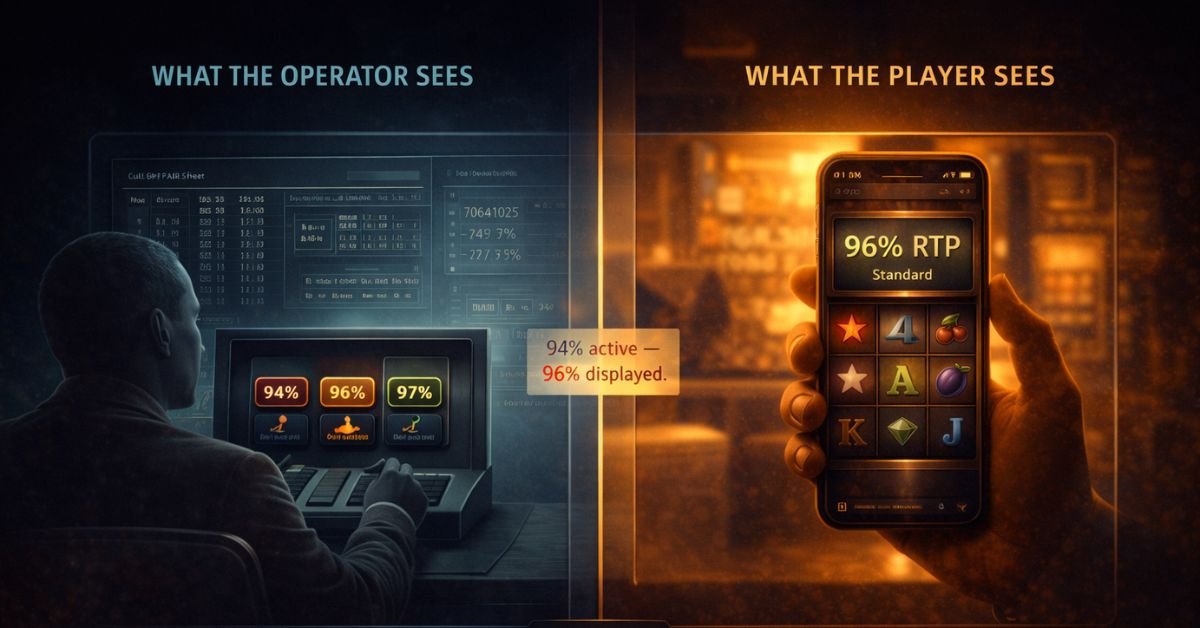
Every online slot you play has an RTP variant — a specific certified build of the game configured at that casino. Not every casino runs the highest RTP variant. There are usually two or three certified builds of any popular title: commonly 94%, 96%, and 97%.
The studio produces all of them. The operator chooses which to deploy. You are told none of this before you play.
The figure displayed in the game — often drawn from the studio’s promotional materials — may not match what is actually running at your casino. This article explains exactly how that system works, what operators decide, why it costs you money, and what you can concretely do about it.
How the RTP Variant System Works
A slot game’s certified return percentage is not a single fixed value that every casino shares equally. Most titles from major studios are submitted to testing laboratories in multiple certified configurations — each a separately approved RTP variant with its own probability architecture.
The underlying mechanism is the reel strip configuration. Each certified RTP variant uses a different virtual reel layout, altering the stop count for each symbol tier across all five reels.
The paytable — the visible payout multipliers — typically stays identical across builds. What changes invisibly is how often each winning combination occurs, producing a different aggregate return.
The studio creates all the builds and obtains separate certifications for each. It then licences them to operators as distinct options.
The operator selects which RTP variant to deploy at their casino. That selection persists until the operator actively changes it — which they can do, though most do not frequently.
The Three-Tier Structure of Most Games
While specific configurations vary by studio and game, a common pattern in the industry produces three certified builds for any given title. The lowest build — often around 94% — is marketed to operators who want higher margins or who operate in markets with lower regulatory minimums.
The standard build at around 96% represents the mainstream positioning and is the figure most commonly cited in reviews and game information panels. The premium build at 96.5–97% is typically reserved for high-traffic operators, competitive markets, or VIP player areas.
Some studios go further. High-volatility games from certain studios carry bonus-buy features that have separate certified return percentages — often 96% in the base game but 97–98% when using the bonus-buy mechanic. These are technically distinct feature configurations within the same game shell, each separately certified.
The result is a layered configuration system where a single game title can run at several different effective return rates simultaneously at different operators — or even at different stakes tiers within the same casino.
RTP Variant System — Key Facts
Why Studios Produce Multiple Certified Builds
Studios produce multiple certified builds because different operators have different regulatory environments and different commercial priorities. Regulatory requirements for minimum return percentages vary significantly across jurisdictions — from 85% in some markets to 92–96% in others. A single-build game would either fail minimum requirements in stricter markets or leave commercial margin on the table in looser ones.
Beyond regulatory compliance, the multi-build model gives operators a commercial lever. An operator running a tight margin on promotions and bonuses may choose a lower-return build on popular titles to offset the promotional cost. A competitor trying to win player trust may deploy the premium build on the same title as a differentiator.
Studios also produce distinct builds for bonus-buy availability. In several regulated markets — including the UK since 2021 — direct bonus-buy features are restricted or prohibited.
Studios certify a bonus-buy-disabled build for these markets and a bonus-buy-enabled build for others. The two builds may carry different certified return percentages because the bonus mechanic typically has a higher RTP contribution than the base game.
5 Hidden Choices Operators Make About Your Game Odds
The operator’s configuration decisions extend beyond simply selecting a return percentage tier. The following five choices are made before you open any game — and none are communicated to you in any standard format.
Choice 1 — Which Certified Build to Deploy
This is the primary decision. The operator selects from the studio’s available builds at contract negotiation or at any subsequent configuration update. Once set, it persists until actively changed.
A player at Casino A and Casino B may be playing the same titled game on a different RTP variant, with materially different return percentages, and no indication of this in either game interface.
The studio’s promotional RTP figure is typically based on the standard or highest certified build — the one most likely to appear in game reviews, comparison sites, and marketing materials. Operators who deploy a lower RTP variant benefit from the halo of the promotional figure without running it.
Choice 2 — Stake-Tier Variant Assignment
Some operators and platforms allow different builds to be assigned to different stake tiers within the same game. A player betting at the minimum stake level might be on a lower-return configuration than a player betting at high stakes on the same title.
This practice is less universal than single-build deployment but has been documented in regulated markets. It creates a system where the game’s actual return configuration is not only hidden from the player but varies based on bet size in ways the player cannot detect from the game interface alone.
Choice 3 — Bonus-Buy Variant Activation
Where bonus-buy features are legally available, operators decide whether to enable the feature and which certified build to associate with it. The bonus-buy version of a game typically carries a higher certified return — in some titles, 2–3 percentage points above the base game build.
A player using the bonus-buy mechanic on a game where the operator has deployed the bonus-buy-enabled build receives a measurably higher expected return per unit wagered than a player playing the base game on the same operator’s standard build. This is a genuine mathematical advantage — one that most players do not know exists or how to access reliably.
Choice 4 — Promotional Period Configurations
Some operators temporarily adjust build configurations during promotional periods — running higher-return builds alongside specific bonus offers, then reverting to standard configurations when the promotion ends. From the player’s perspective, the game feels more generous during the promotion and less generous afterwards. The mathematical reality may be exactly that.
This practice is not universal and is subject to regulatory constraints in stricter jurisdictions. But where it occurs, players who understand the system can time their play around promotional activations more deliberately than those who assume a game’s return is fixed.
Choice 5 — Casino-Exclusive Builds for High-Value Players
Some studios produce bespoke builds for specific high-volume casino partners — configurations not available to other operators. These may carry higher return percentages, modified bonus frequencies, or different max win values than the standard portfolio builds.
Players at casinos with exclusive licensing arrangements may be playing meaningfully different probability architectures than at other operators running the same title. There is no standard mechanism for identifying which operators hold exclusive builds for any given game. The information is proprietary to the studio-operator relationship.
What the Wrong Build Actually Costs You
The gap between a 94% and a 97% certified return percentage may sound like a small difference. Over real session volumes, the cost difference is concrete and significant.
Expected Session Cost by Build — 300 Spins at £1 Stake
300 spins × £1 = £300 total wagered. Expected cost = £300 × (1 − RTP). The difference between the lowest and highest build: £9 per session — effectively the price of ignoring which configuration is active at your operator.
That £9 difference compounds. A player who plays 5 sessions per week across 50 weeks per year with a 3-percentage-point build disadvantage overpays approximately £2,250 in expected terms relative to a player consistently on the premium build — at the same game, the same stake, the same session length.
The compounding effect is larger for higher-stakes players and longer sessions. At £5 per spin, the same 300-spin session comparison produces a £45 gap between the 94% and 97% builds in expected cost. The build selection matters more as stakes increase.
The house edge framing makes this concrete: a 94% build carries a 6% house edge; a 97% build carries a 3% house edge. At £1 per spin over 300 spins, a 3% vs 6% house edge is the difference between £9 and £18 in expected cost. The house edge doubles without the game looking or feeling different in any way you can detect during play.
The promotional RTP figure is not a commitment. When a game review site or game information panel cites a 96% return, that figure describes an RTP variant the operator may or may not be running. It is not a guarantee.
The actual configuration at your specific operator determines your expected cost per session — and that is rarely disclosed.
How to Find the Active Build at Your Casino
Locating the active return configuration at a specific operator requires effort and is not always possible. But several investigative paths are available.
Check the Game’s Information Panel
Open the game, navigate to the information or paytable section, and look for the stated return percentage. Some operators display the active build’s RTP in this panel — not the studio’s promotional figure. If the number differs from what review sites show for the game, you may be looking at a different certified configuration from the one being advertised.
Check the Casino’s Terms and Game Rules Pages
Regulated operators — particularly in the UK and Denmark — are increasingly required to disclose the return percentage for each game in their library. This information appears in game-specific terms pages, casino help sections, or dedicated RTP disclosure documents. Not all operators maintain this, but UK GC-licensed operators typically have it available somewhere in their documentation.
Ask Customer Support Directly
Contact the casino’s customer support and ask specifically: “What is the certified return percentage for [game name] at this casino?” A well-run, transparent operator should be able to answer this. An operator who cannot or will not confirm the active build is telling you something useful about their approach to player information.
Use Third-Party RTP Trackers
Several independent sites track operator-specific configurations for popular games — comparing the build running at each casino against the studio’s standard published figure. These databases are not exhaustive, but for popular titles at major operators they provide a reasonable comparison baseline. Search for “[game name] RTP by casino” to find current data.
Compare Over Extended Play
This method requires patience and statistical caution. Tracking your actual return over a large number of spins (minimum 10,000 for meaningful convergence) gives a rough signal of the active RTP variant — though session variance means this has wide confidence intervals.
It is more a consistency check than a precise measurement. If your tracked return is consistently 4–5 percentage points below what review sites show, investigate the active configuration through the formal channels above.
The fastest practical route: Check the in-game information panel first. If it shows a different RTP from what review sites quote for the title, contact support to confirm. Two minutes of investigation before a session can save you a meaningful amount in expected session cost over time.
The Regulatory Position on Variant Disclosure
Regulatory requirements around build disclosure have been tightening gradually, with the UK Gambling Commission leading the most substantial moves toward transparency.
In the UK, operators are required to make the return percentage of every RTP variant they deploy available to players — not just the studio’s standard figure. This requirement has driven a shift toward in-game disclosure and game-specific terms pages. Implementation is imperfect, but the regulatory direction is clearly toward operator-level disclosure rather than studio-level promotional figures.
The Malta Gaming Authority and other European regulators have similar requirements in principle, with varying enforcement rigour. In markets licensed by Curaçao and similar offshore jurisdictions, disclosure requirements are minimal and operator configuration choices are almost entirely opaque.
The practical picture for players in well-regulated markets: the information is technically available but requires active effort to find. For players in loosely regulated markets, the operator’s chosen build is typically invisible without direct investigation. The iGaming licences guide covers the regulatory landscape and its consumer protection implications in detail.
The UK Gambling Commission Model
The UKGC’s position on return percentage transparency has moved consistently toward requiring that players can access the specific return configuration running at their operator — not a generalised industry figure. This regulatory approach treats the active build selection as consumer-relevant information that players have a right to access. Whether other jurisdictions follow this model will determine whether the variant selection system remains broadly opaque or becomes a standard transparency requirement across regulated gambling markets.
Applying This to Your Game Selection
Understanding how operator build selection works changes the practical checklist for any game selection decision. The RTP figure you read on a review site or in a game information panel is now a starting point, not a confirmed fact. Your protocol should treat it accordingly.
What You Used to Do (and Why It’s Incomplete)
Check the published RTP. Choose the game with the highest figure. Assume the displayed percentage reflects what you are playing.
This approach treats the promoted figure as accurate and fixed — which it may not be. It ignores that the same game can run on different RTP variants at different operators, and that the displayed number may not match what is actually deployed.
What to Do Instead
Check the in-game information panel RTP specifically. Verify against your casino’s documented game terms where available. Contact support if these sources disagree.
Use the confirmed RTP variant figure — not the published promotional one — as your cost comparison input for casino game selection. Run the confirmed figure and volatility through the RTP Calculator to model the session distribution.
Choosing Between Casinos Based on Build Availability
Once you understand the build selection system, comparing casinos on the same game becomes a viable strategy. Two operators running the same slot on different RTP variants represent genuinely different expected costs — a 96% vs 94% configuration is not a cosmetic difference.
For regular players with a preferred set of games, the build selection at each operator is a concrete, financially meaningful differentiator. A casino consistently deploying the higher RTP variant is offering better expected value for the same games than a competitor running lower configurations — independent of bonuses, promotions, or any other variable.
Combined with bonus value calculations using the bonus analysis guide, build awareness gives you a more complete picture of where your money goes furthest across the operators in your consideration set.
Volatility and Build Interaction
Build selection interacts with volatility in an important way. A high-volatility game on a lower certified build produces a worse expected return concentrated in rare large events — meaning you not only pay more per unit wagered in expectation, but you also need to survive the same high-variance dry runs to potentially access the same large wins. The combination is particularly unfavourable.
For high-volatility games where your expected session cost is already disproportionately sensitive to whether the bonus triggers, running a lower build amplifies the risk further. If a game’s certified return is already uncertain in any given session due to high variance, building a further return disadvantage from an unknown build configuration compounds the downside. This is the category of game where confirming the active build before playing matters most.
Use the volatility guide to understand how these two variables interact for specific game profiles — and run your confirmed build figure through the calculator to model the realistic session range before committing to a stake level.
Further Reading
The build selection system is one of the five critical information gaps covered in the slot information asymmetry article — the gap between what operators know about a game’s probability architecture and what players can access. ⚠ /slot-information-asymmetry/ — session-published, verify live before using as link.
For the underlying mechanism that makes different builds possible — the reel strip configuration changes between certified versions — the PAR Sheet Explained article covers the foundational document. For the correct interpretation of the return percentage figure itself — what it tells you, what it does not, and how it relates to actual session outcomes — the RTP Guide is the primary reference.
For the ethical debate around whether studios should be required to disclose configuration parameters — including making active build information standard consumer disclosure — the should-slot-producers-publish-par-sheets article covers both sides. ⚠ /should-slot-producers-publish-par-sheets/ — session-published, verify live.
For the regulatory context governing what operators must disclose, and how disclosure requirements vary across major licensing jurisdictions, the iGaming Licences guide is the relevant reference. For how the active build interacts with session volatility to produce the realistic outcome distribution at your specific stake and session length, the Volatility and RTP Calculator and Session Risk Analyser translate the confirmed configuration into concrete session modelling. For the game creation process within which multiple builds are designed and certified, How Slot Machines Are Made covers the full production sequence.
Track Whether Your Casino’s Build Matches the Promoted Figure
The only way to build a long-run picture of the actual return you are getting — versus the promoted figure — is systematic session tracking. The Win Per Session Tracker records your results over time, giving you the data to compare your real outcomes against what the active build should produce.
Analyse My Session Risk →RTP Variant — FAQ
What is an RTP variant in online slots?
An RTP variant is a separately certified build of the same slot game carrying a different certified return percentage. Studios produce multiple builds — commonly a range from around 94% to 97% — each with a different reel strip configuration. Operators choose which build to deploy at their casino.
Players are not typically told which build is active, though the in-game information panel sometimes shows the operator-specific figure.
Do all casinos run the same build of a slot game?
No. Different operators can and do run different builds of the same title. Casino A might run the 96% standard build while Casino B runs the 94% lower-margin configuration of the same game.
The game looks and plays identically in both cases — the same symbols, the same paytable, the same visual experience. Only the return configuration differs, and that difference is not communicated to players in any standard format.
How do I find which RTP variant is running at my casino?
Check the in-game information panel first — some operators display the operator-specific figure there rather than the studio’s promotional number. If that is unclear, look for the casino’s documented game terms or RTP disclosure page. UK Gambling Commission-licensed operators are required to make this information available.
If neither of those sources provides a clear answer, contact customer support directly and ask for the certified return percentage for the specific title. An operator who cannot answer this question is telling you something about their transparency approach.
Is it legal for casinos to run lower builds without telling players?
In most jurisdictions, yes — provided the active build meets the regulatory minimum return threshold and the casino’s terms do not explicitly guarantee a specific return figure. Operators are not generally required to proactively communicate which certified build is deployed, though requirements are tightening in stricter markets. The UK Gambling Commission has pushed toward greater transparency on this point.
Operators in loosely regulated markets face minimal disclosure requirements and the configuration choice can be entirely opaque.
How much does the build choice actually affect my expected results?
The difference between a 94% and 97% build on a 300-spin session at £1 stake is £9 in expected cost — £18 versus £9. At £5 per spin the same comparison produces a £45 difference. Over a year of regular play at modest stakes, the build disadvantage accumulates to a substantial expected overpayment relative to playing consistently on the higher certified configuration.
The game’s visual and mechanical experience is identical across builds — the cost difference is entirely invisible unless actively investigated.
Does the bonus-buy RTP variant carry a different return than the base game?
Yes, typically. The bonus-buy mechanic — where players pay a premium to trigger the bonus feature directly — is separately certified and usually carries a higher return percentage than the base game build. In some titles the bonus-buy configuration sits 2–3 percentage points above the standard base game return.
Whether the bonus-buy variant is available depends both on the operator’s choice to enable it and on the regulatory environment — direct bonus-buy features have been restricted or prohibited in several markets including the UK since 2021.
Should I switch casinos if I find a lower build at my current operator?
For the specific games you play most regularly, yes — build selection is a concrete, financially meaningful differentiator across operators. A casino consistently running the higher certified build of your preferred titles offers better expected value for the same games. This comparison should be made alongside the value of welcome bonuses, ongoing promotions, withdrawal terms, and the operator’s overall licensing reputation.
A higher RTP variant at a poorly-regulated operator is not necessarily a better deal than a lower one at a well-regulated casino with strong player protections.