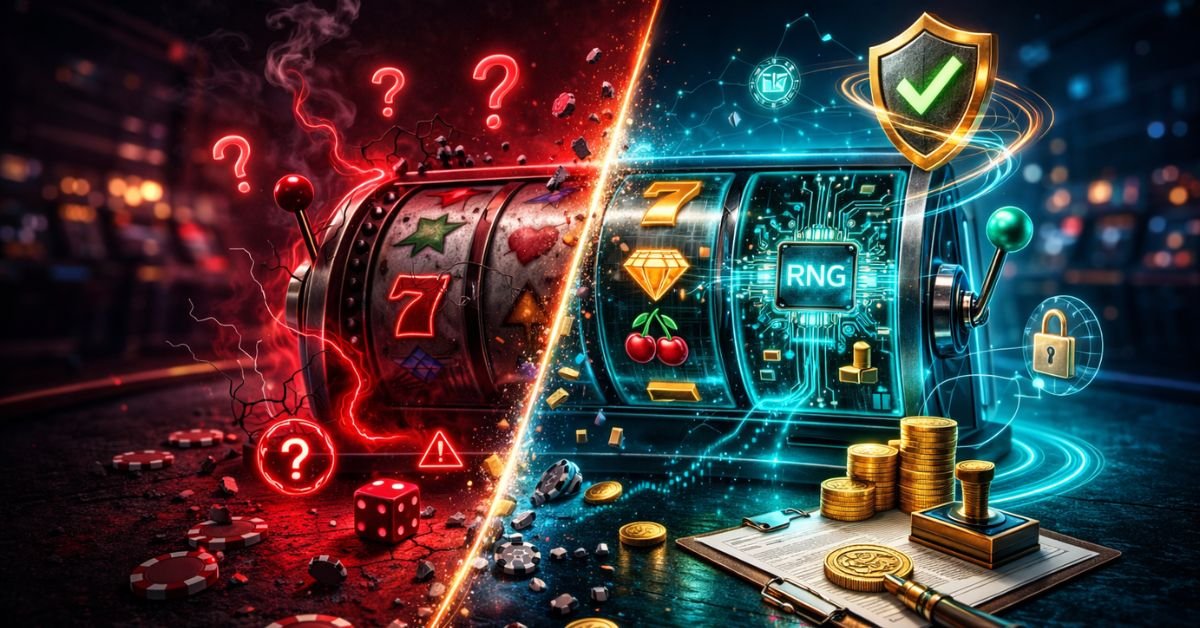
Are online slots fair? The short answer: yes — if you are playing at a licensed casino with games from certified providers. But “fair” does not mean what most people think it means. Fair does not mean you will win. Fair does not mean every session is balanced. Fair means the outcomes are genuinely random, independently generated by an RNG, and the game’s RTP matches its published specification over millions of spins. This guide answers the fairness question with the mechanical detail you need — how the RNG actually works, who verifies it, what can and cannot be manipulated, and the 6 red flags that signal an unfair game.
Are Online Slots Fair? The Direct Answer
Online slots at licensed casinos are fair in the technical sense: the outcomes are generated by a certified Random Number Generator, independently tested to produce statistically random results, and verified to return the published RTP over time. The operator cannot manipulate individual spin results. The game studio cannot alter the math model after certification. And the licensing authority can audit the game at any time.
Are Online Slots Fair — Quick Reference
The question “are online slots fair” usually comes from one of two places: genuine concern about whether games are rigged, or frustration after a losing session that feels impossible. Both are addressed in this guide — the first with mechanical evidence, the second with mathematical reality.
What “Fair” Actually Means When Asking Are Online Slots Fair
“Fair” in the context of online slots has a specific technical meaning that is different from the everyday use of the word. Understanding this distinction is essential to answering “are online slots fair” honestly.
What Fair Means
The RNG produces genuinely random, independent outcomes on every spin. The game’s actual return matches its published RTP specification within statistical confidence intervals over millions of spins. No party — player, operator, or studio — can predict or manipulate individual results.
What Fair Does Not Mean
Fair does not mean the player has a 50% chance of winning. Fair does not mean you will break even over a session. Fair does not mean the game distributes wins evenly. The house edge is a structural feature of fair games — it ensures the operator retains a percentage over time. A 96% RTP game is fair and is designed to cost you 4% of your total wagered amount.
This distinction matters because most player frustration about fairness comes from conflating “fair” with “profitable.” A slot can be perfectly fair — fully random, accurately paying its RTP — and still produce 10 consecutive losing sessions for a single player. That is not rigging. That is volatility operating within a negative-expectation game.
How the RNG Guarantees Fair Outcomes — Are Online Slots Fair at the Technical Level?
The Random Number Generator is the mechanical answer to “are online slots fair.” It is the algorithm that produces every spin result, and understanding how it works eliminates most fairness concerns.
How the RNG Works — Simplified
Step 1: The RNG runs continuously, generating thousands of random numbers per second — even when nobody is playing.
Step 2: When you press spin, the game captures the current RNG output at that exact millisecond.
Step 3: That number is mapped to a position on the virtual reel strips — determining which symbols appear on each reel.
Step 4: The game engine checks the result against the payline or ways-to-win rules and calculates the payout.
Step 5: The animation plays. But the result was determined at step 2 — the reel animation is visual presentation, not a live event.
The critical properties that make the RNG fair: each spin is independent (the result has no relationship to any previous or future spin), the results are uniformly distributed across the virtual reel mapping (no positions are favoured or avoided), and the seed that initialises the RNG is cryptographically secure (nobody can predict or reconstruct the sequence). How RNG Works in Online Slots covers the full technical mechanism including PRNG vs TRNG, seeding, and reseeding.
Who Tests and Certifies That Online Slots Are Fair?
The answer to “are online slots fair” is not based on trust — it is based on independent verification. Multiple layers of testing exist between the game studio’s code and your spin button.
| Verification Layer | Who Does It | What They Test |
|---|---|---|
| RNG certification | eCOGRA, GLI, iTech Labs, BMM Testlabs | Statistical randomness of the RNG output, seed security, absence of patterns or biases |
| Math model verification | Same labs + internal studio QA | RTP matches published specification, hit rate is accurate, max win mechanics function correctly |
| Game certification | Testing lab on behalf of the regulator | Complete game behaviour: symbols, paylines, features, bonus triggers all match the submitted math model |
| Operator audit | UKGC, MGA, other regulators | Casino is running the certified version, RTP configuration matches what is displayed, responsible gambling tools are functional |
| Ongoing compliance | Regulator + testing labs | Periodic re-audits, player complaint investigation, enforcement of any detected non-compliance |
What certification actually proves: That millions of simulated spins produced results within the expected statistical range for the published RTP. That the RNG output showed no detectable patterns. That the game’s feature triggers, multiplier mechanics, and payout calculations all function as the math model specifies. This is not a cursory check — it is rigorous statistical analysis performed by accredited laboratories. iGaming Licenses Explained covers what each regulatory authority requires.
Can Online Slots Be Rigged? The Honest Answer
At a licensed casino running certified games: no. The game’s math model is locked at certification. The operator can choose from pre-set RTP tiers (e.g., 96.5%, 94.5%, 92%) but cannot alter the random distribution of outcomes or target individual players. The RNG runs server-side and is protected by the same cryptographic security that protects banking transactions.
The RTP Configuration Issue — Fair but Not Always Transparent
This is the one area where “are online slots fair” has a nuanced answer. Most modern slots ship with multiple RTP configurations — the studio publishes the highest (e.g., 96.5%) and the casino may run a lower one (e.g., 94%). Both configurations are certified and fair. But if the casino does not clearly display which RTP is active, the player is making decisions based on incomplete information. This is not rigging — both RTPs produce random outcomes — but it is a transparency problem. Always check the RTP in the game’s info panel at the casino where you play, not in a review citing the published maximum.
At unlicensed casinos: the answer changes. Without regulatory oversight, there is no independent verification that the game’s code matches its claimed math model. Operators could theoretically alter RTP configurations, use uncertified game builds, or run games from providers that have not undergone testing. This is why licensing is the single most important factor in answering “are online slots fair” for any specific casino. The Licensing section explains what each authority requires and how to verify a licence.
RTP and Fairness: Why “Are Online Slots Fair” and “Will I Win” Are Different Questions
The RTP is the mathematical proof that the game is fair — and simultaneously the proof that you will lose over time. A 96% RTP game returns €96 for every €100 wagered across all players over millions of spins. The remaining €4 is the house edge — the operator’s mathematical profit.
| What RTP Tells You | What RTP Does Not Tell You |
|---|---|
| The game’s long-run cost of play | What will happen in your next session |
| The mathematical fairness of the game’s design | Whether you will be profitable today |
| How the game compares to other games | How volatile the experience will feel |
| The operator’s long-run advantage | How your short-term results will distribute |
A player who loses €500 in one session on a 96% RTP game is not experiencing an unfair game. They are experiencing volatility within a negative-expectation system. Over enough sessions, their total return will converge toward 96% of total wagered — but individual sessions can land anywhere from 0% to 10,000%+. The Slot Volatility and RTP Calculator simulates this distribution so you can see the real range before committing money.
6 Fairness Myths About Online Slots — Debunked
| Myth | Reality | Why People Believe It |
|---|---|---|
| “This slot is due for a win” | Each spin is independent. The RNG has no memory of previous results. | Gambler’s fallacy — a cognitive bias, not a game feature |
| “The casino switched the RTP after I won” | RTP changes require recertification and regulatory approval. They cannot be toggled per player. | Losing streaks after a win feel suspicious, but are statistical reality |
| “Slots pay more at certain times” | The RNG runs 24/7 with no time-based variation. Outcomes are identical at 3 AM and 3 PM. | Pattern-seeking — the brain finds correlations in random data |
| “Demo mode has better odds” | Demos use the same certified math model as real-money play. | Players often explore more games in demo and remember the highlights |
| “The casino knows I’m about to win” | The operator cannot see or influence individual spin results. The RNG is server-side and tamper-proof. | Illusion of control + paranoia from losing streaks |
| “Higher bets give better RTP” | RTP is constant regardless of bet size in almost all modern slots. | Some old jackpot games had bet-dependent RTP; modern ones do not |
Hot and Cold Slots covers the gambler’s fallacy in full. Casino Strategies for Slots evaluates every common system. Player Psychology in Slot Games explains why these beliefs form and persist — they are not stupidity, they are cognitive biases operating in an environment designed to amplify them.
6 Red Flags That a Casino or Game May Not Be Fair
1. No Visible Licence
If the casino does not display a licence from a recognised authority (UKGC, MGA, Gibraltar, Isle of Man) — or the licence number cannot be verified on the regulator’s website — there is no independent guarantee the games are certified.
2. Unknown Game Providers
Games from providers you have never heard of, with no certification marks, no published RTP, and no presence in any provider directory are higher risk. Stick to studios with documented certification records.
3. No RTP in the Game Info
Every certified game displays its current RTP in the info panel. If you cannot find the RTP anywhere in the game or on the casino’s terms page, that is a transparency failure — and potentially a sign the game is running an undisclosed configuration.
4. Withdrawal Obstruction
Repeated delays, new verification requirements after a win, or changing terms after you request a withdrawal are the most common signs of an unfair operator. The Withdrawal Speed Tracker shows real payout data from actual players.
5. Bonus Terms That Prevent Winning
100× wagering requirements, €20 max cashout on a “€500 bonus,” and 5% slot contribution rates are not technically unfair — but they are designed to make it nearly impossible to profit. The Casino Bonus Terms Scanner scores offers by actual clearability.
6. No Responsible Gambling Tools
Licensed casinos are required to offer deposit limits, session timers, self-exclusion, and reality checks. A casino without these tools is either unlicensed or non-compliant — neither of which inspires confidence that the games are legitimate.
How to Verify That Online Slots Are Fair — Your Practical Checklist
| Check | How to Do It | What It Confirms |
|---|---|---|
| Verify the casino licence | Find the licence number in the footer → check it on the regulator’s website | The operator is regulated and subject to audits |
| Check the game provider | Open the game info → note the studio name → verify on Slot Providers | The studio holds its own certifications and supplies to licensed markets |
| Verify the RTP | Open the game info panel (i or ? button) → find the RTP percentage | The current RTP at this casino matches (or is close to) the published standard |
| Look for testing lab seals | Check the casino footer or About page for eCOGRA, GLI, iTech Labs logos | An independent lab has tested the games |
| Test in demo mode | Play 100 spins in free demo — verify features trigger and function as described | The game mechanics match the paytable description |
| Check withdrawal reviews | Search the Withdrawal Speed Tracker or forums for real player payout experiences | The casino actually pays out — the fairest game is meaningless if you cannot withdraw |
Test any game’s fairness in demo mode — same math model as real money, no deposit needed
Browse 28,000+ Free Demo Slots →Are Online Slots Fair — Further Reading
How RNG Works in Online Slots covers the complete technical mechanism — PRNG vs TRNG, seeding, and reseeding. Seed in Slot Games explains the cryptographic foundation. Slot Game Math Models covers the probability tables and virtual reel strips that the RNG maps to. RTP in Slots explains the long-run return metric. iGaming Licenses Explained covers what each authority requires. And the Slot Player Handbook covers the 7 fundamentals every player should know — with fairness verification as Rule 7.
Frequently Asked Questions — Are Online Slots Fair
Are online slots fair?
Yes — at licensed casinos running certified games. The outcomes are generated by a tested Random Number Generator, the RTP matches the published specification over millions of spins, and independent testing labs verify the math. The operator cannot manipulate individual spin results.
Can online casinos rig slot games?
Licensed casinos cannot rig certified games. The game’s math model is locked at certification and the operator can only choose from pre-approved RTP tiers. Unlicensed casinos have no such constraints, which is why licensing is the most important factor in fairness.
Why do I keep losing if slots are fair?
Because “fair” means random outcomes within a negative-expectation system. The house edge means the expected long-run result is a loss. Individual sessions can be profitable, but over enough play, total returns are less than total wagered. Losing streaks are mathematically normal — they are volatility, not rigging.
How do I know if a specific slot is fair?
Check the casino’s licence on the regulator’s website, verify the game provider has certification, open the game info panel to confirm the current RTP, and look for testing lab seals (eCOGRA, GLI, iTech Labs). The verification checklist in this guide covers all 6 steps.
Can the casino change the RTP of a slot?
Casinos can choose from pre-set RTP configurations provided by the studio (e.g., 96.5%, 94.5%, 92%). They cannot create custom RTPs or change them on a per-player basis. Each configuration is separately certified. Always check the RTP in the game’s info panel at the casino where you play.
Do slots pay more at certain times of day?
No. The RNG runs continuously with no time-based variation. Outcomes are identical at any time. Hot and Cold Slots explains why the perception of time-based patterns is a cognitive bias, not a game feature.
Are demo slots and real-money slots the same?
Yes — demo versions use the same certified math model, the same RNG, and the same feature mechanics. The only difference is that demo play uses virtual credits instead of real money. This is why testing in free demo mode accurately represents the game’s behaviour.
What is provably fair and is it better than RNG certification?
Provably fair is a cryptographic system (common in crypto casinos) that lets players verify individual outcomes after each round. It proves the result was not manipulated but does not replace proper licensing and third-party testing. Licensed + provably fair offers the strongest protection. Provably fair alone lacks regulatory oversight.
Responsible Gambling: Understanding that online slots are fair confirms one critical truth: the house edge is a permanent feature of fair games, not a sign of unfairness. No amount of play will change the mathematical expectation. Set limits before every session using the Responsible Gambling Planner. Help is available at BeGambleAware.org and GamCare.org.uk.