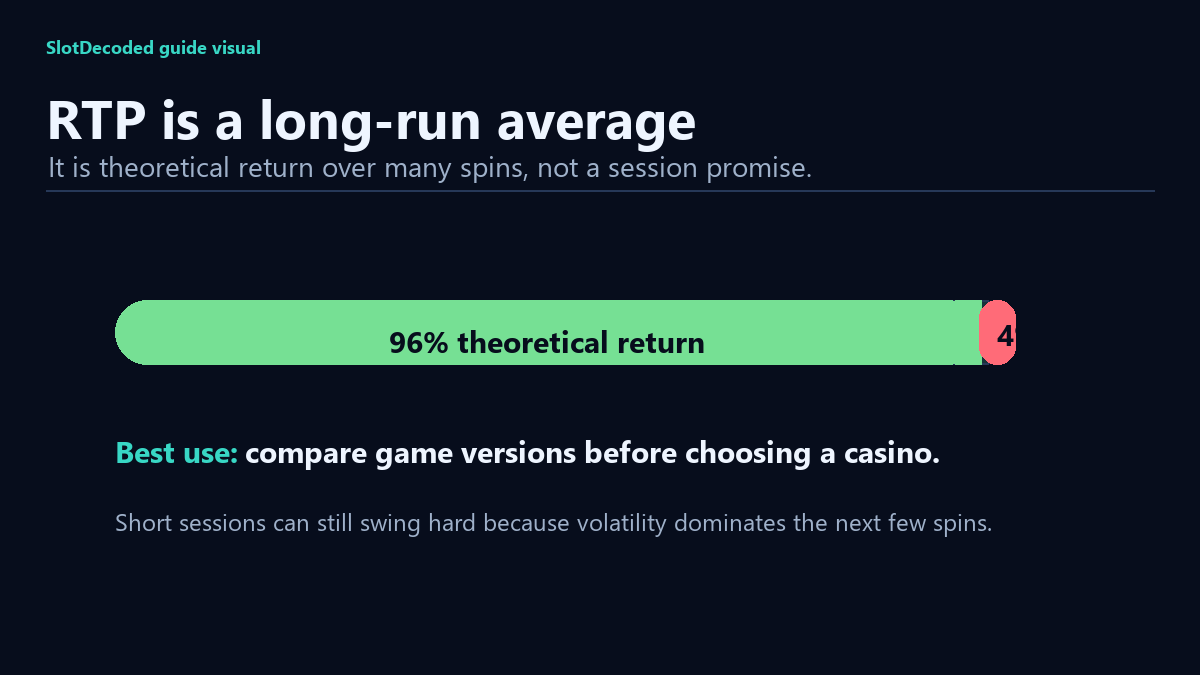
Short answer: Return to Player, or RTP, is the theoretical percentage of wagered money a slot is designed to return over a very large number of spins. A 96% RTP does not mean you get £96 back from every £100 session. It means the game has a 4% theoretical house edge before variance, bonuses, stake choice and casino rules.
RTP in one simple example
| Published RTP | Theoretical house edge | Expected long-run cost per £100 staked |
|---|---|---|
| 97% | 3% | £3 |
| 96% | 4% | £4 |
| 94% | 6% | £6 |
| 92% | 8% | £8 |
That is a long-run average, not a session guarantee. In a short session, volatility can dominate the result.
What RTP does tell you
- the theoretical cost built into the game;
- whether one casino version may be worse than another;
- how much return is available before promotional terms;
- why a game with the same theme can still have different value at different casinos.
For the practical cost view, pair this page with house edge in slots.
What RTP does not tell you
- how likely you are to win this session;
- how often bonuses will trigger;
- whether the next spin is “due”;
- whether a high max-win game is worth chasing;
- whether a bonus offer has positive value after wagering rules.
If you want the session-feel side, read hit frequency vs win rate vs RTP and slot volatility next.
RTP variants: the hidden comparison problem
Some games are available in multiple certified RTP versions. One casino may run a higher-RTP version while another runs a lower-RTP version of the same title. That is why you should check the game info screen where available instead of relying only on a review page or provider listing.
For a deeper guide, use casino RTP variant selection.
Common RTP misunderstandings
- “96% RTP means I get 96% back today.” No. Short sessions can finish far above or below the theoretical average.
- “Higher RTP means low volatility.” No. Two games can have similar RTP and very different win distribution.
- “A bonus makes RTP better automatically.” Not if wagering rules, game weighting, max bet or max cashout reduce the practical value.
- “A slot that has not paid is closer to its RTP.” No. Past spins do not make the next result due.
RTP and casino bonuses
RTP is only one part of bonus value. A promotion can look generous and still be poor if it has high wagering, low game contribution, a restrictive max bet or a low max cashout. When you are evaluating a bonus, combine the game’s RTP with wagering requirements, game contribution rates and sticky vs non-sticky bonus rules.
RTP and responsible play
RTP should make you more cautious, not more confident. It shows the game has a built-in cost. Use it to choose less expensive games, but still set a money limit, time limit and stop point before playing.
How to use RTP before playing
- Find the published RTP in the game info, paytable or rules screen.
- Compare it with the casino’s version if the provider offers multiple RTP builds.
- Check volatility so you understand whether returns are smooth or uneven.
- Check bonus terms if you are playing with a promotion.
- Set your budget from money you can afford to lose, not from the expected return.
FAQ
Is higher RTP always better?
For expected cost, yes. But RTP does not describe volatility, feature frequency or session comfort.
Can RTP guarantee a win?
No. RTP is a theoretical long-run percentage. It does not predict a single session.
Where do I find a slot’s RTP?
Start with the game information screen, paytable or rules panel. If a casino does not make the version clear, treat that as missing information.