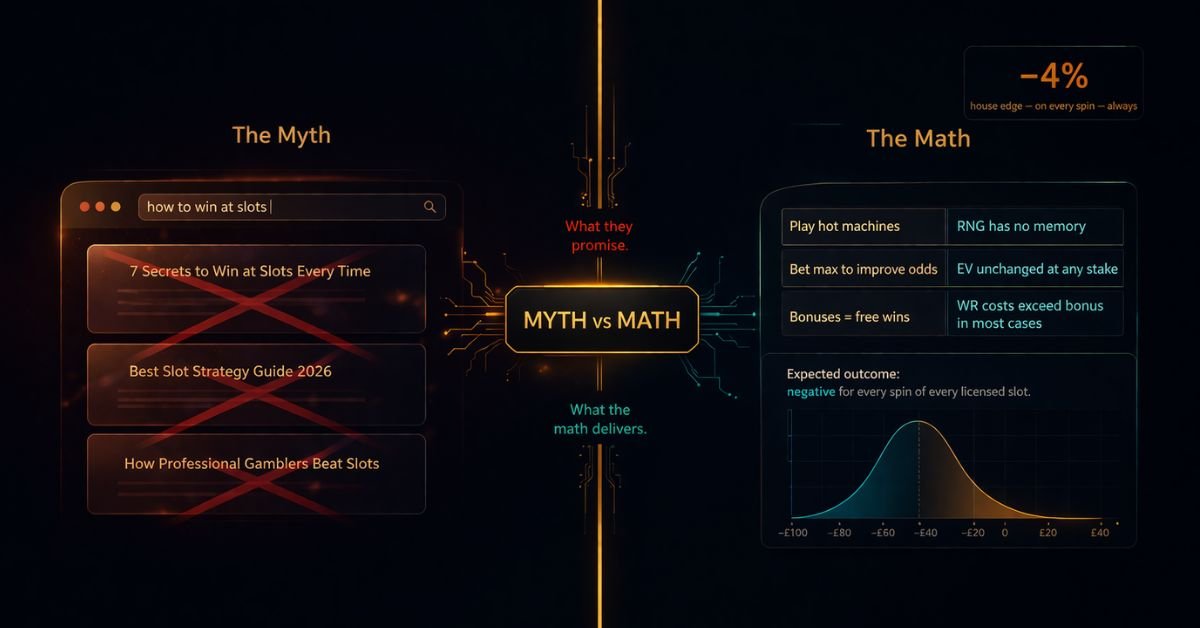
You searched for how to win at slots — and what you found was almost certainly a list of tips that sound plausible, promise an edge, and are built on a mathematical impossibility. “Play high RTP games.” “Manage your bankroll.” “Choose the right volatility.” “Know when to walk away.” Every one of those tips is real advice that real sites publish. Some of it is even partially useful. But none of it is a method for winning at slots — because the phrase “how to win at slots,” in the sense that most players mean it when they search it, describes something that the certified mathematics of every licensed slot game makes structurally impossible. This article explains exactly why, what the research says about the sites that write “how to win” content, what you genuinely CAN influence, and what question you should actually be asking.
What the “How to Win at Slots” Search Actually Reveals
The phrase “how to win at slots” is among the most searched queries in online gambling. Millions of players type it every month — and what they want, beneath the words, is usually reasonable: they want to play more intelligently, lose less, get more from their sessions, understand the game well enough to make better decisions. Those are legitimate goals. The problem is that the phrase they are using to find answers frames those goals in a way that the mathematics of the game cannot deliver — and that framing, left unchallenged, leads players directly into the cognitive traps that gambling sites built their business models around.
Most of what ranks for “how to win at slots” is content written to rank for “how to win at slots” — not to answer it honestly. Gambling affiliates write those articles to attract traffic and convert it to casino signups. The tips they list are chosen for plausibility and authority-feel, not for mathematical accuracy. They use the phrase because players search it, not because they have a coherent answer to it. The research on iGaming content quality — which audited 247 gambling websites for mathematical accuracy and responsible communication — classified “how to win” as precisely the type of language that is “mathematically prohibited” in honest gambling content. Not because the tips are always false but because the question itself misrepresents what slots can deliver and conditions players to expect something the game’s certified mathematics cannot produce.
“How to Win at Slots” — What the Research and Math Show
What “Winning” Actually Means in a Negative-EV Game
Before the mathematics can be explained, the word “winning” needs to be defined precisely — because it means different things depending on the timeframe, and conflating them is exactly how misleading content produces the illusion of useful advice.
Session Winning — Real, Common, and Irrelevant to Strategy
It is entirely possible to “win” in any individual session of slots play. Because slot results are volatile — especially on high-volatility games — a meaningful proportion of sessions end in profit. A player at a high-volatility 96% RTP slot may see 20–25% of sessions end above where they started. That 20–25% is real. Those wins feel real. They are real. The problem is they do not represent a strategy — they represent variance. The same probability architecture that produces those profitable sessions produces the 75–80% of sessions that end at a loss, and produces the expected cost that is negative on every single spin regardless of previous results. A player who won last session and a player who lost last session face exactly the same expected value on the next session. Session winning exists. A method to produce it reliably does not.
Long-Run Winning — Mathematically Ruled Out
Over a large enough number of spins — what mathematicians call the limit as n approaches infinity — the law of large numbers ensures that any player’s cumulative return converges to the game’s theoretical RTP. A 96% RTP slot will return 96p for every £1 wagered across enough spins. The remaining 4p per £1 is the house edge — mathematically guaranteed revenue for the operator across any sufficiently large sample. No strategy changes this. No pattern of bets, no timing, no bet sizing, no bonus-hunting approach produces a positive expected value across the long run in any licensed slot. The mathematics of the PAR sheet is a certified specification — the game’s probability architecture is fixed at certification and cannot be influenced by player behaviour.
The Variance Trap — Why Session Wins Feel Like Evidence of Strategy
The most dangerous feature of high-volatility slots in the context of “how to win” thinking is that they produce large, infrequent wins that feel like the result of something the player did. You chose this game. You bet this amount. You spun at this moment. And you won 200×. The temptation to attribute that outcome to a decision is almost irresistible — it is the same pattern-attribution instinct that drives the illusion of control and the gambler’s fallacy. But the variance that produced the 200× win is the same variance that produces the long losing runs before and after it. The win was not a reward for good strategy. It was the tail of a distribution playing out. The session-win rate is a mathematical property of the game, not a reflection of player skill.
Why “How to Win at Slots” Is Mathematically Incoherent
A question is mathematically incoherent when it asks for something that the relevant mathematical system cannot provide — not because the answer is hard to find but because the thing requested does not exist within that system. “What is the square root of red?” is incoherent in mathematics. “How do I find a prime number greater than all prime numbers?” is incoherent — there is no largest prime. “How do I consistently win at a negative-expected-value game?” is incoherent in the same structural sense.
Here is the precise argument. A strategy for “winning at slots” would need to produce a positive expected return over a meaningful number of plays. For any strategy to produce positive expected return, it would need to either change the game’s probability architecture (impossible — the RNG output is determined by certified algorithms independent of player behaviour) or identify and exploit a systematic positive-EV situation within the game (impossible — every bet in every licensed slot has a negative expected value by regulatory requirement). No player action — bet sizing, timing, game selection, bonus hunting — can turn a negative-EV game into a positive-EV game. The certified mathematics is fixed. The question assumes a solution exists in a system where the solution is structurally prohibited.
This is not a matter of not knowing the answer. It is a matter of the question being the wrong question. Compare it to other negative-EV systems: “How do I consistently win at roulette?” has the same structural problem. The answer is not “here are some tips” — it is “you cannot, by design, over any meaningful sample size.” The honest iGaming response to “how to win at slots” is the same: you cannot win at slots in the long-run, and any content that tells you otherwise is either confused or dishonest about what it is offering.
6 Common “How to Win at Slots” Tips — Debunked With Math
These are the six most commonly published “how to win at slots” tips across mainstream gambling content, each assessed precisely against the mathematics of how slots actually work.
“Play slots with the highest RTP — you’ll win more money back.”
Higher RTP reduces your expected cost per unit wagered — it does not increase your probability of finishing a session in profit. A 97% RTP game costs 3p per £1 staked in expectation. A 94% RTP game costs 6p per £1 staked. The difference is real and meaningful for bankroll management: at £2 per spin over 200 spins, the expected cost difference is £12 versus £24. That matters. But it does not change the fundamental negative-EV structure of either game. You lose less on the higher-RTP game — you do not “win more.”
Additionally, the RTP your casino runs may not be the highest available variant of the game. Operators configure RTP variants — 94%, 96%, 97% builds of the same title are common — and rarely disclose which is active. The tip to “play high RTP” is advice you may not even be able to act on without knowing what’s configured at your operator.
✓ Useful partial advice — but “lower cost” is not “winning.” The framing is wrong even when the advice direction is correct.
“Bet maximum to activate all features and improve your odds.”
This tip conflates two separate things. In some slot configurations, certain features (progressive jackpots, some bonus rounds) are only available at maximum bet — in which case not betting max genuinely excludes you from part of the game’s probability architecture. That is a factual point worth knowing. But it is categorically not a “winning strategy.” Betting maximum on a game with a jackpot accessible only at max bet changes what you are playing — you are now playing a game with a jackpot component. The expected value of that game is still negative. The bet sizing advice is valid only in the narrow sense that you should know what the game requires to access all its features — not as a method to win more frequently or more profitably.
On most modern video slots, max bet simply scales all payouts proportionally. The probability of any outcome is identical at any qualifying stake. There is no EV advantage to betting higher on these games — you are simply buying larger versions of the same negative-EV experience.
✓ Know what max bet unlocks. ✗ Do not interpret “unlock more features” as “improve your expected outcome.”
“Find ‘hot’ machines — avoid ‘cold’ ones. Slots run in cycles.”
This is the hot and cold slots myth — one of the most thoroughly debunked beliefs in gambling, and one that survives exclusively because variable ratio reinforcement makes short-term patterns feel real. The RNG generates outcomes for each spin independently. There is no memory, no cycle, no compensation mechanism. A slot that has paid out heavily in the last 20 spins has an identical probability architecture on spin 21 to a slot that has not paid out in 200 spins. The probability of any outcome on the next spin is determined entirely by the certified reel strips and paytable — not by the history of outcomes. “Hot” and “cold” are interpretations your pattern-seeking brain imposes on an independent random sequence. They are not properties of the machine.
✗ Entirely without mathematical foundation. A machine has no knowledge of its own recent history.
“Use a stop-loss limit and a win target — walk away at the right moment.”
Stop-loss limits and session budgets are genuinely good bankroll management practice — they protect you from catastrophic sessions and enforce the pre-commitment structure that responsible gambling research identifies as the most effective harm-reduction tool. So the advice direction is correct. But the framing as a “winning strategy” is not. Setting a stop-loss limit does not improve your expected value. It changes when you stop — it does not change what happens while you are playing. A player who walks away after losing £50 has limited their session loss. They have not improved their probability of winning on any spin during the session. Stopping at the right moment is protective. It is not a mechanism for producing profitable sessions.
Similarly, “win targets” — stopping when you are up — do nothing to improve expected value. If you stop when ahead, you crystallise that particular session outcome. You have not found a way to be systematically ahead. The sessions where you are not up when the target would trigger are unaffected by having set the target. Walk-away discipline is a bankroll tool. It is not a method to win at slots.
✓ Use stop-loss limits for bankroll protection. ✗ Do not confuse session discipline with a winning strategy.
“Play during off-peak hours — casinos loosen the slots when it’s quiet.”
Online slot outcomes are determined by a certified PRNG that runs independently of time, player count, casino traffic, or any external variable. The RTP is certified by an independent testing laboratory and is a mathematical property of the reel strip configuration — it cannot be “loosened” or “tightened” in real time without rebuilding and recertifying the game. This is not just a claim about operator ethics. It is a structural impossibility in a properly certified game. The certified RTP is fixed at game build. Regulatory requirements prohibit operators from adjusting RTP dynamically. The “off-peak loosening” myth confuses legal online slots with certain historical anecdotes about land-based slot management — and even those anecdotes describe RTP variant swaps, not real-time probability adjustments.
✗ Structurally impossible for licensed, certified online slots. The RNG does not know what time it is.
“Use casino bonuses to win — they give you free money to play with.”
Casino bonuses extend your playtime by increasing the total amount wagered without a proportional increase in your deposit — which is genuinely beneficial in one narrow sense: more wagering at the same expected cost per unit means the law of large numbers works slightly in your favour in smoothing variance. However, wagering requirements — typically 20×–50× the bonus amount before withdrawal — mean you must wager far more than the bonus value before you can extract any winnings. At a 96% RTP game with a 35× wagering requirement on a £100 bonus: total required wagering = £3,500; expected cost of wagering = £3,500 × 0.04 = £140. You have paid £140 in expected losses to access a £100 bonus. The bonus is often net negative in expected value terms before you start. The specific math depends on game contribution rates, max bet rules, and other terms that most “how to win with bonuses” content ignores entirely.
✓ Some bonuses have positive EV under specific conditions — but this requires mathematical evaluation of individual terms, not general advice. The full framework is in the casino strategies guide.
What the Research Found When 247 Gambling Sites Were Audited
The “how to win at slots” content problem is not anecdotal. A multi-year qualitative research project auditing 247 gambling websites for how they reflect the mathematical dimension of gambling in their content produced specific, quantified findings about the quality — and systematic inadequacy — of gambling content online, including the prevalence of “how to win” framing.
The study’s findings are stark in their consistency: only 1.72% of reviewed sites included structural descriptions of games in mathematical terms. Only 8.47% provided correct definitions for the mathematical terms they used. The classification of “how to win” language as “mathematically prohibited” reflects the research finding that this framing appears in articles that simultaneously make factual claims about probability, RTP, and strategy — while the framing itself implies something the game’s certified mathematics cannot deliver.
More specifically, the research identified a direct connection between SEO commercial pressure and mathematical quality degradation. Sites whose content was driven primarily by keyword ranking strategies — which is the overwhelming majority of gambling affiliates — were found to be significantly more likely to use “how to win” framing, less likely to define the math terms they used, and less likely to reflect the actual mathematical structure of the games they described. The incentive to rank for “how to win at slots” overrides the incentive to answer it honestly, because honest answers — “you cannot, by design” — do not convert visitors into casino depositors.
What This Means for Players Searching This Phrase
When you search “how to win at slots,” the content you find has been written primarily to rank for that search and convert you to a casino affiliate, not to answer your underlying question. The tips are chosen for plausibility, shareability, and authority-feel — not for mathematical accuracy. The sites writing them have a financial incentive to maintain your belief that winning at slots is achievable through better strategy, because that belief is what motivates casino deposits. This is not a conspiracy theory — it is a straightforward description of how gambling affiliate economics work, confirmed by the systematic content quality failure found across the majority of reviewed sites. Treating “how to win at slots” content from gambling affiliates as genuine gambling education is the same as treating cigarette company health advice as genuine public health guidance.
What You Can Actually Control — and the Difference It Makes
None of the above means players are powerless or that all decisions are equivalent. The honest version of the question players are trying to answer — “how do I play slots more intelligently?” — has genuine, specific, mathematically grounded answers. They are just not answers to “how to win at slots.”
✓ You CAN control: Game selection by RTP
Choosing a 97% RTP game over a 94% RTP game at the same stake and session length reduces your expected cost by half. Over 300 spins at £1: expected cost goes from £18 to £9. That is a real, material difference — not a path to winning, but a meaningful reduction in the cost of the session you are buying.
✗ You CANNOT control: The probability of any outcome
No player decision — bet size, timing, previous results, button press pattern — influences the RNG output that determines what lands on the next spin. Every spin’s probability is set by the certified reel strip configuration. Player actions have no effect on it.
✓ You CAN control: Stake sizing relative to bankroll
Playing at 0.5% of your session bankroll per spin rather than 5% dramatically reduces the probability of bust before your intended session ends. This is real variance management — it does not change the expected cost, but it gives the law of large numbers more time to smooth the distribution, reducing catastrophic loss probability within a session.
✗ You CANNOT control: Whether a near-miss means a win is close
Near-misses are a consequence of asymmetric reel strip weighting — engineered to appear more frequently than a uniform probability distribution would produce. They carry no information about the next spin. There is no mechanism by which the frequency of near-misses signals an imminent win.
✓ You CAN control: Session length and pre-commitment
Deciding in advance how long you will play and how much you will risk, and enforcing those limits with deposit and session tools set at account level, is the single most evidence-backed responsible gambling intervention available. Pre-commitment limits protect the version of you that has not yet been affected by in-session reinforcement dynamics.
✗ You CANNOT control: Recovering a losing session
The expected cost of each additional spin is the same regardless of what has happened previously. A £50 loss does not make the next spin more likely to return £50. The chasing-losses dynamic exploits the false belief that past losses create a future positive expectation. They do not. The expected value of the next spin is independent of session history.
✓ You CAN control: Volatility matching to your bankroll
High-volatility slots produce a wider outcome distribution than low-volatility slots at the same RTP. A player with a £50 session budget who plays a 10,000× max-win high-volatility slot faces a much higher bust probability before any large win than a player at a medium-volatility game. Matching volatility to your actual session bankroll is real, mathematically meaningful decision-making.
✗ You CANNOT control: Whether you win in any given session
Session outcomes are random variables with a distribution determined by the game’s certified math. You can influence the parameters of that distribution — RTP, volatility, stake — but you cannot determine where any individual session lands within it. Winning is a possible outcome, not a controllable one.
The correct framing is this: players can control the cost structure of the game they are playing and the behavioural parameters of how they play it. They cannot control the game’s underlying expected value or influence any individual spin’s outcome. Everything that is genuinely useful in “how to win at slots” advice is actually advice about managing the cost structure and session behaviour — not about winning in any meaningful long-run sense.
The Better Question: What Should You Be Asking Instead?
The question “how to win at slots” is worth replacing — not with nihilism (“you can’t, don’t play”) but with questions that have honest, useful, specific answers. Here are the questions that the mathematics and research actually support, and the answers they generate.
| Instead of asking… | Ask this | The honest, useful answer |
|---|---|---|
| “How do I win at slots?” | “What is the expected cost of my session and how do I reduce it?” | Choose the highest available RTP variant, use the lowest stake that gives you meaningful session length, and model your expected cost before starting with the RTP calculator |
| “What’s the best slot to play?” | “Which slot matches my bankroll, session goals, and risk tolerance?” | Match volatility to bankroll size, choose RTP as high as available, verify hit rate if published — then use the session risk analyser to see what your parameters produce |
| “How long should I play for?” | “At what session length does my bust probability reach an unacceptable level?” | Model it numerically: at your stake and bankroll, how many spins before 80% chance of bust? That is your mathematical session ceiling — set your time limit below it |
| “Should I increase my bet after losses?” | “How does bet sizing affect my session variance and bust risk?” | Increasing bets after losses increases expected cost and bust probability simultaneously — it never improves expected value. Flat or declining staking after a losing run is always the lower-risk approach |
| “Is this game worth playing?” | “What does this game cost me per session and what experience does it deliver in return?” | Every licensed slot costs money in expectation. The question is whether the entertainment value of that specific game’s features, volatility profile, and session feel is worth the expected cost at your stake. That is an informed personal decision — not a mathematical optimisation |
| “How do I use bonuses to win?” | “Does this specific bonus offer have positive expected value after wagering requirements?” | Calculate: bonus value ÷ wagering requirement × house edge = expected cost of extracting the bonus. If that cost exceeds the bonus value, the bonus is net negative. Most are. A few, under specific conditions, are not — but the calculation must be done for each offer individually |
The reframe that changes everything: You are not trying to win at slots. You are buying a gambling experience at a known expected cost and making rational decisions about which experience to buy, at what price, for how long. That reframe does not make slots less enjoyable. It makes you a player who understands what you are actually doing — rather than one who has been conditioned to chase something the game cannot deliver. Use the gambling math guide to build the full mathematical vocabulary for making those decisions well.
Further Reading: fewer links, clearer next steps
The next step after this article is not a wall of every related SlotDecoded page. Use the links below based on the job you are trying to do.
- Understand the math: start with gambling math explained, then read RTP, volatility, and house edge.
- Understand the psychology: read gambler’s fallacy, illusion of control, and chasing losses.
- Plan a safer session: use the session risk analyser and responsible gambling planner before increasing stakes.
Source check: this cleanup aligns the article with UK Gambling Commission technical standards on random outcome generation and SlotDecoded’s own RTP/house-edge explainers. It removes the sprawling related-link wall so the page has one clearer reader path.
Ask the Right Question About Your Next Session
The Session Risk Analyser answers the question “how to win at slots” should have been asking all along: what is the expected cost of my session, what does the realistic outcome distribution look like, and what is my probability of ending in profit? Numbers, not tips.
Analyse My Session →How to Win at Slots — FAQ
Is it possible to win money playing slots?
Yes — in any individual session. Slots produce positive outcomes in a meaningful proportion of sessions, particularly on high-volatility games. What is not possible is winning reliably or systematically over a large number of sessions. The game’s certified negative expected value ensures that, over time, any player’s cumulative return converges toward the game’s RTP — which is always below 100%. Individual session wins are real. A strategy that produces long-run profit is structurally impossible.
Why do so many sites publish “how to win at slots” guides if winning isn’t possible?
Because “how to win at slots” is one of the most searched phrases in gambling, and gambling affiliate sites generate revenue by ranking for popular searches and converting traffic to casino deposits. Writing honest content (“you cannot win at slots in the long run by any strategy”) does not generate casino signups. Writing optimistic, tip-based content that maintains the belief that winning is achievable through better play does. A research audit of 247 gambling websites found that the pursuit of search rankings was the primary driver of content quality degradation across the industry — and “how to win” language was specifically identified as one of the clearest examples of mathematically incoherent framing used for commercial purposes.
Does choosing a high-RTP slot help you win more?
It reduces your expected cost — which is real and meaningful. At the same stake and session length, a 97% RTP game costs half as much per spin in expectation as a 94% RTP game. Over a long session, that difference is material. But “costs less” is not the same as “wins more.” The higher-RTP game still has a negative expected value. You will still lose money over a long enough run. The RTP choice is real and worth making — just understand what it actually changes: the rate of expected loss, not the direction.
What is the best slot machine strategy?
The mathematically honest answer: choose the highest available RTP, match volatility to your bankroll (lower volatility for smaller budgets, higher volatility only if your bankroll can survive its long losing runs), stake at 0.5–1% of your session budget per spin to maximise session length relative to bankroll, set deposit and session loss limits at account level before you start, and model your expected session cost before opening a game. These decisions reduce the cost and increase the longevity of your session. None of them change the game’s expected value or produce long-run profit. That is the honest upper bound of what slot strategy can achieve.
Do betting systems like Martingale work on slots?
No — and this is mathematically provable, not just asserted. The Martingale system (doubling stakes after each loss until a win covers all previous losses) and all similar progressive staking systems cannot change a game’s expected value. Every spin’s EV is determined by the certified RTP — staking patterns have no influence on it. What Martingale does is dramatically accelerate the rate at which your bankroll is depleted during a losing run, because you are betting exponentially larger amounts on the same negative-EV game. The system fails catastrophically when a losing run exceeds your bankroll or the table/stake limit — which is a mathematically certain event given enough play. No betting system produces long-run profit from a negative-EV game. This has been mathematically proven; it is not a matter of opinion.
Can you win at slots using bonuses?
In specific, carefully calculated situations, yes — a bonus offer can have positive expected value after wagering requirements. This requires: the bonus value to exceed the expected cost of clearing the wagering requirements at your qualifying game’s RTP, no max cashout cap that limits your upside below the expected cost, and game contribution rates that allow you to play a high-RTP title during wagering. Most bonus offers fail this test. The wagering requirements (typically 20×–50× the bonus amount) mean you must wager many times the bonus value before extraction, at which point the expected cost of wagering typically exceeds the bonus value. Each offer requires individual calculation — generic advice to “use bonuses to win” is not useful and usually wrong.
Is there a difference between “having a winning session” and “having a strategy to win”?
Yes — and this distinction is the core of understanding how to win at slots honestly. A winning session is a real event that happens in a predictable proportion of sessions (determined by the game’s volatility and RTP — typically 20–30% of sessions at a high-volatility 96% RTP game end in profit). A strategy to win implies producing profitable sessions through skill or method — which does not exist. Every winning session is a variance outcome, not a skill outcome. Players who attribute their winning sessions to their decisions are experiencing the same pattern-attribution error that drives the illusion of control. The sessions they won, they would have won regardless of their “strategy.” The sessions they lost were also unaffected by it.
What questions should I actually be asking about slots instead of “how to win”?
The most useful questions are: What is the expected cost of my intended session? What does the realistic outcome distribution look like at my stake and session length? Does this game’s volatility match my bankroll? What RTP variant is this casino running? What is the true win rate (proportion of spins returning more than the stake) on this specific game? What structural features should I recognise as they occur during play? These questions have specific, mathematical, honest answers that help you make genuinely better decisions — unlike “how to win at slots,” which asks for something the certified mathematics of every licensed slot game cannot deliver.