
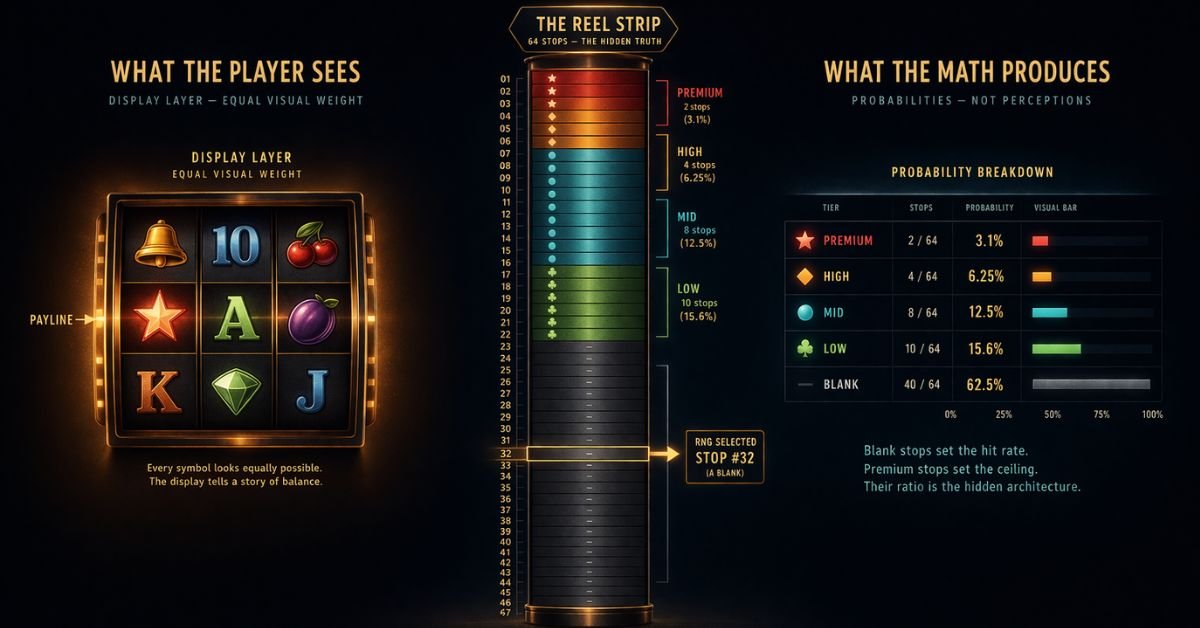
The reel configuration of a slot machine is the hidden data structure that translates every RNG number into a payout — or a loss. Understanding how reel configuration and the payout schedule interact is one of the most important things a player can learn. It explains why two games with identical RTPs feel nothing alike, why some slots drain a bankroll through a hundred small near-misses while others hold steady then pay explosively, and why the symbols you see on screen tell you almost nothing about the underlying probability architecture.
Every spin you make is the direct product of two connected structures: the reel configuration, which maps stop positions to symbols, and the payout schedule, which assigns returns to winning symbol combinations. Neither of these is shown to you before you play. This article explains both in full, with worked examples, and draws out the five hidden truths that the reel configuration and payout schedule together reveal about any slot game.
What Reel Configuration Actually Is
A reel configuration is the specific assignment of symbols to stop positions across all five virtual reels. Each reel is a list — typically 32 to 128 entries long — where each entry is a symbol.
The RNG selects one entry per reel on every spin. The number of times a symbol appears in that list is its weight, and weight equals probability.
This is not visible in the game interface. The display shows symbols in the reel window at equal visual size, giving no indication of how many stop positions each symbol occupies. A premium symbol appearing once in 64 stops and a low-value symbol appearing 12 times in 64 stops are rendered identically in the window.
The reel configuration is documented in the PAR sheet — the game’s probability accounting report. It is submitted to testing laboratories for certification and is treated as proprietary intellectual property. Players do not have access to it.
Reel Configuration — Core Facts
Reel Configuration vs Physical Reels
Early mechanical slot machines used physical reel strips with symbols printed at equal intervals. Each physical stop was equally probable — probability was transparent because the configuration was visible.
Virtual reels changed this entirely. A studio can assign the same symbol to 1 stop or to 40 stops on the same reel.
The display shows the symbol occupying identical visual space regardless. The reel configuration creates a probability layer entirely decoupled from the visual presentation.
This decoupling is what makes the reel configuration the most consequential — and least visible — structural feature of any modern online slot.
The Payout Schedule: What It Tells the Reel Configuration to Pay
The payout schedule is the table that assigns a return to every possible winning combination of symbols across active paylines. It specifies: which symbol combinations pay, on how many matching symbols, and what multiplier each combination carries.
The payout schedule is usually visible — it appears in the game’s paytable. But reading it in isolation is misleading without the reel configuration context.
A combination that pays 500× looks impressive. Whether it occurs once in 50,000 spins or once in 5 million spins is determined entirely by the reel configuration — not by the paytable.
Payout schedule and reel configuration must be read together. The payout schedule tells you what each combination pays. The reel configuration tells you how often each combination occurs.
Their interaction produces the certified RTP and every downstream statistical property of the game.
How the Payout Schedule and Reel Configuration Produce RTP
RTP is the sum of (combination probability × combination payout) across every winning combination, divided by the stake. Each combination probability comes from the reel configuration. Each combination payout comes from the payout schedule.
Changing the payout schedule without changing the reel configuration changes the RTP directly. Changing the reel configuration while keeping the payout schedule fixed also changes the RTP — by altering the frequency of every combination. Studios use both levers to target a certified RTP (house edge) figure.
This is why multiple certified RTP variants of the same game are possible. The same visual game, the same symbols, the same paytable — but a different reel configuration that changes combination frequencies, producing a different certified RTP.
How Reel Configuration and Payout Schedule Work Together
The following illustrates how these two structures interact using a simplified single-reel example with 16 stop positions.
Three observations stand out from this worked example. First, blank stops contribute 0% to RTP — they exist purely to create variance and reduce hit rate.
Second, low-value symbols contribute the most RTP despite their small payouts, because higher weight means far more frequent occurrence. Third, the premium symbol’s 500× payout sounds dominant but contributes less than 0.5% of total RTP due to extreme scarcity.
This is the reel configuration and payout schedule interaction in its simplest form. Real games use this same structure across five reels, dozens of symbols, and often hundreds of possible winning line combinations.
5 Hidden Truths About Reel Configuration and Payouts
Truth 1: Blank Stops Determine Your Session Texture More Than Any Paying Symbol
Blank positions on the reel configuration do not appear in the payout schedule at all. They pay zero and contribute nothing to RTP. But they are the single biggest driver of session feel.
Blank density directly controls hit rate. A reel configuration with 50% blank coverage produces a low hit rate — roughly half of all spins return zero on that reel before considering other reels. Designers use blank density as the primary lever for controlling how often the game responds.
Players tend to focus on premium symbols and large payouts when evaluating a slot. The hidden truth is that blank stop count in the reel configuration is what will shape most of their experience — the length of losing sequences, the frequency of near-misses, the pace of bankroll depletion.
Truth 2: The Payout Schedule Multipliers Are Meaningless Without Stop Count Context
A paytable showing a 1,000× premium combination looks spectacular. But 1,000× with 1 premium stop per 64-stop reel means the five-reel combination occurs roughly once in every 1.07 billion stop combinations.
Compare that to 50× for a symbol with 4 stops per reel — a five-reel alignment occurring once in every ~107 million combinations. The 50× combination is ten times more likely to align despite paying 20 times less.
Reading payout schedules without reel configuration data systematically misleads players about the relative value of different winning combinations. The multiplier in the payout schedule tells you what something pays. The reel configuration tells you whether it ever will.
Truth 3: Asymmetric Reel Configuration Is Engineered, Not Random
Most players assume that if a premium symbol is weighted at 2 stops out of 64, that applies equally across all five reels. In most games it does not. Studios routinely assign higher premium symbol weights to early reels (1 and 2) and lower weights to later reels (4 and 5).
This asymmetric reel configuration produces near-misses at above-chance frequency. Reels 1 and 2 show premium symbols more often than the combination can complete. The player experiences frequent apparent proximity to a big win that the reel configuration of later reels makes statistically unlikely.
This is a deliberate design choice in the reel configuration, not an emergent property of randomness. The near-miss research consistently identifies its motivational consequences for continued play.
Truth 4: Multiple RTP Variants Use the Same Payout Schedule but Different Reel Configurations
When a studio produces a 94% and a 97% variant of the same game, they typically keep the payout schedule identical — the same symbol combinations paying the same multipliers. What changes is the reel configuration.
The lower-RTP variant achieves its reduced return by increasing blank stop density and decreasing premium and mid-symbol stop counts across the reels.
From the player’s perspective, the games look and feel identical. The paytable is unchanged. The reel configuration is the hidden variable driving the different outcome.
This is why the active RTP variant at your specific casino matters — and why checking it where operators disclose it is the most direct available improvement to your reel configuration awareness.
Truth 5: The Reel Configuration Controls Bonus Trigger Frequency
Scatter symbols — the triggers for most bonus features — occupy stop positions in the reel configuration exactly like any other symbol. Their weight on each reel directly determines bonus trigger frequency.
A scatter symbol with 3 stops on each of five reels (64-stop reels) has a five-reel alignment probability of (3/64)⁵ ≈ 0.0000027% — roughly once per 37 million spins. Moving the scatter to 4 stops per reel nearly triples that frequency.
The studio controls bonus frequency entirely through the reel configuration. Players experience bonus triggers as feeling “rare” or “regular” without knowing the stop count behind it.
When a game’s RTP is heavily weighted toward bonus features, the scatter stop count in the reel configuration determines how accessible that RTP actually is in any given session. A sparse scatter reel configuration means many sessions end without a bonus trigger — and without most of the game’s certified return.
Reading Reel Configuration Signals Without the PAR Sheet
Reel configuration data is not publicly available for most online slots. But the statistical outputs it produces — RTP, volatility, hit rate, and max win — constrain what the reel configuration must look like. Inferring from outputs back to the implied reel configuration category is the practical skill available to players.
| Published Signal | Implied Reel Configuration | Session Consequence |
|---|---|---|
| High volatility + Max win >5,000× | Premium symbol: likely 1–2 stops per reel. Blank density: likely 40–55%. Near-miss engineering: probable asymmetric weighting. | Long blank sequences. Frequent near-misses on early reels. Session heavily dependent on bonus trigger. |
| Low volatility + Max win <1,000× | Premium symbol: likely 4–8 stops per reel. Blank density: likely 20–30%. More even symbol distribution. | Frequent small returns. Shorter blank sequences. Balance declines steadily but with regular interruption. |
| Hit rate >30% (where published) | Low blank density in reel configuration. Many low-value symbol stops. Low premium symbol scarcity. | High proportion of sub-stake returns (LDW exposure). Game feels active. Losing feels slow rather than sudden. |
| Hit rate <20% (where published) | High blank density. Scarce symbols across all tiers. Very sparse premium coverage. | Average 5+ consecutive blank spins. Hit events feel significant. Bankroll can deplete quickly in dry runs. |
| Bonus frequency ~1 in 100 spins | Scatter symbol: likely 3–5 stops per reel in reel configuration. Reasonable bonus accessibility. | Bonus accessible within most standard sessions. Base game vs bonus RTP split relatively accessible. |
| Bonus frequency ~1 in 250+ spins | Scatter symbol: likely 1–2 stops per reel. Sparse scatter coverage. | Many sessions end without bonus trigger. Effective RTP substantially below certified figure in those sessions. |
Practical Guide: What to Check Before You Open a Game
You cannot read the reel configuration directly. But you can build a reasonably accurate profile of it from available signals before any money is spent.
Step 1 — Check the Four Published Numbers
RTP (and whether your casino confirms the active variant), volatility label, max win, and hit rate where the studio publishes it. These four inputs together constrain the reel configuration into a category — sparse/asymmetric or balanced/uniform — that tells you what the session will feel like before you start.
Step 2 — Read the Paytable With Configuration in Mind
Look at the gap between the premium 5-of-a-kind multiplier and the low-symbol 5-of-a-kind multiplier. A very large gap (e.g. 2,000× vs 5×) signals extreme reel configuration asymmetry between symbol tiers — high blank density, sparse premium coverage. A moderate gap (200× vs 10×) signals a more balanced reel configuration.
Step 3 — Check Bonus Trigger Frequency
Some studios publish average bonus frequency in the game information panel. If not available, look for review site data.
A 1-in-200 bonus on a game with 60% bonus RTP allocation means many short sessions will not access most of the certified return. Calibrate your session length and bankroll accordingly.
Step 4 — Model the Session Distribution
Feed the RTP and volatility into the volatility and RTP calculator to see the realistic outcome distribution at your stake and session length. This converts the reel configuration’s hidden statistical outputs into a concrete before-play picture — expected cost, realistic range, and probability of ending ahead.
One thing to remember about reel configuration: every statistical property you observe or infer about a slot — its hit rate, its bonus frequency, its near-miss pattern, its balance between small and large events — is a downstream consequence of the reel configuration. Understanding this means understanding that session variation is structural, not random noise. The game was built to produce the experience you are having.
Further Reading
The reel configuration is the foundational layer described in the PAR Sheet Explained article — the document where reel configuration is specified. For how the RNG connects to the reel configuration — how a generated number becomes a stop position becomes a symbol — the virtual reels article covers the full mapping mechanism. ⚠ /virtual-reels-slots-explained/ — session-published, verify live before using as link.
For how reel configuration produces symbol weighting — the specific probability of each symbol per reel — the symbol weighting article covers the mechanism. ⚠ /symbol-weighting-slots/ — session-published, verify live.
For how the same RTP can emerge from very different reel configurations, the Volatility Guide and same-rtp-different-feel article cover the output variation. ⚠ /same-rtp-different-feel-slots/ — session-published, verify live.
For the asymmetric reel configuration that produces near-misses above chance frequency, the Near-Miss Effect article covers the behavioural consequences. For the game creation process, How Slot Machines Are Made covers the full production sequence.
For the hit rate and RTP — the primary statistical outputs of the reel configuration — those guides cover correct interpretation and limits. For session modelling tools, the Volatility and RTP Calculator and Session Risk Analyser are the starting points.
Track How Reel Configuration Plays Out in Real Bonus Sessions
Understanding reel configuration tells you how the game is built. The Bonus Hunt Tracker shows you how it actually pays — session by session, bonus by bonus — so you can see whether the theoretical architecture matches your real results.
Explore Bonus Buy Slots →Reel Configuration — FAQ
What is reel configuration in a slot machine?
Reel configuration is the specific assignment of symbols to stop positions across each of the five virtual reels. Each reel is a list of stop positions — typically 64 entries — where each position contains a symbol. The number of times a symbol appears in the list is its weight, and weight equals probability of landing on any spin.
Reel configuration is documented in the PAR sheet and is not publicly disclosed for most online slots.
How does reel configuration affect the payout schedule?
The payout schedule specifies what each symbol combination pays. The reel configuration determines how often each combination occurs. RTP is the product of the two: for every combination, its probability (from reel configuration) is multiplied by its payout (from the schedule) and summed.
Changing either structure changes the RTP. Multiple certified RTP variants of the same game typically use an identical payout schedule but different reel configurations — more or fewer blank stops adjusting the frequency of every combination.
Why are blank stops so important in reel configuration?
Blank stops pay zero and contribute nothing to RTP. But they are the primary control for hit rate — the proportion of spins returning any positive amount. High blank density in the reel configuration produces a low hit rate, creating long zero-return sequences between wins.
Low blank density produces a higher hit rate with more frequent small returns. Blank stop count is the hidden lever that most directly shapes session texture, yet it is the least visible aspect of reel configuration to players.
Is reel configuration the same on all five reels?
Not in most modern slot designs. Each reel has its own independent configuration. Studios routinely apply asymmetric weighting — placing more premium symbol stops on early reels (1 and 2) than late reels (4 and 5).
This asymmetric reel configuration produces near-misses at above-chance frequency: early reels show premium symbols more often than later reels can complete the combination. The near-miss frequency is a designed output of this reel configuration asymmetry, not random variance.
How does reel configuration control bonus trigger frequency?
Scatter symbols — which trigger bonus features — occupy stop positions in the reel configuration like any other symbol. Their weight per reel determines bonus trigger frequency exactly. More scatter stops means more frequent bonus triggers; fewer stops means sparser triggers.
When a game allocates 60% of its certified RTP to the bonus feature, the scatter stop count in the reel configuration determines how accessible that RTP is in practice. A sparse reel configuration for the scatter means many sessions end without triggering the bonus — and without accessing most of the certified return.
Can I read the reel configuration from the paytable?
Not directly — the paytable shows payout multipliers but not stop counts. However, the relative gap between multipliers provides a signal about reel configuration structure. A large gap between the premium payout (e.g. 2,000×) and the low-symbol payout (e.g. 5×) signals an asymmetric reel configuration with very sparse premium coverage and dense low-symbol coverage.
A moderate gap suggests more balanced weighting. Combined with volatility label, hit rate, and max win, the paytable structure gives a reasonable inference about the underlying reel configuration category.
Why do different RTP variants of the same game feel different despite identical paytables?
Because the reel configuration — not the payout schedule — changes between variants. A 94% RTP variant typically increases blank stop density and reduces premium and mid-symbol stop counts compared to a 97% variant. The paytable multipliers remain identical.
But the lower-variant reel configuration produces every winning combination less frequently, resulting in a lower aggregate return at the same stake. The game looks identical; the reel configuration determines the actual outcome frequency.