
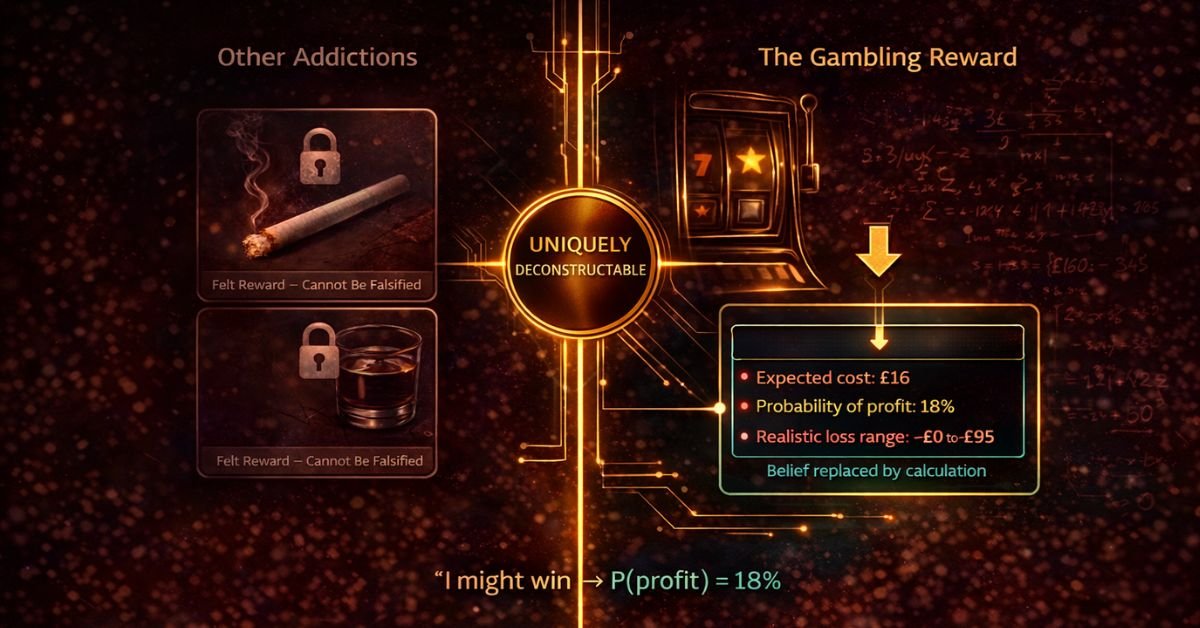
The gambling deconstructable reward is the single most important and least exploited concept in responsible gambling — and it is the reason slot gambling can be approached differently, more honestly, and more effectively than any other addiction. Every major addiction has a reward. The reward is why people continue despite harm. But gambling’s reward has a property no other addiction’s reward shares: it is a mathematical expectation, not a felt experience, and mathematical expectations can be calculated, examined, and falsified before you ever open a game. This article explains exactly what that means, how to apply it, and why the entire responsible gambling system has barely touched it.
What the Gambling Reward Actually Is — Not What You Think
Before you can understand why the gambling deconstructable reward is unique, you need to be precise about what the gambling reward actually is. Most people describe it vaguely: the thrill, the excitement, the hope. These are real psychological experiences that accompany gambling. But they are not the primary reward that drives the decision to place a bet and continue placing bets. The primary reward in slot gambling is specific and simpler: the expectation of winning money.
Not winning money. The expectation of winning money — the belief, held before each spin, that this bet might return more than it costs and that continued play might produce a net monetary gain. Every other dimension of the gambling experience — the sound design, the visual effects, the near-miss engineering, the bonus anticipation — exists in service of sustaining that expectation. The game is built to make the belief in a positive expected outcome feel reasonable, imminent, and worth one more bet. Strip all of that away and what remains is the core: a player who believes, or half-believes, or wants to believe, that continuing to play is financially worthwhile.
That belief — “I might win, and if I keep playing it might pay off” — is the target. It is what drives the session forward. It is what responsible gambling needs to address if it is going to be effective. And it is, uniquely, a mathematical claim.
The Gambling Deconstructable Reward — Key Facts
Three Types of Addiction Reward — Why Only One Is Deconstructable
To appreciate why the gambling deconstructable reward is such a significant concept, it helps to see it against the full landscape of addiction rewards. Not all rewards are the same kind of thing. The type of reward an addiction provides determines what kind of intervention can address it. And gambling’s reward type is, in this respect, genuinely unique.
Neurochemical Rewards
Nicotine, alcohol, opioids, stimulants. The reward is a direct pharmacological effect on brain chemistry — dopamine release, anxiety reduction, euphoria. It is experienced immediately as a physical and psychological sensation. It cannot be mathematically falsified because it is not a belief about a future event. It is something the person is actually feeling. Harm messaging must work around this reward, not through it.
Behavioural / Psychological Rewards
Compulsive eating, social media addiction, gaming addiction. The reward is a psychological experience — comfort, stimulation, social validation, identity expression. Real and felt. Cannot be falsified mathematically. The person is not acting on a belief about a future monetary event; they are responding to an immediate psychological need. Standard harm communication is equally limited here.
Monetary Expectation Reward
Slot gambling, casino gambling broadly. The primary reward is not something the player is currently experiencing — it is a belief about a future event: that continued play might produce a net monetary gain. This is a probabilistic expectation. It has an expected value. That expected value is negative and calculable from public data. The belief is mathematically falsifiable before any bet is placed. This property exists nowhere else in addiction.
This taxonomy is not an argument that gambling is a less serious addiction than smoking or alcohol. It is an argument that gambling addiction has a unique structural feature — the deconstructable reward — that creates a specific harm-reduction opportunity that does not exist for any other major addiction. The responsible gambling field has largely treated gambling as one more instance of the harm-communication problem it already knows how to address. The research suggests this is a category error. Gambling’s reward type requires a different approach — and that approach is available precisely because the reward is mathematical.
The Deconstructable Reward Argument: Why “I Might Win” Is a Mathematical Statement
The core of the gambling deconstructable reward argument runs as follows. When a player is at the reels — deciding to spin again, deciding to stay after a loss, deciding whether the session has been worth it — the motivation driving that decision is, at its root, a belief: “I might win. Continuing to play could result in a net monetary gain.”
That belief is not a feeling. It is a proposition about the future. And propositions about future probabilistic events have mathematical content that can be examined.
Step 1 — The Belief Has a Probability
The probability that any given spin returns more than the stake can be estimated from published data. If a game has a 96% RTP and a medium-high volatility rating, its hit rate (proportion of spins returning anything) might be around 25%. Its true win rate (proportion of spins returning more than the stake, after accounting for losses disguised as wins) is lower still — perhaps 15–18% on a multi-line game. The belief “I might win on this spin” is therefore a belief with a 15–18% probability of being immediately vindicated, and an 82–85% probability of being immediately falsified. That is not “I might win.” That is “I will almost certainly not win on this spin.”
Step 2 — The Expected Value Is Negative
Beyond any individual spin, the belief “continuing to play will be financially worthwhile” has a mathematically precise expected value. For a 96% RTP slot at a £1 stake per spin: expected return per spin = £0.96, expected cost per spin = £0.04. Over 200 spins: expected total cost = £8.00. That £8.00 is not a guarantee — actual results vary around the expectation. But it is the probability-weighted average outcome across an infinite repetition of the same session. The belief that 200 more spins might produce a net gain is not wrong in the sense that it is impossible — it is wrong in the sense that it has a negative expected value, which means it is a bad bet in the strict mathematical sense every time it is placed.
Step 3 — The Reward Belief Can Be Replaced With a Calculation
The crucial move in the gambling deconstructable reward framework is this: the vague belief “I might win” can be replaced, before you start, with a concrete calculation. Not “there’s always a chance” but “at my stake, over my intended session, the math says: expected cost £X, realistic range £Y–£Z, probability I end in profit: N%.” When you have done that calculation and it is in front of you — concrete, personalised, specific — you are no longer acting on the belief. You are acting on a mathematical picture of what the belief actually means. That is deconstruction: replacing the motivating belief with its mathematical content.
Why This Is Different From Just Saying “The House Always Wins”
“The house always wins” is a statement about the long run that every player has heard and that changes almost no one’s behaviour. It fails because it is abstract, general, and applies to an infinite series that no individual player will ever experience. The gambling deconstructable reward approach is different in three specific ways: it is personalised (your stake, your session length, your game), it is concrete (a number, not a principle), and it applies to the specific session in front of you (not the infinite long run). “The house always wins over millions of players” is background knowledge. “Your expected cost this session is £22 and the probability you end in profit is 14%” is a picture of your situation right now. That specificity is what makes the deconstruction meaningful rather than theoretical.
Worked Examples: Deconstructing the Reward in Practice
The gambling deconstructable reward principle is most useful when it becomes operational — when you can actually run the numbers. Here are three worked examples across different game types and session parameters, showing exactly what deconstruction looks like in practice.
Example 1 — Medium Volatility Slot, Casual Session
Reward Deconstruction — Medium Volatility, £0.50 stake
Note: These figures are illustrative based on typical medium-volatility math profiles. Your game’s specific RTP and volatility produce different numbers — use the session risk analyser for your actual parameters.
Example 2 — High Volatility Slot, Larger Session
Reward Deconstruction — High Volatility, £2.00 stake
High volatility dramatically widens the loss distribution. The same expected cost (−£16) conceals a much wider range of actual outcomes than medium volatility. “I might win big” is mathematically true but the 18% probability of any profit and 35% chance of losing £60+ is the fuller picture.
Example 3 — The “Just £20 More” Mid-Session Decision
This is the most practically important deconstruction point: the mid-session re-evaluation. You are £30 down. You are considering depositing another £20 to continue. The reward belief at this point is particularly strong: you feel close to a recovery win, the game has been producing near-misses, and £20 feels small relative to what you’ve already spent.
Mid-Session Reward Deconstruction — The £20 Top-Up Decision
The sunk cost trap. The £30 already lost does not make the next £20 more likely to return. It is mathematically irrelevant to what the next spin will produce. The feeling that you “need” to continue to recover what’s been lost is the chasing-losses cognitive pattern — and it is the moment when the gambling deconstructable reward principle is most practically valuable. Deconstructing the reward in this moment means replacing “I might recover” with “the expected cost of the £20 I’m about to add is negative, the session is already at a loss, and continuing adds expected cost without reducing the existing loss.”
What Falsifying the Reward Does to Your Motivation — and What It Doesn’t
The gambling deconstructable reward argument is powerful — but it requires honest accounting of both what it achieves and where its limits lie. Falsifying the reward mathematically does not simply make the motivation to gamble disappear. Understanding why is as important as understanding the argument itself.
What It Does
When the expected monetary value of a session is made concrete and personal before you begin, two things happen. First, the vague optimism of “I might win” is replaced by a specific probabilistic picture. The player who knows they have a 20% chance of ending in profit is in a different cognitive position from the player who holds an unexamined belief that things might go well. The unexamined belief is more motivationally powerful precisely because it has not been confronted with its content. Second, the commitment to a session becomes an explicit decision rather than a drifting continuation. When you have modelled what the session is expected to cost and decided to proceed anyway — as entertainment, as a calculated choice within a budget you can afford — you are making an informed decision. That is categorically different from proceeding on a vague positive expectation that has not been examined.
What It Doesn’t Do
Reward deconstruction does not eliminate the psychological experience of gambling. The variable ratio reinforcement schedule built into slot design operates at a neurological level that mathematical knowledge cannot override in real time. The near-miss urgency, the bonus anticipation, the compulsion to continue after a loss — these are not beliefs that can be falsified. They are psychological states produced by structural features of the game. Reward deconstruction addresses the belief that motivates beginning and continuing. It does not reach the neurological responses that arise during play.
This is why the gambling deconstructable reward argument is most powerful as a pre-session intervention — before the active-play psychological state has been established. Once you are in the game, the cognitive architecture that made the reward examination possible is being competed with by neurological reinforcement mechanisms that operate faster and more directly than rational assessment. The calculation done calmly before you start can inform a decision made under conditions when calm calculation would be difficult.
| Intervention Moment | Effectiveness of Reward Deconstruction | Why |
|---|---|---|
| Pre-session (before opening game) | Highest | Cognitive state is calm, rational assessment is accessible, the calculation can inform a genuine decision about whether to play and at what parameters |
| At session start (game is open, first spin not placed) | High | Anticipation has begun but reinforcement cycle has not yet started; reviewing the pre-session calculation is still accessible |
| Natural break in session (bonus ended, balance check) | Moderate | Brief window of reflective capacity; returning to the pre-session model can anchor the re-evaluation in math rather than mood |
| Mid-spin, in active play | Low | Variable ratio reinforcement is operating; neurological state reduces accessibility of rational assessment; reward deconstruction is too slow for this context |
| After near-miss or losing run | Very low without preparation | Chasing motivation is at maximum; the deconstructable reward argument requires having done the calculation beforehand to reference — doing it in this moment is very difficult |
Why the Responsible Gambling System Has Almost Entirely Missed This
If the gambling deconstructable reward is such a significant opportunity, why has the responsible gambling system — with decades of research, significant funding, and regulatory backing — not built its primary intervention around it? Several interconnected reasons explain the gap.
The Harm-Communication Default
Responsible gambling messaging was developed within a public health framework that already had a successful template: communicate the harm, increase awareness, modify behaviour. This template was proven to some degree in tobacco (though even there the evidence for warning messages changing behaviour is more modest than commonly assumed) and was applied to gambling without sufficiently examining whether the reward structure was comparable. The default was harm communication. The deconstructable reward argument requires engaging with the reward — which is a more counterintuitive framing for a harm-reduction framework.
The Industry Conflict
A responsible gambling intervention that directly addresses the gambling reward — that says “here is the mathematical picture of what you are about to receive in exchange for your money” — is a significantly more confrontational product than a “Gamble Responsibly” badge. It is in direct tension with the commercial interest of the operator. The responsible gambling system has largely been developed and funded within a framework where operators have significant influence over what messages are delivered and how. The deconstructable reward approach, taken seriously, would require operators to expose the negative expected value of their products in specific, personalised terms before every session. That has not happened because the commercial incentive structure has not required it.
The Mathematical Literacy Assumption
Reward deconstruction requires players to engage with expected value calculations, probability distributions, and session outcome modelling. The assumption has been that most gamblers lack the mathematical literacy to do this, and that mathematical information would be dismissed or misunderstood. The research on RTP miscomprehension — where players systematically misinterpret what RTP means — supports the concern. But the conclusion this leads to should be better tools and better explanation, not abandonment of the mathematical approach. The volatility and RTP calculator and session risk analyser are examples of making the calculation accessible without requiring players to do the math themselves.
The Separation of Math from Responsible Gambling
The gambling mathematics community and the responsible gambling research community have historically operated largely in parallel, with relatively little cross-pollination. Mathematical researchers studied game design, probability architecture, and expected value. Problem gambling researchers studied behavioural patterns, cognitive distortions, and intervention effectiveness. The deconstructable reward argument sits at the intersection — it requires both the mathematical content (expected session outcomes) and the behavioural framing (how to use that content to change decisions). The intellectual framework for connecting them has been developing, but it has not yet shaped the primary design of mainstream responsible gambling messaging.
How Cognitive Distortions Rebuild the Reward After You’ve Deconstructed It
One of the most practically important things to understand about the gambling deconstructable reward principle is that deconstruction is not permanent. The calculation done before a session can be undermined during a session by cognitive distortions that effectively reconstruct the reward belief — replacing the mathematical picture with a new emotionally compelling version of “I might win.” Knowing how this happens is essential for keeping the deconstruction protective throughout the session.
Gambler’s Fallacy — Rebuilds Via “Compensation”
After a losing run, the fallacy rebuilds the reward belief: “I’ve lost a lot, so a win is statistically more likely now.” This directly replaces the correct mathematical picture (the next spin has the same expected value as every spin before it) with a false one. The pre-session deconstruction is countered by mid-session false reasoning. Naming it correctly — “this is the gambler’s fallacy, there is no compensation mechanism” — is the counter.
Near-Miss Effect — Rebuilds Via “Proximity”
After an engineered near-miss, the effect rebuilds the reward belief: “I was so close — the win is coming.” This is not a compensation belief but a proximity belief — the player feels they are getting closer to a win that the math says has no proximity dimension at all. The designed asymmetry of the reel strip has manufactured this feeling. The counter: “this is reel strip design, there is no proximity to a win in an independent random process.”
Hot/Cold Streak Beliefs — Rebuilds Via “Momentum”
After a win or series of wins, the streak belief rebuilds the reward: “This machine is running hot, I should keep going while it’s paying.” This imports a pattern structure onto an independent random process. The win did not change the game’s probability architecture. The next spin has the same expected value as if the previous wins had not occurred.
Illusion of Control — Rebuilds Via “Skill”
The illusion rebuilds the reward by adding a skill dimension: “I’ve figured out the timing / the pattern / when to stop the reels.” This inflates the expected value of continued play by adding a false positive contribution from “skill.” The counter: the RNG samples the outcome at button press; no timing, pattern recognition, or button choice influences the probability space.
Each of these distortions reconstructs the reward from a different angle — compensation, proximity, momentum, skill — and each requires a specific named counter rather than just a general awareness that “slots are random.” The gambling deconstructable reward principle, applied fully, means not just doing the calculation before the session but maintaining the correct mathematical frame during it when these rebuilds attempt to override it. The full psychology of slot player behaviour covers the complete landscape of how this happens in practice.
How to Apply the Deconstructable Reward Principle Before Every Session
The gambling deconstructable reward principle is most useful as a pre-session ritual — a consistent practice that replaces the implicit positive expectation with an explicit mathematical picture before the game begins. Here is a practical protocol.
Step 1 — Identify the Game’s Published Math
Before opening any slot, read the four published PAR sheet outputs: RTP, volatility rating, hit rate where available, and house edge (which is 1 − RTP). These are the factual inputs your reward deconstruction needs. A game with 94% RTP has a house edge of 6% — twice the cost of a 97% game per unit wagered. Volatility determines how widely your actual result will vary around the expected cost. Both matter for understanding what your session is actually buying.
Step 2 — Calculate Your Session’s Expected Cost
Multiply: stake per spin × intended number of spins × (1 − RTP) = expected cost. This is not what you will definitely lose. It is the probability-weighted average of what a player at your parameters loses across an infinite repetition. It is the mathematical content of the reward belief “I might win” — the real number beneath the vague optimism. Write it down. Having it as a concrete figure rather than an abstract percentage changes how you relate to the decision.
Step 3 — Model the Realistic Range
Expected cost is the average. Actual results vary — more so in high-volatility games. Use the volatility and RTP calculator or the session risk analyser to see the distribution of likely outcomes: what is the probability you end in profit, what is the realistic worst case for 80% of sessions, what is the probability of losing more than twice the expected cost. This replaces “I might win” with “18% of sessions at these parameters end in profit, 82% end at a loss, and the loss distribution looks like this.” That is a complete picture of the reward.
Step 4 — Frame the Session as a Purchase
The gambling deconstructable reward principle is most cleanly applied by reframing the session before it begins: you are not trying to win money, you are purchasing a gambling experience at a known expected cost. That cost is the figure from Step 2. The volatility range from Step 3 is the variance around that cost. You are deciding whether the entertainment value of the session is worth the expected cost, within a budget you can genuinely afford to lose. That is a legitimate decision. It is also a completely different decision from “I’m going to try to win money.”
Step 5 — Set Pre-Commitment Limits Before Opening the Game
Use the responsible gambling planner to set a session loss limit equal to or below your maximum affordable loss — not your expected cost. The expected cost is what an average session costs. Your loss limit is the maximum you are willing to pay for the experience. Set this at account level before the game loads. Pre-commitment limits are the structural complement to reward deconstruction: the deconstruction tells you what you are buying, the limits ensure you cannot buy more than you decided to before the game’s reinforcement architecture had a chance to influence you.
The complete pre-session protocol: Check the game’s RTP and volatility → calculate expected session cost → model the outcome distribution → set a loss limit at account level → open the game with both the mathematical picture and the structural limit in place. That combination — reward deconstruction plus pre-commitment — is the closest thing the current evidence base has to an effective responsible gambling intervention for slot players. Neither alone is sufficient. Together they address both the cognitive (the reward belief) and the structural (the in-session reinforcement cycle) dimensions of the problem.
Further Reading
The gambling deconstructable reward concept is grounded in Bărboianu’s research on the mathematics-related specificity of problem-gambling awareness — specifically the argument that gambling is uniquely positioned among addictions because its primary reward is a mathematical expectation that can be examined rather than a felt experience that resists examination. The companion articles that provide the supporting framework for each part of this piece are: the why responsible gambling warnings fail analysis for the full critique of harm-communication frameworks and the evidence base on intervention effectiveness; Player Psychology in Slot Games for the complete landscape of how slot design shapes player behaviour; and the cognitive distortion series — Gambler’s Fallacy, Near-Miss Effect, Illusion of Control, Variable Ratio Reinforcement, Losses Disguised as Wins, and Chasing Losses — for how each distortion reconstructs the reward during play.
For the mathematical inputs needed to run a reward deconstruction, Return to Player Guide, Slot Volatility, Slot Hit Rate, and House Edge in Slots cover each metric. For the tools that make the calculation accessible without requiring players to build their own models, the Volatility and RTP Calculator and Session Risk Analyser are the primary instruments. For the full context on why players gamble — the motivational landscape within which the deconstructable reward operates — the motivations research article covers the evidence on what drives gambling beyond the monetary expectation. The Gambling Math Explained article provides the full mathematical vocabulary needed to run the deconstruction calculations independently.
Deconstruct Your Reward Before the Next Session
The Session Risk Analyser replaces “I might win” with its mathematical content — expected cost, realistic loss range, and probability of profit at your stake level and session length. Run it before you open the game.
Run the Deconstruction →Gambling Deconstructable Reward — FAQ
What is the gambling deconstructable reward?
The gambling deconstructable reward is the primary motivation for slot gambling — the expectation of a net monetary gain from continued play — examined in its mathematical form rather than as a vague belief. Unlike the rewards of other addictions (neurochemical effects, psychological experiences), the gambling reward is a belief about a future probabilistic event: “I might win.” That belief has a probability, an expected value, and a realistic outcome distribution that can be calculated from publicly available game data before any bet is placed. Deconstructing the reward means replacing “I might win” with its mathematical content: the expected cost, the realistic outcome range, and the probability of ending in profit.
Why is the gambling reward different from rewards in other addictions?
Because the gambling reward is not a felt experience — it is a probabilistic belief. A smoker’s reward is a real, immediate neurochemical effect. An alcohol drinker’s reward is a felt physiological and psychological state. These experiences cannot be mathematically falsified because they are actually happening. The gambling reward is different: “I might win money” is a proposition about a future event, not a present experience. Future probabilistic propositions have expected values. Those expected values are negative for every licensed slot ever produced. The belief can be replaced by a calculation — which means the motivating structure of gambling addiction can be addressed in a way that is simply not available for any other major addiction.
Does deconstructing the reward mean gambling stops being fun?
Not necessarily. Reward deconstruction reframes the session as a purchase — you are buying a gambling experience at a known expected cost, not attempting to produce a net monetary gain. That reframing is compatible with genuinely enjoying the experience within a budget you can afford. Many other forms of entertainment have a clear cost with no expectation of financial return — nobody expects cinema tickets to pay off. The issue is not that gambling has an expected cost; it is that the gambling environment is specifically designed to maintain the belief that continued play can produce a net monetary gain. Deconstruction replaces that belief with a clearer understanding of what you are actually purchasing, which makes the decision to gamble more informed without necessarily making it unpleasant.
How do I actually calculate my session’s expected cost?
The basic calculation: stake per spin × number of spins × (1 − RTP as a decimal). Example: £1.00 stake × 200 spins × (1 − 0.96) = £1.00 × 200 × 0.04 = £8.00 expected cost. This is the probability-weighted average loss across an infinite repetition of that session. Your actual result will vary around it — more so in high-volatility games. For the full distribution of realistic outcomes including the probability of ending in profit, use the session risk analyser which models the variance around the expected value for your specific game parameters.
If I know the expected cost, why do I still feel like I might win?
Because knowing the expected cost is mathematical knowledge — and the motivation to continue gambling operates substantially in the epistemic dimension (how randomness is perceived during play) and the neurological dimension (variable ratio reinforcement). The calculation addresses the reward belief when you are calm and thinking clearly. During an active session, cognitive distortions — the gambler’s fallacy, near-miss effect, streak beliefs — reconstruct the reward from different angles, replacing “I know the expected cost” with “I might recover now,” “I was so close,” “this machine is hot.” The solution is not only to do the calculation but to do it before the session, set structural limits that operate regardless of your in-session state, and practise naming the cognitive distortions when they arise during play.
Why hasn’t the responsible gambling system built messaging around this?
Several overlapping reasons. The harm-communication framework used for other addictions was applied to gambling without examining whether the reward structure was comparable — it was not. The industry has commercial incentives that conflict with messaging that directly exposes the negative expected value of its products in personalised terms. The assumption that players lack mathematical literacy has led to abandoning the mathematical approach rather than improving the tools that make it accessible. And the mathematical and responsible gambling research communities have operated largely in parallel rather than collaborating to develop the intervention the deconstructable reward argument suggests. The gap is narrowing — tools that make the calculation accessible without requiring mathematical expertise are being developed — but the mainstream messaging system has not caught up.
Does reward deconstruction work for problem gamblers, or only recreational players?
Reward deconstruction is most effective as a protective tool for recreational players making ongoing decisions about how they engage with gambling. For players showing signs of problem gambling — gambling beyond what they can afford, chasing losses consistently, experiencing distress related to gambling — the neurological and psychological dimensions of the addiction are likely to override the cognitive intervention that reward deconstruction provides. Problem gamblers need professional support and structured intervention. Reward deconstruction can be part of a broader treatment framework — understanding the mathematical reality of gambling is relevant in recovery — but it is not a substitute for clinical support when that support is needed.
What is the difference between saying “the house always wins” and reward deconstruction?
“The house always wins” is an abstract general statement about the long run that every player has heard and that changes almost no one’s behaviour. It fails because it applies to an infinite series that no individual player experiences, it carries no specific information about this session or this game, and it has been heard so often it has lost practical force. Reward deconstruction is the opposite: specific (your stake, your game, your session length), concrete (a number: expected cost £X, probability of profit N%), and applies to the session in front of you right now rather than to the aggregate of millions of players. The shift from abstract principle to personalised calculation is what makes deconstruction useful where the general statement is not.