
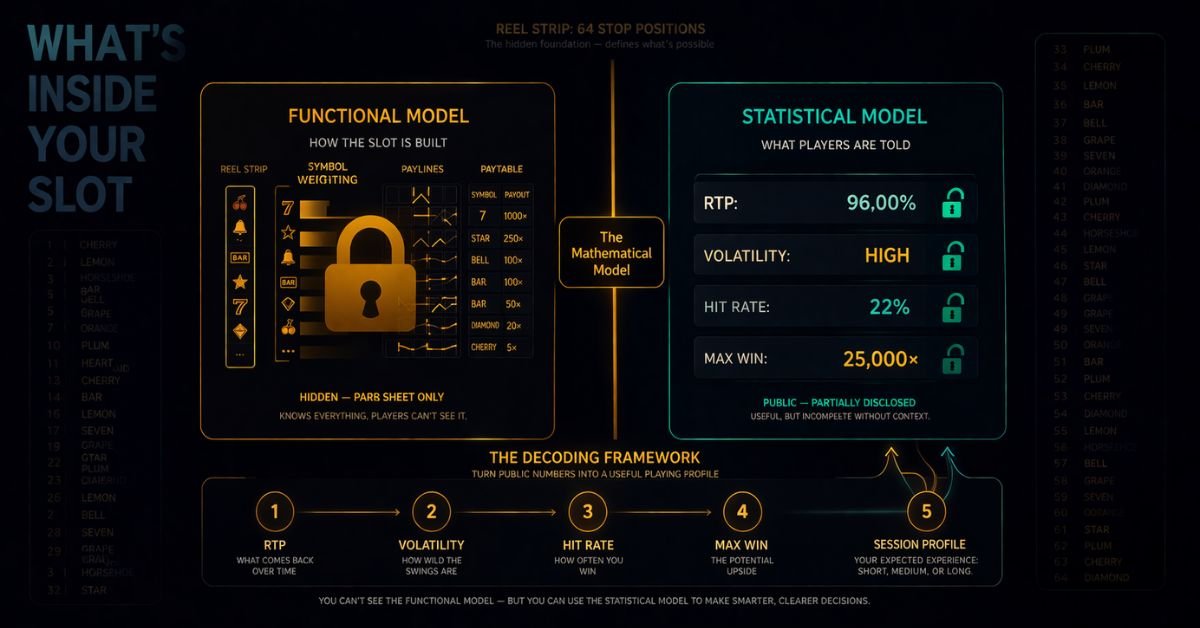
The slot mathematical model is the complete mathematical architecture that determines every outcome a slot game is capable of producing — every probability, every expected value, every win combination frequency, every volatility characteristic. It is not a single document or a single formula. It is a layered system of two distinct types of mathematical structure, one of which is entirely public and one of which is almost entirely hidden. Understanding both layers, how they relate to each other, and what you can infer about the hidden layer from the public one is what decoding a slot actually means. This article is the framework for doing exactly that — systematically, without the PAR sheet, using only the information that is publicly available.
What the Slot Mathematical Model Actually Is
The phrase “mathematical model” is used loosely across the gambling industry — often as a vague synonym for “game math” or “how the numbers work.” Precisely defined, a mathematical model is something more specific: the ensemble of mathematical structures, mappings, and relationships that represent a physical system in formal terms, allowing conclusions about that system to be derived through mathematical reasoning rather than observation alone. For a slot game, the mathematical model is the complete formal specification of how every possible spin outcome is generated, what probability it carries, what it pays, and what the aggregate of all those outcomes delivers over time.
Every licensed slot game is developed from its mathematical model outward. The model is not a description of the game that was built — it is the specification from which the game was built. Art, audio, animations, and feature presentations are layered on top of a certified probability architecture. The PAR sheet — Probability Accounting Report — is the primary document that captures that architecture. Regulatory testing laboratories verify the built game against it. If the live game does not match the model, the game fails certification. As the research on slot mathematical models identifies: “Games of chance are developed structurally and physically around abstract mathematical models, which are their mere essence, and the applications within these mathematical models represent the premises of their functionality.”
This matters for players because it means what you see when you play a slot — the symbols, the animations, the near-misses, the bonus anticipation — is a presentation layer. The slot mathematical model beneath it is what actually determines what happens. Decoding that model means moving from the presentation layer to the mathematical structure beneath it.
The Slot Mathematical Model — Core Facts
The Two-Type Taxonomy: Functional and Statistical Models
The most important conceptual tool for decoding any slot is a distinction that exists in the academic literature on gambling mathematics but has almost never been brought into player-facing content: the taxonomy of slot mathematical models into two distinct categories. These categories have different purposes, different mathematical governing theories, different relationships to what players experience, and critically different levels of public accessibility.
Functional Model
The “How It Works” Layer- Reel strip configurations — the stop-by-stop sequence of symbols on each virtual reel
- Symbol weighting — how many stops each symbol occupies per reel
- Display configuration — grid dimensions, payline structures, position logic
- Payline definitions — which stop combinations count as winning lines
- Feature trigger logic — the conditional rules that activate bonus rounds
- Wild and scatter substitution mechanics
- Symbol arrangement across the reel strip sequence
🔒 HIDDEN — Proprietary IP, held in the PAR sheet, not disclosed to players
Statistical / Probabilistic Model
The “What It Produces” Layer- RTP — the probability-weighted sum of all possible returns
- Expected value — the average return per unit wagered
- Win combination probabilities — how often each paytable entry hits
- Hit rate — proportion of spins returning any amount
- Volatility / variance — shape of the win distribution
- Maximum win — the ceiling of any single spin’s return
- Feature trigger frequency — average spins between bonus activations
🔓 PUBLIC (partially) — RTP, volatility label, and max win are typically disclosed. Hit rate and feature frequency disclosed by some studios only.
The relationship between the two models is strictly one-directional: the functional model determines the statistical model. Given the complete functional model specification (reel strips, symbol weights, paytable), every statistical output can be calculated exactly. RTP is the sum of all (win probability × payout) products across every combination the functional model permits. Volatility is a measure of the variance of the statistical model’s output distribution. Hit rate is the sum of probabilities of all non-zero-return combinations in the functional model.
This directionality is what makes decoding possible in principle but imperfect in practice. You can observe statistical outputs and ask what functional model must have generated them — but the answer is not unique. Multiple different functional configurations can produce the same statistical outputs. A 96% RTP game with high volatility could be achieved through several different reel strip configurations and paytable arrangements. The statistical model constrains the functional model without specifying it uniquely.
The Functional Model: Everything That’s Hidden
The functional model is the game’s engine. It is the set of specifications from which everything you experience flows. Without the functional model, there is no probability to calculate, no RTP to certify, no game to play. And it is entirely hidden from players in virtually every jurisdiction for any online slot produced by any major studio.
Reel Strips — The Core Data Structure
The reel strip is a sequential list of stop positions, each assigned a specific symbol. A virtual reel with 64 stops has 64 entries, each one specifying what symbol sits at that stop. When the RNG generates a number for a spin, it selects a stop position from the strip — the symbol at that position is what appears in the reel window. Five reels means five independent selections, one from each reel’s strip, producing the displayed combination.
The reel strip is the most sensitive element of the functional model because it directly encodes symbol weighting — how often each symbol can land. A premium symbol appearing at 2 of 64 stops has a weight of 2/64 = 3.125%. A blank occupying 20 of 64 stops has a weight of 31.25%. These weights are the raw inputs to every probability calculation in the game. Change any weight and every downstream statistical output changes with it.
Display Configuration — How the Physical Layout Shapes Probability
The display configuration specifies how the reel window is structured: the number of rows visible per reel, the arrangement of paylines across those rows, and which stop positions on each reel are independent of each other. For standard payline slots, each payline is a path through the display grid — a sequence of stop positions, one per reel, that must all show matching symbols for a payline win to be recorded.
The display configuration is not merely cosmetic. The topology of the payline network determines which combinations of symbols constitute winning events, and therefore which combinations the probability model must enumerate. A 5×3 display with 20 paylines has a different combinatorial space than a 5×4 display with 40 paylines — different numbers of intersecting lines, different independence properties, different probabilities for group events like “any payline wins.” The display configuration is the mathematical foundation for the payline probability calculation in the statistical model.
Feature Logic — The Conditional Probability Layer
Modern slots contain bonus features — free spins, hold-and-spin rounds, pick games, cascades — that are themselves governed by the functional model. The trigger conditions (typically: scatter symbols landing in a specified quantity across a spin), the feature’s internal mechanics, and the relationship between base game and feature RTP allocations are all specified in the functional model and verified in the PAR sheet. The feature logic is what produces the “bonus RTP contribution” figure that appears in some studio transparency disclosures — typically 30–60% of total game RTP for medium-high volatility slots.
The Statistical Model: Everything That’s Public
The statistical model is what the functional model produces when the mathematics is run. It is the set of probability distributions, expected values, and aggregate statistical measures that describe the game’s output behaviour. This is the layer players interact with — or rather, the small portion of it that studios and operators choose to disclose.
RTP — The Aggregate Expected Return
Return to Player is the single most important output of the statistical model and the one most widely published. It is the probability-weighted sum of all winning combination returns across all paylines, expressed as a percentage of stake. A certified 96% RTP means that across an infinite number of equivalent sessions, 96p of every £1 wagered is returned in winnings. The full treatment of what RTP means and what it does not covers the interpretation in detail — the critical point here is that RTP is a statistical model output derived directly from the functional model’s reel strips and paytable, not a property that can be set independently of those inputs.
Volatility — The Shape of the Win Distribution
Volatility is the statistical measure of how concentrated or spread the game’s win distribution is. High volatility means most of the RTP is delivered through rare, large events — the distribution is narrow and tall. Low volatility means RTP is spread across frequent, small events — the distribution is wide and flat. Mathematically, volatility is derived from the variance of the outcome distribution, which is itself a direct function of the functional model’s symbol weighting and paytable structure. The volatility guide covers how the published label translates to session behaviour.
Hit Rate — The Frequency of Non-Zero Returns
The hit rate is the proportion of spins that return any amount at all — including sub-stake amounts. It is the sum of all non-zero-return combination probabilities in the statistical model. Where published, it is one of the most useful functional model inferences available to players: a low hit rate (below 20%) implies that the functional model has high blank density on mid and late reels, that premium symbols are rare across the full reel set, and that the game’s session feel will involve long sequences of zero-return spins. Hit rate is not typically required to be disclosed in most jurisdictions — only some studios (notably NoLimit City) publish it routinely.
Maximum Win — The Functional Model’s Ceiling
The maximum win is the certified upper bound on any single spin’s return. It is specified in the PAR sheet and verified by the testing laboratory. The maximum win is a constraint imposed on the functional model — it tells you the absolute ceiling of what the paytable can pay multiplied by the maximum bet, capped at the certified max. A 10,000× maximum win means the functional model’s highest-value combination — premium 5-of-a-kind, multiplied by any active multipliers — cannot exceed 10,000× the stake. This constrains what reel strip weights the high-value symbols can have and sets the ceiling of the premium paytable entry.
The Information Hierarchy: Open, Partial, and Hidden
Before applying the decoding framework, it is essential to know exactly what information is available, what is partially available, and what is hidden. Different pieces of information about the slot mathematical model sit at different tiers of accessibility.
The Five-Step Decoding Framework
With the information hierarchy in place, the decoding framework becomes a structured process of reading public statistical model outputs and inferring what they imply about the hidden functional model. The five steps move from the most constrained inference (RTP establishes the aggregate) to the most granular (how the functional model must be structured to produce the observed statistical outputs simultaneously).
Establish the Aggregate: Read Certified RTP Precisely
The certified RTP is the single most constrained fact about the game. Every component of the functional model — every symbol weight on every reel, every paytable value, every feature specification — must combine to produce exactly this percentage within the approved tolerance (typically ±0.1%). This means RTP is an equality constraint on the functional model: whatever the reel strips look like, they must produce this number. Start here. Note whether the published RTP is the highest available variant or the one your specific casino configures. If there are multiple variants (94%, 96%, 97% for example), record the range — you may be playing a lower variant than the one most prominently disclosed.
→ Inference: You now know the aggregate expected cost per unit wagered. Every inferences below must be consistent with this constraint.
Read the Win Distribution Shape: Interpret the Volatility Label
The volatility label — Low / Medium / High, or a numeric score on some studio’s 1–10 scale — summarises the shape of the statistical model’s win distribution. High volatility means the RTP budget is concentrated in rare events (infrequent large wins, frequent zeros). Low volatility means the RTP budget is spread across frequent events (regular small wins, rare large ones). Within the same RTP, these are radically different functional model configurations: a high-volatility game necessarily has low symbol weighting on premium symbols and high blank density on late reels; a low-volatility game has more moderate weighting across all tiers. The volatility label, despite being coarse, meaningfully constrains the functional model’s reel strip structure.
→ Inference: High volatility implies sparse premium symbol positions, high blank density, and heavy bonus RTP contribution. Low volatility implies more balanced symbol distribution and higher base-game hit rate. These constrain the range of plausible functional configurations.
Quantify Spin Activity: Use Hit Rate Where Available
If the studio publishes a hit rate, this is among the most powerful functional model inference tools available. Hit rate is the sum of all non-zero-return combination probabilities — it tells you, directly, how densely the functional model’s reel strips are configured to produce any winning outcome per spin. A 20% hit rate means 80% of spins return zero. Given the RTP, this strongly constrains how the wins must be distributed: 20% of spins produce all the return, and those 20% must average enough to produce the stated RTP across all spins. Where hit rate is not published, it can sometimes be estimated from extended session observation (though this requires thousands of spins to achieve useful accuracy), or inferred from the volatility label and RTP combination — high volatility, high RTP games typically have 15–25% hit rates; low volatility, similar RTP games typically have 28–40%.
→ Inference: Combined with RTP, hit rate allows you to calculate the average return on winning spins (RTP ÷ hit rate). This gives you a feel for how the functional model’s paytable is structured — smaller, more frequent wins vs larger, rarer ones.
Bound the Premium Tier: Use Maximum Win
The certified maximum win constrains the functional model’s paytable ceiling and, by extension, the rarity of premium symbol combinations. A game with a 50,000× maximum win must have reel strip configurations that make that combination achievable but rare enough that its probability × payout contribution to total RTP does not consume the entire RTP budget — the premium combination’s contribution must leave sufficient RTP for all the other combinations. In practice, a very high maximum win almost always implies very low premium symbol weighting on the reel strips (typically 1–2 stops per reel for the top symbol) and a very low probability of hitting (1 in several million spins or more). A moderate maximum win (1,000×–5,000×) implies a different balance — more frequent premium landings, smaller absolute payouts. The maximum win is an upper bound on what the functional model’s premium tier can achieve, which constrains the weighting logic.
→ Inference: High max win (10,000×+) implies extremely sparse premium symbol weighting — likely 1–2 stops per reel. Low-to-moderate max win (under 3,000×) implies relatively more accessible premium tier weighting. This shapes how you interpret near-misses and bonus potential.
Synthesise into a Session Profile: Combine All Four Outputs
The final step is combining the four statistical model outputs into a consistent picture of the functional model’s likely behaviour during a session. Use the volatility and RTP calculator to model the session-level outcome distribution given your stake and session length. The combination of RTP (aggregate constraint), volatility (distribution shape), hit rate (spin activity frequency), and maximum win (premium tier rarity) gives you the most complete picture of the functional model’s behaviour that is achievable from public data. You still cannot see the reel strips. But you can know: approximately how often you will get nothing, approximately what the average winning spin returns, approximately how rare the bonus is, and approximately what the realistic ceiling and floor of a session at your parameters looks like.
→ Output: A session profile — expected cost, realistic loss range, spin activity rate, approximate bonus frequency, premium tier rarity. This is the decoded model in player-usable form.
Reading Back: What Public Outputs Imply About Hidden Structure
Beyond the five-step framework, there are specific inferences about the functional model’s hidden structure that experienced readers can draw from combinations of public outputs. These are not certainties — they are high-probability structural implications that any functional model consistent with the observed statistical outputs must share.
| Observable Statistical Output | Implied Functional Model Characteristic | Confidence |
|---|---|---|
| High RTP (97%+) with high volatility | Almost all RTP is in rare events — premium symbol weighting is very sparse, blank density is very high, bonus RTP contribution is dominant (likely 60%+). Base game feels very dry between features. | High |
| Low hit rate (under 18%) with standard volatility label | Blank stops dominate mid-to-late reels. Early reels may show symbols more frequently (creating near-miss conditions). The functional model is using reel asymmetry to create session activity on early reels while suppressing completions. | High |
| Very high max win (25,000×+) | Premium combination requires extremely sparse alignment across all reels — probability likely 1 in tens of millions of spins. Paytable ceiling is achievable only through multiplier chains in bonus features, not base-game symbol alignment alone. | Moderate-High |
| High hit rate (35%+) with low-medium volatility | Low-to-mid tier symbols have substantial weighting across all reels. Many combinations resolve as small wins or near-stake returns. Functional model is configured to produce frequent activity — many of these returns will be sub-stake on multi-line configurations, producing losses disguised as wins. | High |
| Bonus triggers every 200+ spins on average | Scatter symbols occupy very few stop positions — likely 1–2 per reel. For three scatters to align simultaneously on five reels at that frequency, the per-reel probability of each scatter landing must be approximately (1/200)^(1/3) ≈ 1 in 5–6 per reel. This implies 1–2 scatter stops on a 5–8 stop reel, or proportionally fewer on larger reel strips. | Moderate |
| RTP splits: 40% base / 60% bonus | The functional model allocates substantial paytable value to the bonus feature. Base game symbol weights and paytable values are configured to deliver only 40% of stated RTP through ordinary spins. A session without a bonus trigger will show a significantly worse observed RTP than the certified figure — the model assumes bonus participation. | High |
| Frequent near-misses (experiential observation) | Strong evidence of asymmetric reel weighting — premium symbols have higher stop counts on early reels than late reels. The functional model is deliberately configured to produce near-miss frequency higher than a uniform distribution would generate. This is a PAR sheet design decision, not random variance. | Moderate (based on observation, not published data) |
Why Near-Misses Are a Functional Model Signal
The near-miss effect is not just a psychological phenomenon — it is a direct readout of the functional model’s reel weighting asymmetry. When you observe frequent two-reel premium landings that don’t complete on the third reel, you are observing the consequence of a deliberate design decision in the functional model: placing more premium symbol stops on Reels 1 and 2 than on Reel 3. This asymmetry is documented in the PAR sheet and is one of the clearest ways the functional model’s structure reveals itself through observable session behaviour. Near-miss frequency, if you track it systematically over many sessions, is a rough proxy for the degree of reel weighting asymmetry. It cannot tell you the exact stop counts, but it confirms the asymmetry is present and suggests its approximate magnitude.
The Hard Limits of Decoding Without the PAR Sheet
The decoding framework above is genuinely useful — it produces a meaningfully better understanding of the slot mathematical model than most players ever access. But intellectual honesty requires being precise about what it cannot produce.
What You Cannot Know Without the PAR Sheet
The exact stop count on any reel. The exact symbol distribution across the reel strip. The precise probability of any specific winning combination. Whether near-miss frequency reflects a 2:1 reel weighting asymmetry or a 5:1 one. The exact contribution of each paytable entry to total RTP. Which specific RTP variant your casino is running. The internal mechanics of the bonus feature’s probability architecture.
What the Decoding Framework Does Give You
The aggregate expected cost, precisely. The shape of the session outcome distribution. The approximate split between base-game and bonus RTP. The rarity class of the premium combination. The approximate spin activity rate. The range of plausible session outcomes at your stake. The structural characteristics the functional model must have to produce the observed statistical outputs — not exactly, but within a meaningful range of inference.
The gap between what can be inferred and what actually exists in the PAR sheet is the information asymmetry that Bărboianu’s research characterises as an ethical problem: slots are the only casino game in which the full configuration determining outcomes is not accessible to players before they play. Every other game exposes its full configuration — the roulette wheel has visible numbered pockets, the blackjack deck composition is known, the lottery numbers are published. Slots uniquely conceal their functional model from the players whose money the model is designed to capture.
This is why the decoding framework is a practical tool but not a substitute for the transparency that should exist. If the functional model were publicly accessible — if the reel strip configuration were a required disclosure as some researchers argue it should be — the decoding steps above would not be necessary inferences. They would be direct readings. Until that transparency requirement exists, the five-step framework is the best available approximation.
Why Decoding the Mathematical Model Changes How You Play
Understanding the slot mathematical model at the level described above changes the relationship between player and game in several specific, practical ways — all of them in the direction of more informed, more honest decision-making.
You Stop Responding to the Presentation Layer
The most immediate practical effect of understanding the two-model taxonomy is that you stop responding to the presentation layer as if it contained information about the functional model. When two premium symbols land on Reels 1 and 2 and Reel 3 shows a blank, you are not receiving a proximity signal — you are observing the surface manifestation of asymmetric reel weighting encoded in the functional model. The near-miss urgency that the psychology of slot design exploits is a response to the presentation layer. Decoding the mathematical model means maintaining access to the functional layer — the knowledge that what you are seeing on screen is a rendering of mathematical structures, not a live narrative about imminent wins.
You Make Informed Game Selection Decisions
The decoded session profile — expected cost, outcome distribution, spin activity rate, bonus rarity — gives you the information needed to choose games that match your actual bankroll and session goals rather than games that match the presentation layer’s emotional appeal. A player who can decode that a high-volatility 96% RTP game with a 15% hit rate and 25,000× max win will produce a 20% probability of session profit and a 35% probability of losing more than 40 units knows what they are selecting. A player responding only to the game’s visual theme and bonus animation is selecting on entirely different criteria. The casino strategies guide covers how these decoded parameters translate into game selection decisions.
You Stop Misattributing Session Outcomes
Understanding that the statistical model’s outputs are determined entirely by the functional model — and that the functional model is fixed at certification — removes the basis for most of the cognitive distortions that drive harmful gambling patterns. Hot and cold slot beliefs require attributing session outcomes to a mutable machine state. The functional model is immutable. The illusion of control requires believing player actions influence the functional model’s outputs. They do not — the RNG selects stop positions from the certified reel strips independently of any player behaviour. Decoding the mathematical model does not eliminate the emotional responses these distortions generate. But it provides the correct framework for naming and countering them.
The practical reorientation from decoding: Every time you sit down at a slot, you are engaging with a certified mathematical model — two layers of it, one fully specified and hidden, one partially observable through the information hierarchy. The functional model will not change during your session. The statistical model’s outputs will vary around their certified parameters. Your job, as a player who has decoded the model, is to choose which certified mathematical architecture to buy a session with, at what stake, for how long — and to evaluate that decision against what the architecture actually costs, not against what the presentation layer makes you feel. Use the session risk analyser to make that evaluation concrete before every session.
Further Reading
This article is the pillar of the Decoding the Mathematical Model cluster. The supporting articles provide the detail for each element of the framework introduced here. For the functional model’s core data structure — the reel strip and how virtual reels work — the forthcoming articles on virtual reels and symbol weighting cover the full mechanism. For the statistical model’s primary outputs, the RTP Guide, Volatility Guide, and Slot Hit Rate provide the complete treatment of each metric and its practical interpretation. The PAR Sheet Explained article covers the full contents of the functional model document that players cannot access — understanding what it contains makes the information hierarchy above concrete and specific. For how the two-model taxonomy maps to gambling mathematics research, Slot Game Math Models covers the underlying academic framework. For the ethical dimension of the information asymmetry, the treatment of why slots are the only casino game where the functional model is hidden covers the specific argument that this constitutes an ethical obligation to disclose.
For the practical application of the decoded session profile, the Volatility and RTP Calculator and Session Risk Analyser operationalise Steps 4 and 5 of the framework above. For understanding why near-misses are a functional model readout rather than a random event, the Near-Miss Effect article covers the mechanism and its psychological implications. For the full landscape of how the functional model’s structural features map to cognitive distortions, Player Psychology in Slot Games connects the mathematical architecture to the behavioural responses it produces. For how the decoding framework applies to the hidden feature math, How Slot Features Affect RTP covers the bonus component of the statistical model in detail.
Apply the Decoded Model to Your Next Session
The Session Risk Analyser takes the statistical model outputs you’ve decoded — RTP, volatility, your stake — and produces a concrete session profile: expected cost, realistic outcome range, and probability of ending in profit. Step 5 of the framework, in two minutes.
Build My Session Profile →Slot Mathematical Model — FAQ
What is the mathematical model of a slot game?
The slot mathematical model is the complete formal specification of every probability, outcome, and expected value the game can produce. It exists in two layers: the functional model (reel strips, symbol weighting, display configuration, paytable) which is hidden in the PAR sheet, and the statistical/probabilistic model (RTP, volatility, hit rate, expected value) which is partially disclosed through the game’s published information. Every slot is designed from its mathematical model outward — the model is not a description of the game, it is the specification from which the game was built.
What is the difference between the functional model and the statistical model?
The functional model specifies how the game works — the reel strip configurations, symbol positions and weightings, payline logic, and feature trigger conditions. The statistical model specifies what the game produces — the probability distributions, expected values, hit rates, and aggregate returns. The relationship is one-directional: the functional model determines the statistical model. Players have access to some outputs of the statistical model (RTP, volatility, hit rate where published) but no access to the functional model’s underlying configuration. Decoding means reading from the accessible statistical outputs backwards to infer the hidden functional structure.
Can you decode a slot’s mathematical model without the PAR sheet?
Partially — and usefully so, even if not completely. The five-step decoding framework uses RTP, volatility, hit rate (where available), and maximum win to construct a session profile that meaningfully describes the functional model’s behaviour. What it cannot determine without the PAR sheet: the exact reel strip configuration, precise symbol stop counts, exact win combination probabilities, or the specific structural source of observed near-miss frequency. These require the PAR sheet’s reel strip data. What the framework does produce: an accurate expected cost, a realistic session outcome distribution, an approximation of the functional model’s category characteristics, and the information needed to make genuinely informed game selection and stake decisions.
Why are reel strips hidden from players?
Game studios treat reel strip configurations as core intellectual property — the specific weighting and arrangement of symbols across the reel strips is the engineering work that produces a particular game’s volatility profile and session character. Studios argue that disclosing this data would allow competitors to replicate their mathematical design without the development investment. Academic researchers have challenged whether this justification is valid — pointing out that the general mathematical formulas governing probability calculations are publicly available and not protectable, and that concealing reel configurations prevents players from evaluating the true odds of the games they are playing. Slots remain the only casino game category where the configuration determining outcomes is not publicly accessible to players.
What does the hit rate imply about the functional model?
Hit rate is the proportion of spins returning any amount — it is the sum of all non-zero-return combination probabilities in the statistical model. Given a known hit rate and RTP, you can calculate the average return on winning spins (RTP ÷ hit rate). Combined with volatility, hit rate strongly constrains the functional model’s reel strip architecture: a low hit rate with high volatility implies high blank density across the reel set, sparse symbol weighting across all tiers, and a statistical model in which the vast majority of RTP is concentrated in rare events. A high hit rate with low volatility implies the opposite configuration — more balanced weighting, more frequent small combinations.
Why do near-misses tell you something about the functional model?
Near-misses — situations where premium symbols land on early reels but the combination fails to complete — are direct evidence of asymmetric symbol weighting across the reel set. If symbol weighting were uniform across all five reels, near-misses would occur at the same rate as any other losing outcome. But because premium symbols are deliberately placed at higher weight on early reels than late reels in many game designs, near-misses occur more frequently than a uniform distribution would produce. Observing frequent near-misses therefore implies that the functional model uses reel weighting asymmetry — a structural design decision that creates the near-miss experience as a feature of the game’s probability architecture, not as a random coincidence.
How does the functional model change between different RTP variants of the same game?
When a studio produces multiple RTP variants of the same slot (94%, 96%, 97% for example), each variant is a separate certified functional model with its own PAR sheet. The visual design, audio, and feature structure are typically identical across variants — the reel strip stop counts and/or paytable values are adjusted to shift total RTP. Most commonly, blank stop counts increase and mid-tier paytable values decrease in lower RTP variants, reducing both base-game hit rate and mid-tier payout frequency. The max win and bonus trigger frequency often remain unchanged. A player at a 94% variant and a player at a 97% variant of the same game are playing different certified functional models that happen to share presentation-layer assets.
What is the most important single inference the decoding framework produces?
The expected cost of a specific session at your parameters — stake, session length, and game’s certified RTP. This is the single most useful output of the decoded model because it replaces the vague belief “I might win” with its mathematical content: a concrete expected cost, a realistic outcome range, and a specific probability of ending in profit. A player who knows before the session that their 200 spins at £1 stake on a 96% RTP game has an expected cost of £8, a realistic session loss range of £0–£60 in 80% of sessions, and an 18–22% probability of ending in profit is in a fundamentally different decision-making position from one who knows only that the game “has a 96% RTP.” The decoding framework converts abstract game parameters into a personal session profile.