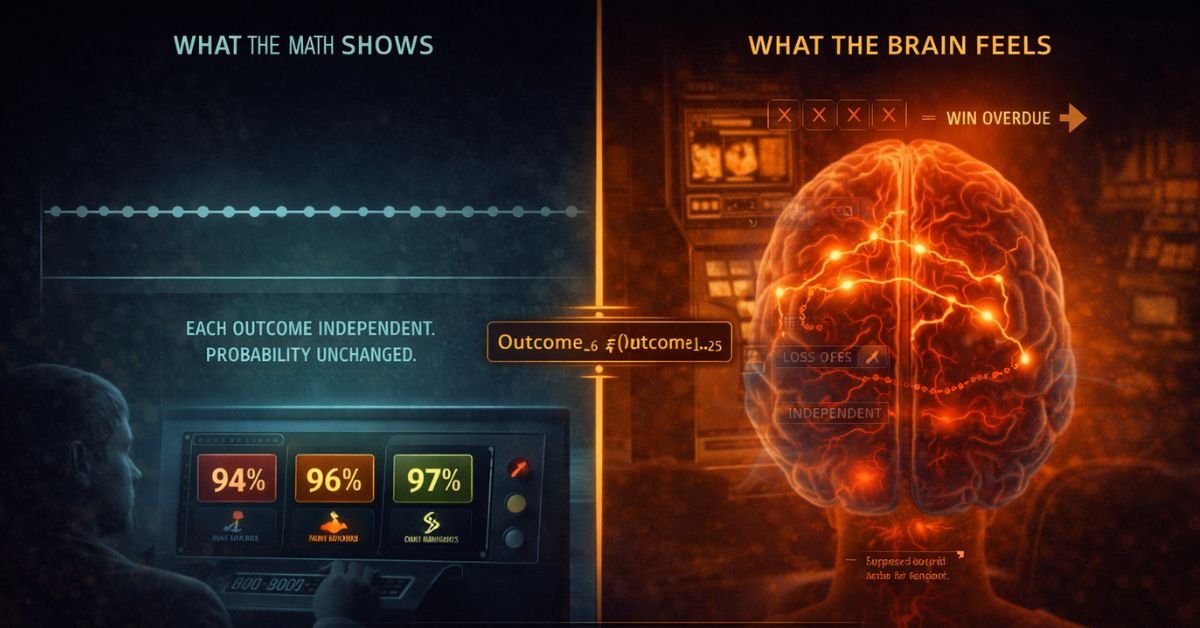
The gamblers fallacy is the belief that past random outcomes influence future independent ones — that after a run of losses, a win becomes more likely, or that a sequence of reds on a roulette wheel makes black overdue. Teaching people that this is mathematically false does not reliably stop them believing it.
Research into the psychology of gambling has consistently found that factual correction narrows the cognitive gap without closing it. People who can correctly explain why the gamblers fallacy is wrong still act on it during active play.
This article explains why mathematical education fails to dislodge the belief, what psychological mechanisms sustain it beneath conscious reasoning, and what actually works as a partial counter — drawing on academic research that most responsible gambling content either ignores or misrepresents.
What the Gamblers Fallacy Actually Is — and What It Is Not
The gamblers fallacy is a specific cognitive distortion: the erroneous belief that statistically independent outcomes become non-independent based on their sequence. In formal terms, it is the violation of the principle of statistical independence — the mathematical property that the probability of any outcome on trial N is unaffected by all previous trials.
It is named after its most visible context — gambling — but it appears in finance (expecting a stock that has fallen to “bounce back”), sports (the hot hand phenomenon in basketball), and medicine (clinicians adjusting diagnoses based on their recent patient sequence). In gambling, the distortion is particularly dangerous because the stakes are financial and the cognitive feedback loop is tight.
The fallacy is not simply ignorance of probability. Research by psychologist Kahneman and others shows it is a product of the representativeness heuristic — the mental shortcut that assumes a small sample should “look like” the overall distribution. We expect randomness to self-correct locally, when in reality the law of large numbers applies only to vast sequences, not to any run of spins visible within a session.
Gamblers Fallacy in Slots — Key Research Facts
Why Teaching the Math Does Not Fix It
The conventional responsible gambling response to the gamblers fallacy is education: explain that each spin is independent, that the RNG produces fresh probabilities on every draw, that no sequence of losses makes the next spin more likely to win. This information is true. Its effect on behaviour is limited.
The reason is dual-process theory — the distinction between fast, automatic System 1 thinking and slow, deliberate System 2 reasoning. The gamblers fallacy is a System 1 response — activating rapidly as a pattern-recognition reflex, beneath the level of conscious analysis.
When you watch five consecutive losses, your brain’s pattern detection circuitry — which evolved to identify real sequences in the physical world — registers the run and generates an automatic expectation of reversal.
System 2 can correct this — if you pause and consciously apply the independence principle, you can override the automatic expectation.
The problem is that active gambling suppresses System 2 engagement. The pace of play, visual stimulation, financial stakes, and emotional arousal of losses all redirect cognitive resources toward the System 1 response and away from deliberate reasoning.
This is why mathematical correction works better at the desk than at the machine. In a study environment, participants can think slowly, apply the independence principle, and give correct answers. In active gambling conditions, the same participants revert to System 1 heuristics.
The knowledge is there. The cognitive conditions to access it in real time are not.
The Information Gap vs The Cognitive Gap
Most responsible gambling content assumes the gamblers fallacy persists because players do not know better. This is the information gap hypothesis. The evidence supports a different model: many players who believe in sequence correction could pass a probability exam.
Their problem is not lack of information but a cognitive gap — the automatic belief-update mechanism that operates during play does not consult the information they hold. Closing the information gap without closing the cognitive gap produces people who correctly understand why the gamblers fallacy is wrong and still act on it.
5 Dangerous Reasons the Fallacy Survives Mathematical Correction
The tendency to expect small samples to resemble the overall distribution is a feature of human cognition that predates formal probability theory by tens of thousands of years. It served a real function in the physical environment where most repeated events do have underlying patterns — weather systems, animal behaviour, seasonal variation. Pattern-detecting in those contexts is adaptive.
Truly random sequences — generated by an RNG with no physical mechanism producing the sequence — are evolutionarily novel. Our brains did not evolve to encounter them. The representativeness heuristic is applied to random slot outcomes the same way it is applied to everything else, because the cognitive system that processes sequences cannot distinguish “genuinely random” from “patterned but complex.”
Mathematical knowledge can tell you that a sequence is random. It cannot disable the evolutionary pattern-detection mechanism that immediately flags the sequence as meaningful. The two systems do not compete on equal terms.
Loss produces emotional arousal — activation of the threat response system, cortisol release, narrowed attentional focus. This arousal state is specifically associated with impaired access to executive function and deliberate reasoning.
The gamblers fallacy is most powerfully activated precisely when arousal is highest — after a run of losses, when the financial stakes of the session feel significant, when the balance has declined toward a threshold. At exactly the moment the corrective knowledge would be most useful, the arousal state makes it least accessible.
This interaction between emotional state and cognitive access is well-documented in the psychology of gambling research. It means that the gamblers fallacy does not operate uniformly across a session — it intensifies as losses accumulate, and the intensification occurs in a cognitive environment where deliberate correction is increasingly difficult to initiate.
The gamblers fallacy is sustained partly by a persistent sense that winning is close. Near-misses in slots — two premium symbols on early reels with the third failing to complete — provide exactly this perceptual signal.
They are not evidence of proximity to a win. But they feel like it.
And that feeling directly feeds the fallacy.
The sequence reads as: “I am running slightly below my expected return, and the game keeps showing me how close the wins are getting.” Neither component of that narrative is supported by the math. The apparent deficit is statistical variance; the near-misses are engineered by asymmetric reel weighting, not by proximity to completion.
But the brain’s pattern-matching system receives the near-misses as confirming data. The fallacy is not just an abstract belief — it is being actively reinforced, spin by spin, by a display mechanism specifically engineered to produce the feeling of proximity. The interaction between near-miss frequency and fallacy persistence is one of the most concerning structural features of high-volatility slot design.
Variable ratio reinforcement — the unpredictable intermittent reward schedule that makes slot play compelling — also makes the gamblers fallacy particularly resistant to correction through experience. In a fixed-ratio context, enough spins without a win would unambiguously disconfirm the “overdue” belief. In a variable-ratio context, the win arrives eventually, always — just unpredictably.
This means that the gamblers fallacy-driven player who waits out a losing run will eventually receive a win. Not because the machine corrected as the fallacy predicted, but because enough independent trials will eventually produce a positive outcome. From the player’s internal experience, however, the sequence feels like confirmation: “I kept going through the losing run, and then the win came.” The variable reinforcement schedule produces exactly the experiential feedback needed to sustain the false belief.
The fallacy is thus not merely theoretically persistent — it is practically reinforced by the structure of the gambling environment, regardless of the player’s mathematical knowledge.
Loss aversion — the cognitive asymmetry in which losses feel approximately twice as significant as equivalent gains — interacts with the gamblers fallacy to produce loss chasing. The logic runs: “I have lost £30 from my budget. A correction is coming.
If I stop now, I lock in the loss before the correction arrives. If I continue, I have a chance to recover.” Both premises are cognitively false.
The £30 is gone regardless of whether a win arrives on the next spin or not. The correction is not coming — each spin is independent. But the combination of loss aversion (making the sunk loss feel urgent to reverse) and fallacy thinking (making the correction feel imminent) produces a powerful motivation to continue playing beyond the point the player planned to stop.
This interaction is particularly significant because it converts the gamblers fallacy from a passive perceptual distortion into an active driver of extended play and loss chasing. Understanding the independence of outcomes intellectually does not neutralise the felt urgency of the sunk loss — it requires a different cognitive intervention to address the loss aversion component, not just the probabilistic one.
How the Gamblers Fallacy Manifests in Slot Play Specifically
In roulette or coin flips, the gamblers fallacy operates on a single, visible, easily-countable random variable. In slots, the distortion manifests in a more complex environment that actively obscures the randomness of outcomes.
The “Warm-Up” Belief
Many slot players believe that a game needs to “warm up” — that recent losses indicate the machine is building toward a pay cycle. This is the gamblers fallacy applied to a continuous variable (the balance) rather than discrete binary outcomes. The RNG produces each outcome independently.
The game has no memory and no pay cycle. The “warm-up” narrative is a systematic misreading of statistical variance as directional momentum.
The “Hot Machine” Misidentification
Players who observe a machine paying frequently conclude it is “hot” and likely to continue paying. This is the hot hand fallacy — the inverse cognitive distortion that perceives positive streaks as predictive rather than random. The hot and cold slots guide covers the evidence in full.
Neither “hot” nor “cold” machines exist in the functional model of any certified slot. What exists is statistical variance around a fixed expected value.
Session Continuation Decisions
The most consequential slot-specific manifestation of the gamblers fallacy is the continuation decision: the choice to keep spinning after a losing run because “it must pay soon.” This is where the fallacy produces its greatest financial harm. The player has reached their planned stop point. The distortion generates a reason to override it.
The override is not justified by any property of the game — the next spin’s probability is identical to every previous one.
Stake Escalation During Losing Runs
Some players increase their stake after a run of losses — reasoning that a larger bet when the win “finally arrives” will recover the losses more efficiently. This is a compounded error: the gamblers fallacy (the win is coming) combined with loss aversion-driven chasing. It increases the expected loss rate during the escalation period while providing no increase in the probability of the corrective win the player is waiting for.
The most expensive form of fallacy thinking in slots is stake escalation during a losing run. It increases the rate at which money is lost in the interval before a win, without changing the probability of the win. If the gamblers fallacy is operating in your session, the decision to raise your stake is the one most likely to compound the financial consequences.
What Research Says Actually Helps
The research literature on effective gamblers fallacy interventions converges on a conclusion that challenges the information-first approach: facts about probability help, but they are not sufficient, and they are least effective at the moments they are most needed.
Pre-Commitment Over In-Session Reasoning
The most robustly effective intervention is pre-commitment — establishing a loss limit at account level before the session begins. This works for a reason that directly addresses the gamblers fallacy problem: pre-commitment does not require in-session reasoning to function. The limit was set by a calmer cognitive state.
It operates structurally, not through the same deliberate-reasoning channel that loses access to corrective knowledge during arousal states.
When the session hits the pre-committed limit, the distortion’s ability to extend play is blocked regardless of whether the player is actively experiencing fallacy thinking. This is the intervention design that matches the psychology of the problem — the gambling session consistently produces the cognitive conditions under which deliberate correction fails, so the intervention must not depend on deliberate correction to function.
Factual Correction — Specifically Framed
Research by Bărboianu identifies a form of mathematical education that is more effective than generic probability instruction: framing the independence of outcomes in terms of the specific mechanism that produces them. Rather than stating “each spin is independent,” the more effective correction is: “The RNG produces a new seed every millisecond. The outcome of this spin was determined at the moment the button was pressed, from a fresh set of probabilities with no memory of any previous outcome.”
This mechanism-based correction gives the player something specific and concrete to hold against the fallacy — not an abstract principle, but an understanding of the actual process. It is more durable under arousal because it provides a physical narrative (“the RNG restarted”) rather than a statistical principle (“outcomes are independent”) that requires active probabilistic reasoning to apply.
Slow Play and Deliberate Pausing
Forced delays between spins — or voluntary deliberate pausing — give System 2 reasoning the time it needs to engage. Research on impulsive decision-making consistently shows that delay attenuates the automatic response and increases the likelihood of deliberate correction activating. A player who waits 10 seconds before spinning after a losing streak is materially more likely to access their corrective knowledge than one who continues at the game’s default pace.
This does not eliminate the gamblers fallacy. It creates a cognitive window in which the corrective knowledge the player holds can become accessible. The responsible gambling planner includes session-pace settings precisely for this reason.
For the connection between RTP and session outcome expectations, the RTP guide covers what the numbers actually mean in practice.
Practical Strategies for Managing the Gamblers Fallacy During Play
What Not to Do (Even If It Feels Right)
Do not continue a session past your planned stop point because “the machine must pay soon.” Do not raise your stake after a losing run to “recover more efficiently when the win comes.” Do not interpret near-misses as evidence that a win is building. Do not use the session’s running total as a decision-making input — each spin is independent of your balance position.
What Research-Supported Practice Looks Like
Set a loss limit before opening any game, at account level. Pause deliberately after any losing run before deciding to continue. Name the fallacy explicitly when you feel the pull to keep going — “this is the gamblers fallacy; the next spin’s probability is unchanged.” Use the session risk analyser to model what a realistic session distribution looks like, so your expectations are calibrated to the actual probability architecture rather than to pattern-based intuition.
The Naming Practice
One of the most practically useful interventions available to individual players is explicit labelling: when you notice the impulse to continue after a losing run because of an intuition that a correction is coming, name it aloud or in writing. “This is the gamblers fallacy. The next spin has the same probability as the first spin of this session.”
This practice activates System 2 reasoning deliberately, by creating a named object to reason about rather than an unnamed impulse to react to. It does not guarantee the distortion disappears. It creates a gap between the automatic impulse and the action — a gap in which the corrective reasoning has a chance to operate.
Combined with a pre-set limit that operates regardless of in-session reasoning, the naming practice gives players two layers of protection: structural (the limit) and cognitive (the labelling). Neither is fully reliable alone. Together they address the gamblers fallacy through two independent channels.
The single most useful thing you can do about the gamblers fallacy before a session: Set your loss limit at account level now, before any emotional or financial context makes it feel negotiable. The pre-commitment works precisely because it was made by a version of you that had not yet been affected by the cognitive conditions that make the fallacy hard to override. That version of you made the right decision.
Trust it over the version of you that is currently in a losing run and feeling like the correction is due.
Further Reading
The gamblers fallacy is the entry point to the full cognitive distortions landscape in slot play. For the complete framework, the Player Psychology in Slot Games hub covers all major distortions and how they interact. For the specific near-miss mechanism that reinforces the fallacy by providing perceptual proximity signals, the Near-Miss Effect article covers the full research.
For variable ratio reinforcement — the reward schedule that makes the fallacy experientially self-confirming — the Variable Ratio Reinforcement article covers the mechanism.
For the companion distortions that interact with fallacy thinking: Illusion of Control covers the belief that player actions influence RNG outcomes; Losses Disguised as Wins covers the multi-line mechanism that produces a rhythm of apparent wins during a losing session. For the RNG mechanism that makes all outcomes genuinely independent — the mathematical basis of the correction — How the RNG Works covers the certified independence in full. For the mathematical education approach covered in the Bărboianu research, the slot math education article covers what the research shows about what probability instruction achieves and what it fails to achieve. ⚠ /slot-math-education-responsible-gambling/ — verify live before using as link.
For the randomness concept that underpins outcome independence, the randomness in slots article covers the full treatment. ⚠ /what-randomness-means-in-slots/ — verify live before using as link.
For pre-commitment tools — the most robustly effective intervention available — the Responsible Gambling Planner implements the structural approach. The Session Risk Analyser provides the calibrated session expectation that replaces fallacy-based intuition with probability-grounded modelling.
Replace Fallacy Intuition With Probability-Grounded Expectations
The gamblers fallacy thrives when your expectation of session outcomes is vague. The Session Risk Analyser shows you what a realistic outcome distribution actually looks like at your stake and session length — calibrating your expectations before any losing run can distort them.
Model My Session →Gamblers Fallacy — FAQ
What is the gamblers fallacy?
The gamblers fallacy is the erroneous belief that statistically independent outcomes influence each other based on their sequence. In slots, it manifests as the belief that a run of losses makes a win more likely on the next spin. Mathematically, each spin is independent — the probability is identical regardless of what has happened before.
The fallacy violates the principle of statistical independence and is produced by the representativeness heuristic: the cognitive tendency to expect small samples to mirror the overall distribution.
Why doesn’t knowing the math fix the gamblers fallacy?
Because the distortion operates through System 1 — fast, automatic cognitive processing — rather than the deliberate System 2 reasoning that holds the mathematical knowledge. Active gambling suppresses System 2 engagement through emotional arousal, pace of play, and financial stress. At the moments when corrective knowledge would be most useful, the cognitive conditions that allow its application are least available.
The information gap hypothesis — that people act on the fallacy because they do not know better — is contradicted by research showing persistent fallacy behaviour in players who can correctly explain why it is wrong.
How does the gamblers fallacy affect slot play specifically?
In slots it manifests as the warm-up belief (that a losing run indicates the machine is building toward a payout), session continuation past planned stop points, stake escalation during losing runs, and interpreting near-misses as evidence of proximity to a win. Each of these is a practical expression of the independence violation at the core of the distortion. Slots are a particularly conducive environment for fallacy thinking because near-miss engineering, variable ratio reinforcement, and rapid pace of play all amplify the conditions under which the distortion activates.
Is the gamblers fallacy the same as the Monte Carlo fallacy?
Yes — the Monte Carlo fallacy is another name for the same cognitive distortion. It refers to a famous incident at the Monte Carlo casino in 1913, where a roulette ball landed on black 26 consecutive times. Players lost millions betting on red, believing the streak made red “overdue.” The incident illustrates precisely the fallacy’s structure: the 26 black outcomes were genuinely independent events; the probability of red on the 27th spin was 48.6% regardless of the preceding sequence.
Gamblers fallacy and Monte Carlo fallacy are interchangeable terms for the same bias.
What is the difference between the gamblers fallacy and the hot hand fallacy?
They are inverse versions of the same basic error. The gamblers fallacy expects reversal after a sequence (a losing run makes a win overdue). The hot hand fallacy expects continuation of a sequence (a winning run means more wins are coming).
Both violate statistical independence — both predict that past outcomes influence future independent ones. In slot gambling, the gamblers fallacy dominates during losing runs and the hot hand fallacy can appear during winning runs. Both produce irrational decisions relative to a correct understanding of outcome independence.
Does the gamblers fallacy increase the risk of problem gambling?
Research identifies it as a significant contributing factor, particularly through its interaction with loss aversion. The combination — losses feel urgent to reverse and a correction feels imminent — produces exactly the motivation for loss chasing that is a defining feature of gambling disorder. Players who experience strong fallacy thinking are more likely to continue sessions past their planned limits, escalate stakes during losing runs, and experience difficulty stopping despite losses.
This does not mean the fallacy causes problem gambling alone, but it is a documented risk amplifier in the research literature.
What is the most effective way to counter the gamblers fallacy in practice?
Research points to pre-commitment — loss limits set at account level before play begins — as the most robustly effective structural intervention. It works because it does not require in-session reasoning to function, bypassing the cognitive conditions that make corrective knowledge inaccessible during active play. For in-session use, the naming practice — explicitly labelling the fallacy impulse when you feel it — activates System 2 reasoning deliberately, creating a gap between the automatic impulse and the decision.
Mechanism-based correction (“the RNG restarted; this spin has no memory of previous spins”) is more durable under arousal than abstract probability principles.