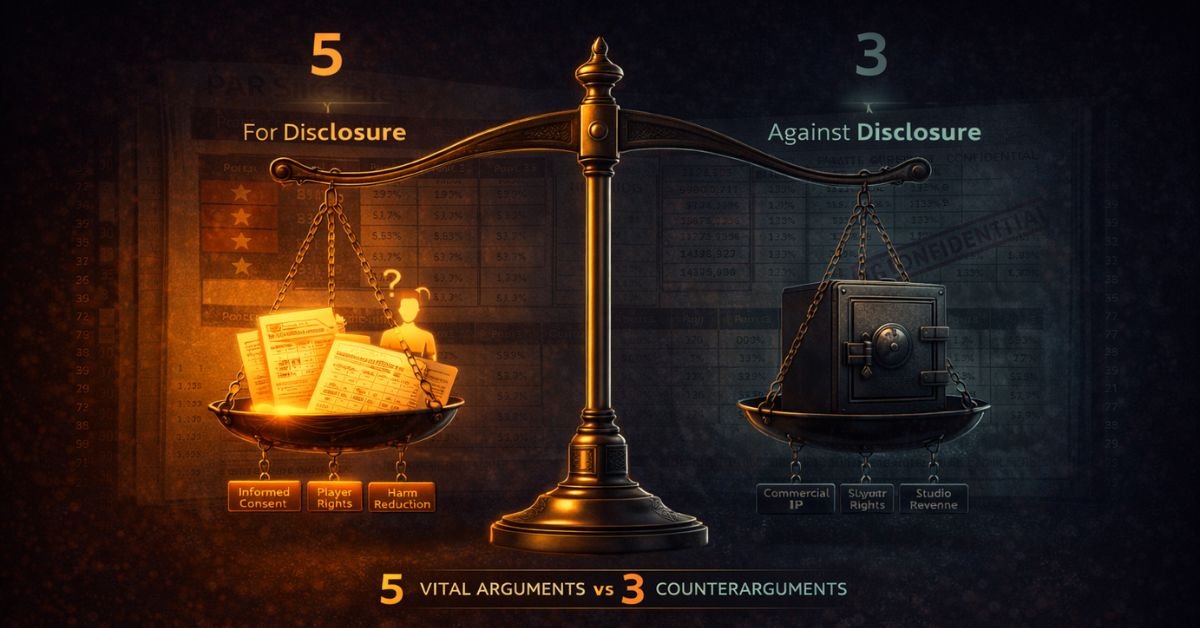
The question of whether slot producers publish PAR sheets — whether mathematical disclosure should be mandated rather than suppressed — is the central ethical debate in responsible gambling research. The PAR sheet is the document that specifies everything: the reel strip configuration, the symbol probabilities, the win combination frequencies, the hit rate, the RTP split. It is what operators, regulators, and testing laboratories see. It is what players never see. Whether that arrangement is justifiable, and whether it should change, is not a settled question — it is an active debate with serious arguments on both sides. This article presents five vital arguments for mandatory PAR sheet disclosure, three substantive arguments against, and assesses where the balance of the case actually sits.
What Is Actually at Stake in This Debate
Before evaluating the arguments, it is worth being precise about what PAR sheet disclosure would and would not involve. The PAR sheet — Probability Accounting Report — is a technical document containing: the virtual reel strip configuration for each reel, the number of stop positions per symbol per reel, the complete win combination probability table, the certified RTP and its base game vs bonus split, the hit rate, and the structural specifications governing feature triggers. It is the mathematical specification from which every statistical property of the game — RTP, volatility, hit rate, near-miss frequency — is derived.
Mandatory disclosure would mean making this document, or the consumer-relevant portions of it, available to players before they spin. It would not mean making the game’s source code available. It would not prevent studios from building games. It would not prevent operators from offering them. It would require that the mathematical parameters determining player outcomes be as accessible to players as they are to the regulatory bodies that certify the game is fair.
Slot Producers Publish PAR Sheets — Disclosure Debate Context
5 Vital Arguments For Mandatory PAR Sheet Disclosure
Informed consent — the principle that a person should understand what they are agreeing to before they agree to it — is a foundational standard in consumer protection law across virtually every jurisdiction. When you buy a financial product, its risks must be disclosed. When you take medication, the probability of side effects must be communicated. When you play a slot, the parameters that determine your probability of winning and your expected cost are hidden in a proprietary document you cannot access.
Without the PAR sheet, a player cannot calculate the true probability of any winning combination. They cannot determine whether the RTP configured at their casino is the highest or lowest available variant of the game. They cannot know the hit rate — how often any return will occur — which is the primary driver of what their session will feel like. They cannot know whether the near-misses they experience are occurring at 2× or 8× the rate a symmetrically weighted game would produce. The slot information asymmetry is not a minor inconvenience; it is a structural barrier to the type of informed decision-making that consumer protection frameworks in every other industry require as standard. ⚠ Verify this link is live before publishing.
Roulette has visible numbered pockets. Blackjack’s probability distribution is derivable from the deck composition and dealing rules, which are publicly specified. Baccarat’s house edge can be calculated from the published rules. Lottery prize structures and odds are published by law in most jurisdictions. Every other major casino game allows a player who understands the rules to calculate the exact probability of every available outcome. Slots are the singular exception — the only category of casino game where the parameters determining your probability of winning are withheld. The RNG certification framework verifies operational fairness — but it does not require the certified specification to be public.
This is not a coincidence of how slots work. Slots could publish their reel strip configurations — the Canadian precedent demonstrates this. The secrecy is a choice, not a necessity. And it is a choice that slots make alone, among all casino products. The question is not “should casino games always be transparent?” The answer to that is already settled — they should be, and they are, for every other game. The question is only “why should slots be the exception?” and the burden of justification falls on those arguing for the exception.
The primary commercial argument for PAR sheet secrecy is that the reel strip configuration constitutes intellectual property — the specific mathematical design that distinguishes one studio’s game from another’s. This argument has some validity in principle: the art of building a slot’s probability architecture to achieve specific experience characteristics is genuine commercial skill that deserves some protection.
But Bărboianu’s research identifies a critical distinction: the general mathematical formulas for calculating probability from reel strip data are publicly available in any probability textbook. What is proprietary is only the specific application of those formulas — the particular stop assignments that produce a game’s certified RTP and volatility profile. And that specific application is precisely what constitutes consumer-relevant probability information. You cannot separate “the IP” from “the probability data” because they are the same thing. When a studio argues that the reel strip configuration is proprietary, they are simultaneously arguing that probability information players need to make informed decisions is trade secret. Those two claims cannot both be valid in a framework that takes consumer protection seriously.
The responsible gambling framework across all regulated markets invests significant resources in player education, harm-awareness messaging, and intervention tools. Research consistently finds that these interventions have limited effectiveness — partly because the cognitive distortions driving harmful play operate at a level that harm-communication cannot reach, and partly because players lack the mathematical information that would allow them to evaluate their session accurately.
PAR sheet disclosure would directly address the second problem. A player who can access the game’s hit rate, the base game vs bonus RTP split, and the near-miss frequency for any game they are considering has the mathematical inputs to make a genuinely informed decision about whether that game’s profile matches their bankroll and psychological tolerance. The responsible gambling system spends enormous resources trying to persuade players to play more carefully. Mandatory disclosure would give players the information they need to do so. The two approaches are not alternatives — disclosure is the structural enabler that makes individual responsible gambling tools effective rather than hypothetical.
The most serious specific harm enabled by PAR sheet secrecy is the invisibility of near-miss engineering. As documented in the academic research on slot design, near-miss frequency above chance expectation is a direct consequence of asymmetric reel weighting — placing more premium symbol stops on early reels than late reels. Research consistently identifies the near-miss effect as among the most powerful drivers of continued play, operating even when players intellectually understand that randomness is independent.
Without PAR sheet disclosure, near-miss engineering is entirely invisible. Players cannot determine whether a game is producing near-misses at 1× or 5× the rate a symmetrically weighted game would generate. Regulators can verify that the RNG is fair — but cannot easily audit whether near-miss frequency is within ethically acceptable bounds without explicit standards, which require the PAR sheet data to evaluate. In several Canadian provincial markets, regulators have used PAR sheet access to restrict above-chance near-miss weighting. Without disclosure, this type of informed regulation is impossible. Near-miss engineering can continue at any intensity, with no accountability to players, regulators, or researchers who study its behavioural effects.
3 Arguments Against — and Why They Fall Short
The arguments for PAR sheet secrecy are not frivolous. They reflect real commercial interests and legitimate operational concerns. Presenting them fairly — and showing where they fail — is more intellectually honest than treating the pro-disclosure case as self-evidently correct.
The strongest commercial argument: a slot studio invests substantial research and development in designing a probability architecture that achieves specific experience characteristics — a volatility profile, a hit rate, a session texture that players find engaging. That design represents the studio’s competitive advantage. Mandatory disclosure would allow competitors to replicate the probability architecture without the development cost, undermining the investment case for original mathematical design.
This argument has some force. Mathematical design genuinely is the core product of a slot studio’s intellectual effort. Some degree of protection is warranted. However, the argument fails to address the consumer information problem it creates: you cannot protect consumer-relevant probability data as IP without simultaneously depriving the people whose money is at stake of information they need for informed decisions. IP protection in other industries is bounded by consumer rights — pharmaceutical companies cannot withhold dosing information on IP grounds. The same principle should apply here. A modified form of the IP argument — protecting the specific combination of parameters as a bundle while requiring disclosure of individual probability metrics — might resolve the tension, but the blanket secrecy that currently exists goes well beyond what IP protection legitimately requires.
A pragmatic counter-argument: even where probability information is made available — as with published RTP figures — research consistently shows that players misinterpret it, ignore it, or use it in ways that do not improve their decision-making. If the currently disclosed RTP figure is routinely misunderstood, expanding disclosure to a full PAR sheet would simply produce more misunderstood data. The argument runs: if disclosure does not produce better decisions, it achieves nothing except compliance cost for studios.
This argument is empirically supported in a narrow sense — consumer uptake of detailed financial and probability disclosures is routinely lower than proponents hope. But it fails as a general principle. The purpose of disclosure is not only individual use by every consumer; it is the systemic improvement of information quality in the market. Nutritional labelling changed what food manufacturers produce even if most consumers never read labels carefully, because journalists, advocacy groups, and informed consumers used the data to create accountability. The same dynamic would apply to PAR sheet disclosure: individual player use may be limited, but researcher access, consumer advocacy, and informed journalism would create accountability that currently cannot exist.
A more specific commercial concern: if the full PAR sheet were available, mathematically sophisticated players could identify games with positive expected value under specific bonus configurations — akin to card counting in blackjack. Studios and operators could face systematic exploitation by a small number of highly informed players who use the disclosed configuration data to extract value in ways that undermine the commercial model.
This concern has genuine force for a very small category of games under specific bonus offer conditions — the bonus-buy slot category, for example, where the combination of a known bonus RTP split and a specific promotional offer could create above-EV situations. However, for the vast majority of standard slot play at standard casino conditions, the negative expected value of every licensed slot means no amount of configuration data creates a mathematically exploitable positive-EV situation. The concern is real but narrow — and the regulatory response should be proportionate: disclose the consumer-relevant information that enables informed decisions while potentially providing limited protection for specific high-vulnerability bonus configurations.
Real-World Precedents: Where Disclosure Has Already Happened
The argument that slot producers publishing PAR sheets is impractical or unprecedented is undermined by the fact that it has already happened — in a form that demonstrates both the feasibility and the limits of voluntary disclosure.
Several Canadian provincial lottery corporations — including the British Columbia Lottery Corporation (BCLC) and the Ontario Lottery and Gaming Corporation (OLG) — have historically published PAR sheets for their land-based video lottery terminals. These documents contain the full reel strip configurations, win combination probability tables, and certified RTP data for every game in their portfolio. Academic researchers, including Harrigan and Dixon at the University of Waterloo, have used these documents extensively to study the relationship between PAR sheet design and player behaviour — producing the research on near-miss engineering and losses disguised as wins that now underpins much of the responsible gambling field.
The experience of the Canadian provincial disclosure is instructive in three ways. First, disclosure was feasible — the studios continued producing games and the operators continued operating them. Second, disclosure was research-generative — the availability of PAR data enabled a body of academic work that produced actionable insights for responsible gambling policy. Third, disclosure had limits — it applied to land-based VLTs in specific provincial jurisdictions and did not extend to online slots from international studios operating under different regulatory frameworks.
The Canadian Disclosure Model as a Template
The BCLC and OLG experience demonstrates that slot producers publishing PAR sheets for certified games is operationally feasible without commercial catastrophe. The studios producing games for these markets continued to do so. The IP concerns that dominate the industry’s resistance to disclosure did not materialise as the competitive harm predicted. What did materialise was an expanded evidence base for responsible gambling research that has directly informed harm-reduction policy in ways that are not possible without PAR sheet access. The Canadian model is not perfect — it is limited in scope and does not cover the online international market — but it is the clearest empirical evidence available that the “it cannot be done” argument is simply wrong.
The Middle Ground: What Partial Disclosure Would Achieve
Full PAR sheet disclosure — publishing the complete reel strip configuration for every game — may face legitimate IP concerns that a proportionate regulatory response should address. But full disclosure is not the only option. A middle-ground approach would require disclosure of the consumer-relevant statistical properties of the game without necessarily requiring publication of the full reel strip in its raw form.
What Partial Disclosure Could Require
Hit rate (proportion of spins returning any amount). Win rate (proportion of spins returning above stake). Base game vs bonus RTP split. Average bonus trigger frequency. Near-miss frequency relative to chance baseline. Maximum win probability (not just the multiplier — the actual probability of achieving it). Active RTP variant disclosed at operator level. These are all derivable from the PAR sheet without requiring the full reel strip to be published.
What It Would Not Require
The full sequential stop-by-stop reel strip list. The exact symbol positioning arrangement that constitutes the studio’s mathematical design IP. The internal feature logic specifications. The proprietary elements of the bonus mechanic that distinguish the studio’s game from a competitor’s. Partial disclosure can be designed to address the consumer information gap without fully exposing the mathematical design that constitutes the studio’s commercial asset.
This middle-ground approach — which Bărboianu’s research supports as a minimum necessary standard — would address four of the five critical information gaps identified in the slot information asymmetry analysis. Hit rate, win rate, RTP split, and near-miss frequency could all be disclosed from this framework. The only gap that would remain partially open is the full reel strip configuration detail — which is the genuine IP element. The consumer protection case for this level of disclosure is essentially unanswerable within any regulatory framework that takes informed consent seriously.
The Verdict: Where the Balance of the Case Sits
The Verdict
The case for requiring slot producers to publish PAR sheets — or at minimum the consumer-relevant statistical properties derivable from them — is substantially stronger than the case against. The five arguments for disclosure address foundational principles of informed consent, consumer protection, and responsible gambling effectiveness. The three arguments against are commercially legitimate but fail to justify the degree of information asymmetry that current secrecy conventions produce.
The most defensible position is not blanket full disclosure versus blanket secrecy. It is a proportionate mandatory disclosure requirement that covers hit rate, win rate, RTP split, near-miss frequency relative to chance, active RTP variant at operator level, and maximum win probability — while potentially allowing studios to protect the specific sequential reel strip configuration as commercial IP. This middle-ground standard would close the consumer information gap without requiring studios to hand competitors their mathematical blueprints.
The Canadian precedent demonstrates this is feasible. The research on near-miss engineering, losses disguised as wins, and RTP split demonstrates why it matters. The responsible gambling evidence base demonstrates that the current information structure actively impairs the effectiveness of harm-reduction interventions. The question is no longer whether slot producers publishing PAR sheets is possible. It is whether the regulatory will exists to require it.
Until disclosure is mandatory: Players are operating with structurally incomplete information about every game they play. The four published numbers — RTP, volatility, max win, and hit rate where available — are the best available approximation of the hidden PAR sheet data. Using them precisely, and modelling what they imply about the hidden configuration, is the most informed approach available under the current disclosure regime.
Further Reading
The foundational research for this article is Bărboianu’s 2014 paper, “Is the secrecy of the parametric configuration of slot machines rationally justified?” in the Journal of Gambling Issues — the first peer-reviewed systematic ethical analysis of PAR sheet secrecy, and the source of the argument that the commercial justification for concealment does not adequately account for the consumer protection consequences. For what the PAR sheet actually contains and why its structure matters, the PAR Sheet Explained article covers the full document in detail. For the consumer information gap that mandatory disclosure would close, the slot information asymmetry article identifies all five critical missing data categories with their practical consequences for player decision-making. ⚠ /slot-information-asymmetry/ — session-published, verify live before using as link.
For the specific harms enabled by PAR sheet secrecy — near-miss engineering and losses disguised as wins — the Near-Miss Effect and Losses Disguised as Wins articles cover the mechanisms and their behavioural consequences. For the broader responsible gambling context in which disclosure would operate — and why it matters for intervention effectiveness — the responsible gambling warnings article covers the research on what makes RG interventions succeed or fail. For the regulatory framework that would need to change to require disclosure, the iGaming Licences Explained article covers how the current certification system works and where its accountability gaps lie. For the game creation process within which PAR sheet design decisions are made, How Slot Machines Are Made covers the full production sequence. For the tools that give players the best available approximation of PAR sheet information under the current disclosure regime, the Volatility and RTP Calculator and Session Risk Analyser translate published outputs into concrete session models.
Work With What’s Available Until Disclosure Catches Up
PAR sheets are hidden. But the published RTP and volatility are real. The Volatility and RTP Calculator converts those two numbers into a concrete session model — outcome distribution, expected cost, and realistic range — so you can make the most informed decision possible with what is actually disclosed.
Run the RTP Calculator →Slot Producers Publish PAR Sheets — FAQ
Should slot producers be required to publish PAR sheets?
The balance of evidence supports mandatory disclosure of at minimum the consumer-relevant properties derivable from the PAR sheet: hit rate, win rate, base game vs bonus RTP split, near-miss frequency relative to chance, and the active RTP variant configured at the operator level. Full sequential reel strip publication raises legitimate IP concerns, but a middle-ground standard could address the consumer information gap without requiring studios to fully expose their mathematical design. The Canadian provincial lottery corporations have demonstrated this is feasible — PAR sheet disclosure did not collapse the market or destroy studio commercial viability there.
What is the main argument against slot producers publishing PAR sheets?
The primary commercial argument is that reel strip configurations constitute proprietary intellectual property — the mathematical design that gives a studio’s game its distinctive probability character. Mandatory disclosure would allow competitors to replicate that design without incurring the development cost. This argument has genuine force as applied to the full sequential reel strip specification. However, it fails to justify withholding all consumer-relevant probability data, since the specific hit rate, RTP split, and near-miss frequency can be disclosed without fully exposing the IP that the argument is intended to protect.
Has any jurisdiction actually required slot PAR sheet disclosure?
Yes. Several Canadian provincial lottery corporations — including the British Columbia Lottery Corporation and the Ontario Lottery and Gaming Corporation — have published PAR sheets for their land-based video lottery terminal games. This disclosure enabled a substantial body of academic research on near-miss engineering, losses disguised as wins, and the relationship between PAR sheet design and player behaviour. The experience demonstrates that PAR sheet disclosure is operationally feasible and research-generative without producing the commercial catastrophe that IP-protection arguments predict.
Why does PAR sheet secrecy matter for responsible gambling?
Because the cognitive distortions that drive harmful gambling patterns — the gambler’s fallacy, the near-miss effect, losses disguised as wins, hot and cold streak beliefs — operate more powerfully in conditions of incomplete information. Without the PAR sheet, players cannot correctly interpret the near-miss frequency they experience, cannot distinguish statistical variance from a structurally different game configuration, and cannot evaluate whether the RTP configured at their casino is the highest or lowest available variant. PAR sheet disclosure would give players the mathematical inputs they need to apply the factual corrections to these distortions — corrections that responsible gambling messaging currently tries to communicate in the abstract without the specific game data that would make them concrete.
Would players actually use PAR sheet data if it were available?
Some would use it directly; most would benefit from it indirectly. The experience with other industry disclosures — pharmaceutical, financial, nutritional — is that individual consumer uptake of detailed technical data is limited but that systemic outcomes improve because researchers, consumer advocates, and informed journalists use the data to create accountability. PAR sheet disclosure for online slots would likely follow the same pattern: a minority of players would read the hit rate and RTP split data directly, while the broader availability would enable academic research, consumer advocacy, and regulatory assessment that currently cannot happen without access to studio-proprietary documents.
What is the near-miss engineering connection to PAR sheet secrecy?
Near-miss frequency above chance expectation is a direct consequence of asymmetric reel weighting — more premium symbol stops on early reels than late reels — which is specified in the PAR sheet. Without disclosure, near-miss engineering is entirely invisible: players cannot determine whether their game produces near-misses at 1× or 5× chance probability, and regulators cannot set evidence-based standards for maximum permissible near-miss frequency without the PAR sheet data to audit against. The Canadian jurisdictions that have restricted above-chance near-miss weighting were only able to do so because they had PAR sheet access. The rest of the world does not, and near-miss engineering at any intensity remains unaccountable.
What can players do now given that PAR sheets are not publicly available?
Use the four publicly available numbers — RTP, volatility label, max win, and hit rate where published — to infer the broad category of the game’s probability architecture. Check whether your casino discloses the active RTP variant. Use the volatility and RTP calculator to model your session distribution from the available data. Treat high-volatility, high-max-win games as bonus-dependent by default and price the risk of a no-bonus session into your bankroll allocation. None of this closes the information gap, but it converts the most misleading form of the asymmetry — reading the headline RTP as a complete game description — into a more honest working approximation.