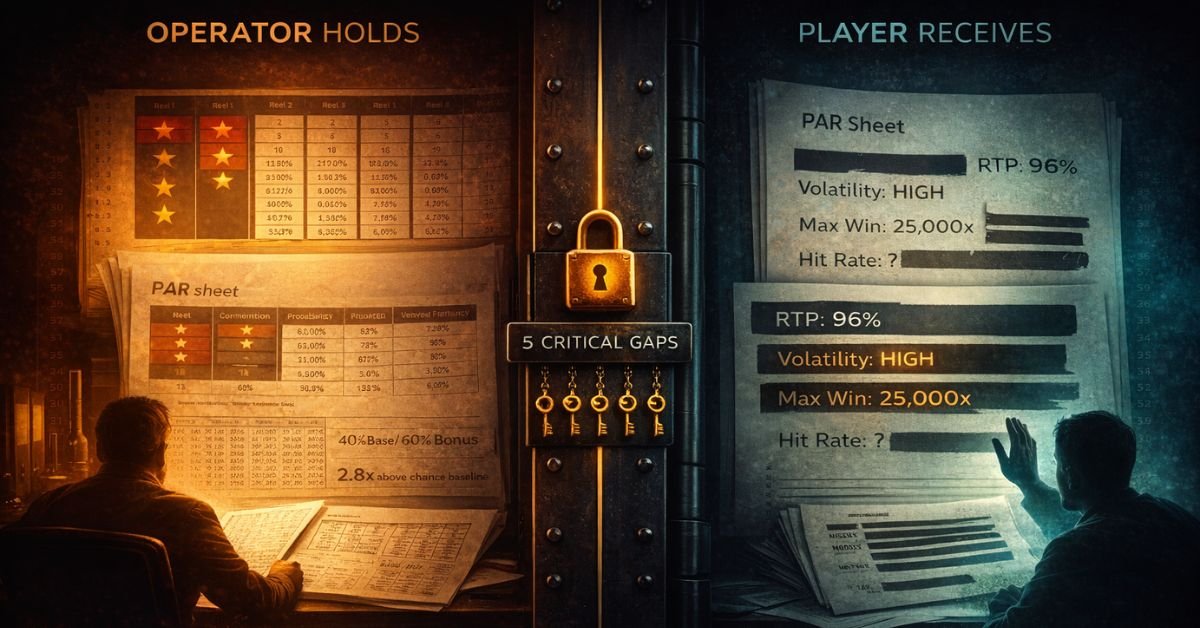
Slot information asymmetry is the structured gap between what the operator knows about the game you are playing and what you are allowed to know. It is not incidental. It is the product of deliberate regulatory choices, commercial incentives, and an industry-wide convention of treating the mathematical architecture of gambling products as proprietary trade secrets rather than consumer information. Before you spin, five critical categories of information directly govern your probability of winning, the true cost of your session, and the structural features that will shape how you respond during play. None of them are disclosed in any standard format you can see before you start. This article names all five, explains exactly what each one contains, and tells you what players can and cannot infer without it.
What Slot Information Asymmetry Actually Means
Information asymmetry is an economic concept describing a transaction where one party holds materially relevant information that the other does not have access to. Used car markets are the canonical example: the seller knows whether the car has hidden mechanical problems; the buyer cannot reliably determine this before purchase. The asymmetry disadvantages the buyer — they may pay more than the car is worth, or accept risk they would not accept if they had full information.
The slot information asymmetry is a structurally similar problem applied to gambling. The operator — and the studio that produced the game — holds the complete mathematical specification of every outcome the game can produce, the probability of each outcome, the distribution of returns across the full range of possible events, and the structural features of the game design that are known to influence player behaviour. The player holds an aggregate statistic (RTP), a coarse category label (volatility), and whatever visual information the display provides. The two parties are not playing the same information game.
This matters beyond fairness as a concept. The slot information asymmetry has direct consequences for whether players can make genuinely informed decisions about which games to play, how much to stake, and how long to play. A player cannot calculate the true expected cost of their session. A player cannot compare two games by their actual probability architectures. A player cannot understand why the game is producing near-misses at the frequency it is, or whether the RTP variant configured at their specific casino is the highest or lowest available build of that game.
Slot Information Asymmetry — The Scale of the Problem
The 5 Critical Information Gaps Every Slot Player Faces
The slot information asymmetry is not a single missing number. It is five distinct categories of information, each directly relevant to player decision-making, none of which are accessible in any standard pre-game format. Here is each one precisely defined, with what it would tell you if you had it and what the absence means for your actual session.
The reel strip is the data structure that assigns each symbol to a specific number of stop positions on each virtual reel. It directly encodes the probability of every symbol landing on every spin of every reel. This is the single most information-rich document about any slot game — the PAR sheet is built around it. Every probability calculation in the game flows from it. Two slots with the same visual symbol set can have radically different reel strip configurations and therefore completely different probability architectures.
What it would tell you: The exact probability of every symbol landing on each reel. How asymmetric the weighting is across the five reels (the source of engineered near-misses). How densely blanks are distributed — the primary driver of zero-return sequences. Whether the premium symbol appears once in 64 stops or once in 512 stops. Everything that actually determines what your session will produce.
What its absence means: You cannot calculate the true probability of any win combination. You cannot know why the game feels the way it does. You cannot compare the actual probability architectures of two games at the same RTP.
Hit rate — the proportion of spins returning any positive amount — is one of the most practically useful pieces of information for a player planning a session. It determines how long zero-return sequences will typically last, how fast your bankroll will move, and how many times per 100 spins the game will produce any feedback at all. Only some studios (notably NoLimit City) publish hit rate as standard. Most do not. No regulator currently requires it.
What it would tell you: That a 16% hit rate means you should expect an average of 6 blank spins between any return. That a 34% hit rate means an average of 3. Combined with the base game vs bonus RTP split, it tells you whether your session experience depends on bonus triggers or is sustained by base game activity. The win rate — how often returns exceed your total stake — is even more informative and is almost never published for any game.
What its absence means: Players systematically confuse a high hit rate with “winning frequently.” They cannot distinguish between a 34% hit rate game and a 16% hit rate game without either prior knowledge or extended play. The feeling that a game “pays well” or “plays tight” is a real experience of an undisclosed statistic. See the hit rate guide for the full treatment.
Most online slots are produced with multiple certified RTP variants — typically 94%, 96%, and 97% builds of the same game, each a separately certified mathematical model with its own reel strip configuration. Operators license whichever variant they choose to run. The RTP figure displayed in the game — often sourced from the studio’s promotional materials — may be the highest available variant, not the variant your casino has configured. Operators are not required to disclose which variant is active in most jurisdictions.
What it would tell you: Whether you are playing a 94% or 97% RTP version of the same title. At £2 per spin over 200 spins, the expected cost difference between these variants is £24 versus £12 — a doubling of your expected session cost. This is a material fact for any informed game selection decision.
What its absence means: Players who rely on the published RTP as an accurate representation of the game configured at their casino may be systematically overestimating their expected return. The information asymmetry here is not about missing data — it is about data that actively misleads through the presentation of a headline figure that may not apply to the specific product being purchased.
High-volatility slots typically allocate a substantial portion of their certified RTP to bonus features rather than base game outcomes. A game might deliver 40% of its 96% RTP through base game wins and 60% through bonus rounds. This split has profound consequences for what a typical session without a bonus trigger actually returns. Yet it is disclosed by only a minority of studios and is not required by most regulators.
What it would tell you: That in a 200-spin session on a game with a 40/60 base/bonus split, triggering zero bonuses (which happens in roughly 33% of sessions when bonus frequency is 1 in 200 spins) means you experienced an effective base game RTP of approximately 38% — not the advertised 96%. The certified figure is an average that assumes regular bonus participation. Without the split data, you cannot price this risk into your session planning.
What its absence means: Players who compare high-volatility bonus-heavy games to lower-volatility base-game-dominant games using only the RTP figure are comparing incompatible products as if they were equivalent. The effective return for a player on a given session is far more dependent on the RTP split and bonus frequency than on the aggregate figure alone.
Near-miss frequency — how often two or more premium symbols land without completing a winning combination — is a direct function of the reel strip’s asymmetric weighting: more premium stops on early reels than late reels. It is a designed property of the game’s PAR sheet, not an emergent consequence of random play. Research consistently identifies near-misses as the most powerful driver of continued play in slot gambling. Yet the engineered frequency of this structural feature is never disclosed to players in any format.
What it would tell you: How much of your experienced “almost winning” is engineered rather than random. Whether the game you are playing generates near-misses at 2× or 5× the rate a symmetrically weighted game would produce. This is directly relevant to managing the psychological responses that near-misses trigger — responses that operate even when you intellectually understand the game is random.
What its absence means: Players have no basis for comparing near-miss exposure between games. They cannot know whether the urgency they feel after a near-miss is responding to an event that occurs at 2% or 10% probability per spin. The emotional salience of near-misses — the feeling that a win is imminent — is calibrated by the design of the reel strips, and that calibration is entirely invisible to the player.
How Slots Compare to Every Other Casino Game
The slot information asymmetry is not a feature of casino gambling in general. It is specific to slots. Every other major casino game exposes its full probability configuration to any player who understands the rules. This comparison is not made enough in mainstream gambling content — it is one of the clearest demonstrations of why slots occupy a uniquely opaque position in the gambling landscape.
✓ Full Information — Other Casino Games
- Roulette: 37 (European) or 38 (American) numbered pockets. All probabilities calculable by inspection. House edge is a published mathematical consequence of the zero pocket — 2.7% or 5.26%. No hidden parameters.
- Blackjack: Full deck composition known. Basic strategy charts calculable from first principles. House edge determinable from rules alone (typically 0.4–0.6% with basic strategy). Card counting exploits the public information further.
- Baccarat: Six or eight deck shoe, all rules published, probabilities exactly calculable. House edge on banker bet: ~1.06%. No hidden parameters.
- Lottery: Number of tickets sold, number of winning combinations, prize tiers — all published. Expected value calculable from public information.
The Unique Position of Slots in the Casino Information Landscape
Slots are the only category of casino game where the parameters determining your probability of winning are not accessible to you before you play — and where those parameters are actively kept secret under a commercial confidentiality convention. A player at a roulette wheel can calculate the exact probability of every bet available to them. A player at a slot machine cannot calculate the probability of a single combination without access to data the operator and studio are not required to provide. This is not an oversight. It is a structural feature of how the slot industry has developed its relationship with regulatory disclosure requirements. The RNG certification framework verifies that the game operates according to its certified specification — but it does not require that specification to be made public.
The Practical Consequences of Playing With Incomplete Information
The slot information asymmetry is not merely a philosophical or ethical problem. It has direct, measurable consequences for how players make decisions, how they respond to game events, and how effectively they can protect themselves from harmful patterns.
You Cannot Verify the Cost Before You Buy It
In any other significant consumer purchase, you know the price before you pay it. The slot information asymmetry means the actual expected cost of your session — which depends on the active RTP variant, the hit rate, the volatility, and the bonus split — cannot be calculated from available information alone. You know the headline RTP. You do not know whether that RTP applies to the game at your casino, how it is distributed across event types, or what proportion of it requires bonus participation to access. You are buying a product whose true cost is partially concealed by the information structure of the industry.
You Cannot Distinguish Structural Design from Bad Luck
When you experience a long zero-return sequence, you cannot know whether it reflects normal statistical variance for a 16% hit rate game, above-average bad luck for a 28% hit rate game, or a session without a bonus trigger on a game where 60% of the RTP requires feature participation. All three of these are different mathematical situations. Without the hit rate and RTP split, they are indistinguishable from the player’s perspective. The inability to distinguish between them is the mechanism through which the gambler’s fallacy operates: if you cannot interpret the dry run correctly, you fill the interpretation gap with the narrative most available to you — the feeling that a correction is coming.
Cognitive Distortions Exploit the Information Gap
Every major cognitive distortion in slot gambling operates more powerfully in the presence of incomplete information. The illusion of control is more compelling when you cannot verify whether your actions genuinely have no effect. Hot and cold slot beliefs are more persistent when you cannot distinguish a statistical dry run from a structurally different game configuration. Near-miss urgency is harder to counter when you do not know whether the near-miss rate is engineered at 2× or 5× chance probability. Losses disguised as wins are harder to identify when the hit rate and win rate are unavailable for comparison. The slot information asymmetry does not create these distortions — but it removes the factual basis that would allow players to evaluate them correctly.
What Players Can Actually Do About Slot Information Asymmetry
The slot information asymmetry cannot be eliminated by individual players — the missing information is held by studios and operators and is not publicly accessible. But players can systematically reduce the asymmetry by using all available public information precisely and by applying the correct inferential framework to what the published numbers imply about the hidden ones.
| Information Gap | What You Can Infer | How |
|---|---|---|
| Reel strip config | Category of weighting strategy — sparse/asymmetric vs balanced/uniform | High volatility + high max win → sparse premium weighting, high blank density, asymmetric near-miss design. Low volatility + moderate max win → balanced distribution. See the math models guide. |
| Hit rate | Approximate range (15–25% for high-vol, 28–40% for low-vol) from volatility label and RTP | Use the published hit rate where available. Where not published, infer from the volatility label and use the calculator to model outcome distribution. |
| Active RTP variant | Whether you are on the standard or a lower variant | Check the casino’s specific game page — some disclose the active variant. Compare against the studio’s published range. Some review sites track operator-specific RTPs. |
| Base/bonus split | Whether the game’s return is base-game-dominant or bonus-dependent | High volatility + rare bonus trigger + very high max win = bonus-dominant RTP. Lower volatility + frequent trigger + moderate max win = base-game-accessible. Treat high-volatility games as bonus-dependent by default. |
| Near-miss frequency | Whether near-miss design is aggressive or moderate | High-volatility games with sparse late-reel premium coverage produce more asymmetric near-miss patterns. Track subjectively during play. Name the near-miss correctly when it occurs — “engineered asymmetry, not proximity to winning.” |
The practical protocol for reducing asymmetry before you play: Check the four publicly available numbers — RTP (verify which variant your casino runs if possible), volatility, max win, hit rate where published. Run them through the volatility and RTP calculator to model your session distribution. Treat any game with high volatility and high max win as bonus-dependent, and price the risk of a no-bonus session into your bankroll allocation. Use the session risk analyser to set a concrete expected cost before you play. None of this closes the information gap — but it converts the most misleading form of it (headline RTP as a complete description) into a more honest picture of what you are actually buying.
The Regulatory Picture: Why This Gap Still Exists
The slot information asymmetry persists not because regulators are unaware of it but because the regulatory framework has been designed around a different set of priorities. The primary objective of slot regulation is ensuring that certified games operate as specified — that the RNG is fair, that the displayed outcomes accurately reflect the mathematical results, that the certified RTP is achieved in practice. These are legitimate objectives that the current certification framework largely achieves.
What the framework does not require is that the specification itself be publicly available. The testing laboratory sees the PAR sheet. The regulator receives the certification. The player receives the output of the process — a game that operates correctly according to a specification they are not permitted to see. This arrangement treats the reel strip configuration as commercially sensitive intellectual property whose disclosure would harm the studio’s competitive position. Academic researchers, including Bărboianu (2014), have challenged whether this justification is adequate given that the general mathematical formulas for calculating slot probabilities from reel strip data are publicly available — making only the specific application of those formulas protectable, not the category of information itself.
Some jurisdictions have moved toward greater disclosure. The UK Gambling Commission has progressively tightened requirements around game information and has introduced provisions requiring operators to provide players with more accurate RTP information. Several European markets require more granular volatility information than the coarse low/medium/high classification. But the core information asymmetry — reel strip configuration and win probability tables remaining proprietary — has not been meaningfully addressed in any major licensing jurisdiction as of the time of writing.
The licensing framework that governs slot operators — covered in the iGaming licences explained guide — is worth understanding as context. Licensed operators operate under regulatory oversight that provides meaningful consumer protection in many dimensions. The slot information asymmetry is not a sign that licensed slots are unfair in their operation. It is a sign that the regulatory framework has not yet caught up with the consumer information standards that most players would expect to apply to a product they are purchasing.
Further Reading
The slot information asymmetry sits at the intersection of the transparency cluster and the math model cluster. For the specific document that contains the hidden information — what it holds and why it is not public — the PAR Sheet Explained article is the primary reference. For how to read the functional model from the statistical outputs that are available, the Slot Game Math Models guide covers the two-layer framework. For the hit rate gap specifically — the most practically useful undisclosed metric — the Slot Hit Rate article covers everything that can be known and inferred. For the RTP interpretation problem — how the published percentage can actively mislead without the distribution context — the RTP Guide and the same-RTP-different-feel article cover the limits of the headline figure. ⚠ /same-rtp-different-feel-slots/ — session-published, verify live before using as link.
For the cognitive consequences of playing with incomplete information, Player Psychology in Slot Games covers how the information gaps interact with each major distortion. The Near-Miss Effect covers how engineered near-miss frequency — information gap 5 above — connects to continued play motivation. For the broader question of whether slots are fair given the certification system that exists, Are Online Slots Fair covers the RNG certification process and its relationship to the information asymmetry. For practical tools that partially compensate for the gap by modelling session outcomes from available data, the Volatility and RTP Calculator and Session Risk Analyser are the starting points.
Work With the Information You Have
You cannot see the PAR sheet. But you can model what the published numbers imply. The Session Risk Analyser converts RTP and volatility into a concrete session distribution — expected cost, realistic range, and probability of profit — before you spin.
Model My Session Risk →Slot Information Asymmetry — FAQ
What is slot information asymmetry?
Slot information asymmetry is the structural gap between what operators and studios know about a slot game’s mathematical configuration and what players are permitted to access before playing. Operators hold the complete PAR sheet — reel strip configurations, win probability tables, RTP split, hit rate, near-miss engineering — while players hold only an aggregate RTP percentage, a coarse volatility label, and the maximum win. This gap is not incidental; it reflects regulatory choices and commercial conventions treating the mathematical architecture of gambling products as proprietary trade secrets rather than consumer information.
What are the 5 critical hidden information gaps in slot gambling?
The five gaps are: (1) the reel strip configuration — symbol probabilities per reel, which determine every combination probability in the game; (2) the hit rate and win rate — how often any return occurs and how often returns exceed the stake; (3) the active RTP variant — which of the multiple certified builds (94%, 96%, 97%) your specific casino is running; (4) the base game vs bonus RTP split — what proportion of the certified return is accessible through base game spins versus bonus features; and (5) the near-miss frequency — how often premium symbols are engineered to appear on early reels without completing across all five.
Why don’t casinos have to disclose reel strip configurations?
Because the regulatory framework for slot certification has been designed around operational fairness — verifying that games operate as specified — rather than consumer information transparency. Studios treat reel strip configurations as proprietary intellectual property. The testing laboratory and regulator see the PAR sheet under confidentiality. Players receive the certified output of the process but not the specification itself. Academic researchers have challenged whether this arrangement is ethically adequate, arguing that players cannot make genuinely informed decisions about a game whose core probability architecture is entirely hidden from them.
Is the RTP percentage displayed on a slot always accurate?
The displayed RTP is typically the highest available certified variant of the game, or the studio’s standard promotional figure — not necessarily the variant your specific casino has configured. Operators license whichever RTP build they choose, and most are not required to disclose which variant is active. At common stakes and session lengths, the difference between a 94% and 97% RTP variant represents a meaningful doubling of expected cost. The RTP you see may be accurately certified — but for a different version of the game than the one you are playing.
How does slot information asymmetry differ from other casino games?
Every other major casino game exposes its full probability configuration. Roulette has visible numbered pockets and a calculable house edge. Blackjack probabilities are derived from published rules and standard deck composition. Baccarat’s house edge is calculable from the published dealing rules. In all of these, a player who understands the rules can calculate the exact probability of any outcome without requiring any information the operator holds privately. Slots are the only category where the parameters determining your probability of winning are not disclosed in any accessible format before you play.
Can players do anything to reduce slot information asymmetry?
Partially. Players can use the four publicly available numbers — RTP, volatility label, max win, and hit rate where published — to infer the broad category of the game’s probability architecture: sparse/asymmetric (high-vol, high max win) or balanced/uniform (low-vol, moderate max win). They can check whether their casino discloses the active RTP variant. They can use session modelling tools to convert published RTP and volatility into a concrete session distribution. None of this closes the gap, but it converts the most misleading form of the asymmetry — treating the headline RTP as a complete description — into a more honest probabilistic picture.
Does information asymmetry mean slots are unfair?
Not in the operational sense — certified slots operate precisely as their tested specifications require, and the RNG framework provides meaningful protection against manipulation. But “fair” has two components: fair operation (the game does what it says) and fair information (the player can understand what they are buying). Slots satisfy the first criterion through certification. They systematically fail the second through the conventions described in this article. A game can operate exactly as certified and still leave the player in a materially inferior information position relative to the operator. That asymmetry is a genuine consumer protection concern independent of the operational integrity of the certification system.