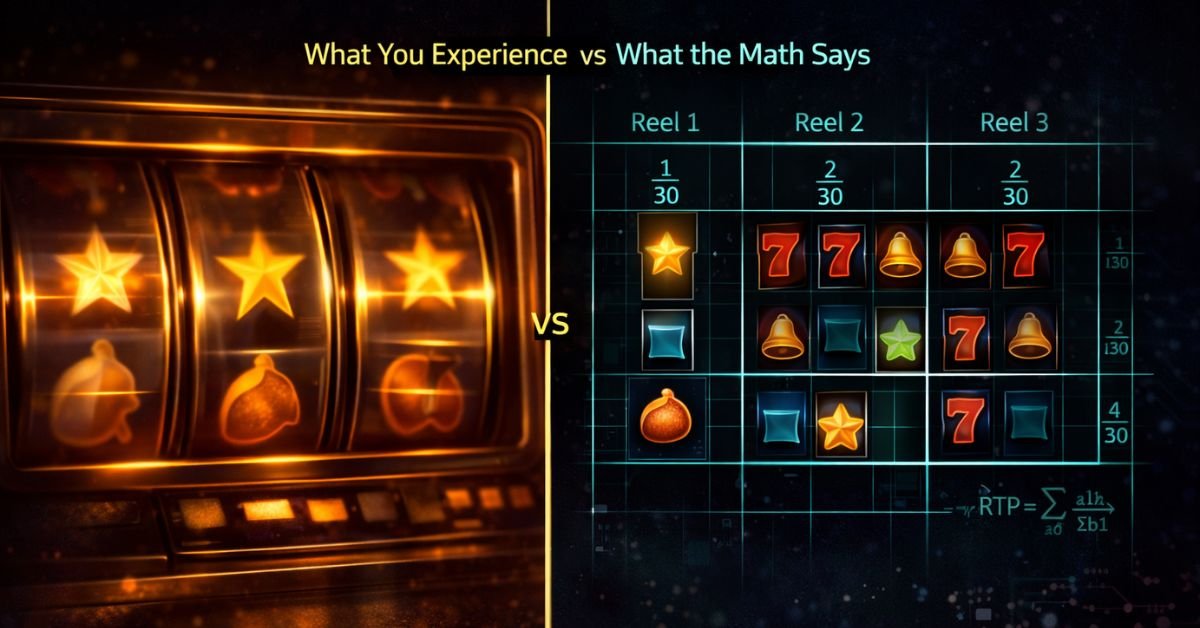
Slot math education is consistently promoted as a responsible gambling tool — learn how RTP works, grasp the randomness, understand expected value, and you will make better decisions at the reels. The assumption sounds reasonable. The research evidence behind it is far more complicated. Multiple empirical studies testing whether teaching the mathematics of slot games actually changes player behaviour have returned contradictory, inconclusive, and in several cases clearly negative results. At the same time, there is a specific mechanism through which slot math education does appear to reduce harm — and it works differently from what most responsible gambling messaging assumes. This article covers what the evidence actually says, what type of mathematical understanding matters and why, and how to apply it practically before your next session.
The Assumption Behind Slot Math Education as a Responsible Gambling Tool
The idea that slot math education leads to safer gambling rests on a simple chain of logic: if players understood the true probabilities, the real expected value, and the mathematical certainty of long-run loss, they would make different decisions — gamble less, set tighter limits, resist chasing losses, and stop misreading near-misses as signals of impending wins. It is the “if only they knew” theory of harm prevention.
This theory has shaped a substantial body of responsible gambling intervention work over the past two decades. Educational modules covering probability, RTP, expected value, and the law of large numbers have been developed, tested in school settings, delivered in clinical contexts, and embedded into awareness campaigns. The Harvard Medical School’s Division on Addictions produced a landmark curriculum called “Facing the Odds” specifically on this basis. Regulatory frameworks in multiple jurisdictions require that RTP figures be displayed on machines and in online game interfaces — the implicit assumption being that the number informs player decisions in a protective direction.
The problem is that the evidence has not reliably confirmed the chain. Slot math education is not simply a matter of learning the numbers. The route from mathematical knowledge to changed gambling behaviour is neither direct nor guaranteed. Understanding exactly where that chain holds and where it breaks is what separates useful responsible gambling content from well-intentioned noise — and it determines whether players who invest time in learning about slot math actually benefit from doing so.
Slot Math Education and Responsible Gambling — Research Snapshot
What the Research on Slot Math Education and Behaviour Actually Found
The empirical record on whether slot math education changes gambling behaviour is genuinely mixed — not in the sense that some studies found strong effects and others found weak ones, but in the deeper sense that several well-designed interventions found no statistically significant change at all, or produced unexpected counter-effects.
Williams and Connolly (2006) tested a specific gambling mathematics course on university students and found that while knowledge scores improved substantially, there was no significant difference in gambling behaviour between the intervention group and controls. Steenbergh et al. (2004) found that warning messages and brief mathematical interventions improved knowledge of gambling risk but did not reliably change irrational beliefs or actual behaviour. Pelletier and Ladouceur (2007) found effects on erroneous perceptions in some conditions but not others. Turner et al. (2008) found that life-skills and critical-thinking curricula showed more promise than pure mathematics delivery — which pointed toward a different underlying mechanism than simple knowledge transfer.
Across these fifteen or so major empirical studies, the pattern that emerges is not that slot math education is useless — but that the relationship between mathematical knowledge and behaviour change is not direct, and that the content and framing of what is taught matters enormously. Simply delivering probability theory, RTP definitions, and expected value formulas does not, on its own, produce the change it is assumed to produce.
Why the Contradictory Results Are Not a Dead End
The inconclusive findings from slot math education programmes do not mean that understanding the math is irrelevant to safer play. They mean the interventions tested the wrong kind of understanding. Most modules delivered basics of probability, expected value, and the law of large numbers — what researchers classify as pure and applied mathematical knowledge. What was almost universally absent was epistemic knowledge: the deeper understanding of what those probability concepts actually mean in the real world of gambling, why they apply to your session in the specific way they do, and what the player’s experience of randomness genuinely reflects. That absence is where the protective mechanism breaks down.
Why Standard Slot Math Education Often Fails to Change Gambling Behaviour
To understand why slot math education that delivers facts — “slots have a 96% RTP,” “each spin is independent,” “the house always wins long-term” — often fails to change how people play, it helps to understand what kind of knowledge those facts represent and what kind of cognitive territory they do not reach.
Pure mathematical knowledge tells you that P(A∩B) = P(A) × P(B) for independent events. Applied mathematical knowledge tells you this means the probability of two scatters landing simultaneously is the product of their individual reel weights. Both are factually correct. But neither one reaches the part of the player’s cognition where gambling fallacies, near-miss effects, and chasing behaviour actually live.
The reason is that the cognitive distortions most relevant to problem gambling are not primarily errors of mathematical calculation. They are errors of perception and epistemic interpretation. They operate in the gap between what the player experiences during a session and what the mathematical model describes in the abstract. Filling that gap requires a different type of slot math education: one that explains why probability theory applies to gambling in the way it does, what the concepts represent in the real world rather than only in equations, and what the player’s live experience of randomness actually means.
What Standard Slot Math Education Gives You
The ability to calculate or look up RTP. The definition of expected value. The formula for independent probabilities. The rule that the law of large numbers applies. These are valuable — but they are facts about abstract mathematical structures. They do not, on their own, change how randomness feels during a session or why a near-miss creates urgency to continue playing.
What Deeper Slot Math Education Gives You
An understanding of what it means for outcomes to be equally possible — and why that is a theoretical idealisation, not a physical property of the machine. An understanding of why statistical independence means the slot has no memory — not just that it doesn’t, but why the concept of independence is constructed the way it is and what that means for your experience. This is the level where distortions are actually corrected.
A player who “knows” that each spin is independent can still feel — after a long losing run — that a win is overdue. The mathematical fact is present in their memory. But it has not been applied to their actual experience of randomness, which operates at a different cognitive level entirely. Delivering the formula again does not help. What helps is unpacking why the concept of independence means what it means in relation to what they are experiencing when they play — which is the epistemic layer that most slot math education programmes skip.
Why the Gambling Reward Is Mathematically Unique — and Why That Matters
One of the clearest arguments for why slot math education specifically holds promise for responsible gambling — and why it differs from awareness campaigns for every other addiction — comes from the unique structure of the gambling reward itself.
When responsible gambling messaging is designed, it tends to be modelled on frameworks developed for other addictions: tobacco, alcohol, substances. Those frameworks centre on communicating harm — warning labels, health statistics, consequences of continued use. The implicit model is that the addicted person values the reward of the substance and needs to be made aware of what it is costing them.
Gambling has a different reward structure. The primary reward is monetary — the possibility of winning. And unlike the rewards of smoking or drinking, the monetary reward in gambling is mathematically deconstructable. It is not a subjective sensation that resists analysis. It is a probability-weighted expected value that can be calculated precisely, and when it is calculated correctly, the reward itself dissolves under scrutiny.
The Deconstructable Reward — What Makes Gambling Unique
A smoker’s reward — the perceived stress relief, the ritual, the physiological response — cannot be mathematically falsified. The smoker can know the health statistics and continue anyway because the reward is real to them at a subjective level that evidence does not reach. A slot player’s reward — the expected monetary value of their next session — can be shown, precisely, to be negative under any finite time horizon. The “I might win” motivation can be converted into a probability-weighted calculation that demonstrates concretely what the realistic range of outcomes looks like. Mathematical modelling of session outcomes is not just educational — it is a direct interrogation of the reward that drives continued play. No other addiction has this property. It is the strongest specific argument for slot math education as a responsible gambling intervention.
This is why slot math education holds genuine promise — but only when it is applied to the reward itself, not just to abstract probability facts. A player who understands that their 200-spin session at a 96% RTP slot with a £2 stake has an expected cost of £16, and who can see the realistic range of outcomes around that expectation using a session modelling tool, has had their reward structure interrogated mathematically in a way that no warning label achieves. This mechanism is specific to gambling and does not apply to any other addiction category.
Two Types of Mathematical Knowledge — and Why Only One Reaches the Right Place
The distinction that resolves why some approaches to slot math education work and others do not comes from the epistemology of applied mathematics. When you learn about slot math, you can acquire two fundamentally different kinds of knowledge — and most educational interventions have delivered only one of them.
Pure and Applied Mathematical Knowledge
This is the content of most slot math education and the type of understanding most players pursue when they research games: RTP definitions, probability calculations, the formula for expected value, the mechanics of RNG operation, hit rates, volatility as statistical variance. This knowledge is factually correct and genuinely useful for making informed choices about which games to play and what to expect from a session. It is the “what” of the math.
Epistemic Knowledge
Epistemic knowledge is the understanding that surrounds and contextualises those mathematical facts — the “why” and “how does this apply here.” It includes: what it means in practical terms for probability to be a theoretical idealisation rather than a physical property of the slot machine. What the assumption of equally possible outcomes actually implies about your session. Why the law of large numbers applies to an infinite series of plays and not to your current 200 spins. How the mathematical concept of independence relates to what you actually experience as “the machine having no memory.” What it means that expected value is a statistical average across an infinite run — and what that implies for any finite session you will ever have.
| Knowledge Type | Example in Slot Math Education | Where It Operates | Effect on Cognitive Distortions |
|---|---|---|---|
| Pure mathematical | “Each spin has the same probability — P(A) is constant” | Abstract — the equation level | Limited — player “knows” it but distortions operate below this level |
| Applied mathematical | “This game’s RTP is 96% — I expect to lose 4% of total staked per session” | Practical — connects math to decisions | Moderate — helps with game selection and bankroll planning |
| Epistemic | “Independence means the slot has no capacity to remember or compensate — my feeling of ‘overdue’ reflects my perception of randomness, not the game’s mathematical state” | Conceptual — the level where distortions live | High — directly targets the cognitive mechanism behind the gambler’s fallacy, near-miss effect, and chasing behaviour |
The research conclusion — that standard slot math education does not reliably change gambling behaviour — is largely explained by the fact that most programmes deliver types 1 and 2 while missing type 3 almost entirely. Epistemic knowledge is not harder to communicate than applied mathematics. It simply requires a different framing: not “here is the formula” but “here is what this concept actually means for what you experience when you spin the reels.”
What Slot Math Education Actually Fixes: The Specific Mechanism
With the two-knowledge framework in place, it becomes possible to state precisely what slot math education does and does not achieve when it reaches the right level of depth.
The mechanism that works is this: when a player genuinely understands the mathematical structure of the game they are playing — not just as abstract facts, but in terms of what those facts mean for their actual moment-to-moment experience — they are equipped to recognise cognitive distortions as they arise and to correctly interpret the structural features of slot design that would otherwise mislead them.
The Facing-the-Odds Principle
The “facing the odds” principle, developed by Harvard Medical School’s Division on Addictions and tested empirically in multiple contexts, holds that probability is the central concept in slot math education and deserves primary attention in any protective intervention. The empirical findings suggest that facing the odds is a necessary but not sufficient condition for behaviour change. It is the right starting point but requires the epistemic layer to be added: not just the odds, but what those odds mean for your realistic session outcomes, why they cannot be improved through timing or pattern recognition, and what the full distribution of outcomes looks like across thousands of equivalent sessions — not just the expected value headline.
The Reduction-to-Models Principle
A more advanced principle identified in the research is the reduction-to-models approach: the idea that a player who can mentally represent the game they are playing as a mathematical model — stripped of its visual design, its audio triggers, its near-miss engineering, and its bonus anticipation — is working with an objective representation of the game that is free of the structural risk factors embedded in the player-facing experience. A slot machine reduced to its PAR sheet reel strip configuration and probability table contains no near-miss effect, no illusion of control, and no variable ratio reinforcement. Those elements exist only in the presentation layer. A player who can access the mathematical model beneath that layer is less susceptible to the distortions the presentation layer is specifically designed to produce.
What This Looks Like in a Real Session
You are playing a high-volatility slot. Two scatters land on reels 1 and 2. The third reel shows a blank. You feel the urgency — “so close.” The reduction-to-models principle means you can access the mathematical reality: the blank on Reel 3 is not a near-miss in any meaningful sense — it is the predictable result of asymmetric reel strip weighting that intentionally places fewer scatter positions on middle reels. The third reel was never as likely to complete the combination as the first two. The urgency you feel is real. The near-miss as proximity to winning is a structural illusion created by the PAR sheet’s math design. Slot math education at this level gives you the language to name what just happened — and naming it correctly changes its emotional weight.
The Cognitive Distortions That Slot Math Education Targets — and How
Not all gambling cognitive distortions are equally addressable through slot math education. The research is clear that some distortions have a mathematical correction at their core, while others are more deeply neurophysiological and structural. Knowing which category each distortion falls into is itself a form of useful knowledge.
| Cognitive Distortion | What It Is | Slot Math Education Helps? | What Type of Knowledge Applies |
|---|---|---|---|
| Gambler’s Fallacy | Belief that past outcomes influence future ones — “a win is overdue after a losing run” | Partially | Epistemic — understanding statistical independence at the conceptual level, not just as a formula, is what corrects this |
| Near-Miss Effect | Near-misses feel like proximity to winning and drive continued play | Yes — strongly | Structural + applied — knowing that near-misses are deliberate reel strip design removes their signal value entirely |
| Illusion of Control | Belief that skill, timing, or ritual can influence slot outcomes | Yes — strongly | Applied + structural — understanding RNG operation and reel independence removes any factual basis for control beliefs |
| Losses Disguised as Wins | Sub-stake returns on multi-line games feel like wins due to celebration sounds and visuals | Yes — directly | Applied — understanding that a return below total stake is a net loss, regardless of what the game celebrates, resolves this |
| Hot and Cold Slot Beliefs | Belief that slots run in winning phases and losing phases | Yes — directly | Applied — understanding RNG and statistical independence removes any basis for phase beliefs; no memory, no phases |
| Variable Ratio Reinforcement | Unpredictable reward schedules create compulsive repetition | Limited | Structural awareness helps — naming the mechanism reduces its perceived legitimacy — but the reinforcement schedule operates at a neurological level that knowledge alone cannot override |
| Chasing Losses | Increasing play to recover losses — the escalating “just one more spin” spiral | Partially | Applied — understanding that expected value is negative on every additional spin removes any mathematical basis for recovery play; but chasing also has strong emotional and neurological drivers beyond mathematical correction |
The hard limit of slot math education. Variable ratio reinforcement schedules produce compulsive behaviour patterns that operate below the level of conscious reasoning — the same schedules embedded in slot machine design are used across multiple clinical addiction contexts. Mathematical knowledge can name the mechanism and reduce its perceived legitimacy. It cannot neutralise the neurological response. Players showing signs of problem gambling need support that goes beyond educational content — slot math education is a protective tool for recreational players, not a treatment for addiction.
What Slot Math Education Does Not Fix — Being Honest About the Limits
Any honest account of slot math education as a responsible gambling tool requires being direct about what it cannot do. Overstating its protective power is itself a form of misleading content.
It Does Not Change the House Edge
Understanding that a slot has a negative expected value does not change the mathematical reality of playing it. The house edge is fixed by the game’s certified PAR sheet math and verified by the testing lab. Slot math education can help you choose better games, set more realistic expectations, and make more rational stake decisions — but it cannot convert a negative expectation game into a positive one. Every spin still carries the same expected cost regardless of how well you understand the numbers.
It Does Not Guarantee You Apply It Under Pressure
There is a documented gap between what players know about gambling and what they do when actively playing. The emotional and neurological states produced by a live session — near-miss urgency, loss-chasing escalation, bonus anticipation — are not primarily cognitive. They operate at a level that mathematical knowledge does not always reach in real time. A player who can correctly explain RTP while calm may still respond to a near-miss with the same emotional urgency as a player who has never considered the math. Slot math education prepares you before the session. It is not armour during it.
It Does Not Replace Pre-Commitment Tools
The evidence base for responsible gambling consistently identifies pre-commitment strategies — deposit limits, loss limits, time limits, session cooling-off periods — as among the most reliably effective practical tools available. These work because they operate structurally, before the psychological state of active play begins. Slot math education complements these tools but does not replace them. A player with deep mathematical understanding but no pre-session limits set is less protected than a player who knows nothing about RTP but has firm limits in place.
The Correct Priority Order
Set your limits first. Apply slot math education second. Limits protect you even when mathematical understanding is overwhelmed by the emotional state of an active session. Use the responsible gambling planner to set concrete deposit and loss limits before you start. Then use mathematical understanding to improve the quality of the game selection and session design decisions that those limits frame.
A Practical Framework: How to Apply Slot Math Education Protectively
Given what the research says about what works and what does not, there is a specific and practical way to apply slot math education as a protective tool. It operates in three layers, in priority order.
Layer 1 — Understand the Game’s Math Before You Play
Before playing any slot, read the four player-accessible outputs from the game’s PAR sheet: the published RTP, the volatility rating, the hit rate where available, and the max win. Do not evaluate these numbers in isolation — understand what they mean together. A 96% RTP high-volatility game with a 20% hit rate means 80% of your spins return nothing, your bankroll depletes faster than a lower-volatility equivalent, and the RTP is concentrated in rare events that your session may or may not capture. That is not good or bad — it is accurate. Slot math education at this level means knowing your realistic session distribution before the session begins, rather than being surprised by it mid-session. The volatility and RTP calculator models this concretely across hundreds of simulated sessions.
Layer 2 — Name the Structural Effects Correctly as They Occur
The most practical in-session application of slot math education is having the language to name structural effects correctly when you experience them. Two scatters land, the third reel shows a blank: “reel strip asymmetry — the middle reel has fewer scatter positions by design, not by chance.” A 0.40× return on a 1.00× stake triggers a win sound: “loss disguised as win — this is a 0.60× net loss.” A long losing run builds urgency: “no memory — the RNG assigns identical probability to the next spin regardless of session history.” These corrections are not complicated. But having the specific language to apply them in the moment changes their emotional weight — which is the protective mechanism in practice.
Layer 3 — Use the Math to Interrogate the Reward Itself
The most powerful application of slot math education is directing it at the gambling reward — at the “I might win” motivation — rather than only at the risk. Before starting a session, calculate what your expected loss looks like in concrete numbers. Use the session risk analyser to model your genuine bust probability at your intended stake level across your intended session length. When the expected value of continued play is visible as a concrete number rather than an abstract percentage — when “96% RTP” becomes “I expect to lose £24 staking £600 over this session, with a realistic range of £0 to £120 depending on variance” — the reward structure of “I might win” becomes significantly harder to sustain as motivation for extended play. That is the deconstructable reward mechanism, and it is the specific point at which slot math education most directly reduces the power of gambling as a reward system.
The practical sequence: Set limits with the RG planner → read the game’s published math → model the session with the calculator → name structural effects correctly during play → re-evaluate at natural break points using the math, not the mood. In that sequence, slot math education is a genuine protective tool. Applied in isolation without the pre-commitment structure around it, it is useful context but insufficient protection on its own.
Further Reading
The arguments here draw on research worth engaging with directly if you want to go further. The foundational paper is Bărboianu (2015), “Mathematical Models of Games of Chance: Epistemological Taxonomy and Potential in Problem Gambling Research” — it is the source of the epistemic knowledge argument and the clearest published account of why standard slot math education underperforms in responsible gambling contexts. The companion research on the mathematics-related specificity of problem gambling awareness covers the deconstructable reward argument in detail.
On the site, the cognitive distortion articles provide the practical layer beneath the framework here. Gambler’s Fallacy in Slots covers the specific failure mode that epistemic understanding of statistical independence is designed to correct. Near-Miss Effect in Slots covers the structural distortion that reel strip asymmetry produces and that slot math education can correctly reframe. Illusion of Control and Variable Ratio Reinforcement cover the distortions where mathematical education has the most and least effect respectively. Losses Disguised as Wins is the multi-line PAR sheet construction issue that applied math knowledge directly resolves. For the mathematical foundation itself, Slot Game Math Models Explained, PAR Sheet in Slots, and RTP Guide provide the factual base. For practical tools that apply the math to your real session before you start, the Volatility and RTP Calculator, Session Risk Analyser, and Responsible Gambling Planner are the three most directly useful starting points.
Apply Slot Math Education Before Your Next Session
The Session Risk Analyser models your realistic outcomes — expected loss, bust probability, and variance range — so the math is visible before the game becomes emotional.
Model My Session Risk →Slot Math Education and Responsible Gambling — FAQ
Does slot math education actually make you a safer player?
It can — but not automatically, and not through the mechanism most responsible gambling messaging assumes. Empirical studies on slot math education interventions have produced mixed results, with several finding no significant change in gambling behaviour. The research identifies a specific type of understanding — epistemic knowledge, not just mathematical facts — that does operate on the cognitive distortions driving harmful play. Slot math education at this deeper level means being able to name and correctly interpret structural effects of the game as you experience them, which reduces their power to mislead your decisions.
Why doesn’t knowing the RTP stop people from gambling too much?
Because knowing a number is not the same as understanding what it means for your real experience. Knowing a slot has a 96% RTP tells you the long-run mathematical return. It does not tell you what your next 200 spins are likely to look like, why a near-miss is not proximity to winning, or why a losing run does not make a win more likely. The RTP number is applied mathematical knowledge — useful but passive. The understanding that changes behaviour requires going further: knowing why the long-run figure does not apply to any individual session you will ever have, and what that implies for evaluating your position mid-session.
What is the difference between applied math knowledge and epistemic knowledge in slots?
Applied mathematical knowledge tells you the facts: the RTP percentage, the formula for expected value, the rule that spins are independent. Epistemic knowledge tells you what those facts mean in the real world of your session: why independence means the machine has no memory at a conceptual level, not just as a rule; why expected value is a mean over an infinite series and what that implies for your finite session; why probability is a theoretical idealisation rather than a physical property of the machine. Epistemic knowledge operates at the level where gambling cognitive distortions actually live — applied knowledge alone does not reach there.
Which cognitive distortions does slot math education help most?
Most directly: the near-miss effect (knowing near-misses are reel strip design, not random proximity to winning), the illusion of control (understanding RNG operation removes any basis for timing or ritual beliefs), losses disguised as wins (sub-stake returns are net losses regardless of celebration sounds), and hot-and-cold slot beliefs (statistical independence means no phases exist). The gambler’s fallacy is partially addressable through epistemic understanding of independence. Variable ratio reinforcement operates at a more neurological level where mathematical knowledge has limited direct effect.
Why is gambling different from other addictions when it comes to math education?
Because the primary reward in gambling — the possibility of winning money — is mathematically deconstructable in a way the rewards of other addictions are not. The value of “I might win” can be converted into a probability-weighted expected value calculation showing concretely what realistic outcomes look like. This means slot math education can directly interrogate and reduce the power of the reward motivating continued play — something that harm-only messaging frameworks cannot do, because they address the cost of gambling rather than its reward structure.
Is slot math education enough on its own to gamble safely?
No. Pre-commitment tools — deposit limits, loss limits, time limits — are consistently identified in the evidence base as more reliably effective because they operate structurally, before the psychological state of active play begins. Setting firm limits before you start is the highest-priority protective action. Slot math education strengthens the quality of the decisions inside those limits but does not substitute for them.
What is the most practical way to use slot math education protectively?
Three layers in order: First, read the four published game outputs — RTP, volatility, hit rate where available, and max win — before playing, and model what your realistic session looks like using the session risk analyser. Second, learn to name structural effects correctly during play: near-misses as reel design, sub-stake returns as net losses, losing runs as statistically independent from the next spin. Third, use expected value to interrogate the reward itself before starting — knowing concretely what your session is expected to cost in probability-weighted terms is the clearest mathematical argument against extended play when you are already losing.
Can slot math education help someone who already has a gambling problem?
It can provide useful framing but it is not a treatment for problem gambling. Slot math education is most protective for recreational players making ongoing choices about how they engage with gambling. Players showing signs of problem gambling — chasing losses consistently, gambling beyond affordable limits, or experiencing distress related to gambling — need professional support and structured intervention, not more mathematical information. The resources below provide the right starting points for anyone in that position.