This broad bonus hunt guide covers how the format works, bankroll planning, RTP/EV, game selection, tracking and safer-play rules. For a quick definition, start with what is a bonus hunt; for execution, use the planning guide and free tracker.
One-Screen “By the Numbers”
- Typical buy costs: 50x–200x (some tiers higher; check game panel).
- UK-licensed sites: no buy buttons; natural triggers only.
- Safety settings to enable: deposit/session limits + reality checks (timers).
- Mindset: RTP ≠ promise, and every spin is independent.
What Is a Bonus Hunt (and Where It Came From)
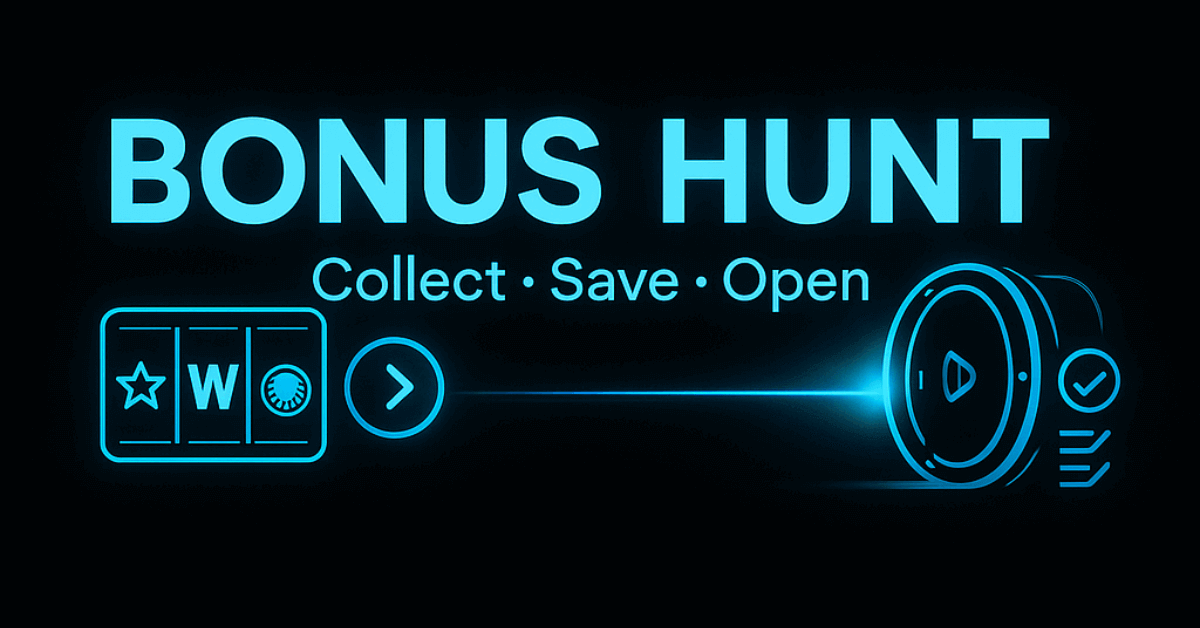
A bonus hunt is a session format where you play multiple slots just to trigger their bonus rounds, save each bonus once it lands, and only open (play out) all saved bonuses later in a single streak. The format grew inside the slot-streaming community (CasinoGrounds/2016 era) and remains a popular watch-party format because it compresses the “highlights” into one burst.
The “save now, open later” part is made possible by regulated platforms that preserve game state if you close a game mid-feature or after a trigger (you resume where you left off next login). Operators document this behavior in their help centers, and regulators embed it in technical standards (interrupted play must be fair and resumable).
Key idea: A hunt doesn’t change a game’s RTP or the RNG’s unpredictability. It’s a session choreography, not a loophole.
How a Bonus Hunt Works — Step-by-Step
Step 1 — Bankroll & bet plan.
Choose a fixed bankroll for “collecting” (e.g., €500). Pre-decide average bet size (e.g., €0.40–€1.00) and a per-game spin limit (e.g., 100–150 spins) before you move to the next title.
Step 2 — Trigger & save.
Open Slot A, spin until you trigger the bonus. When it lands, close the game (don’t play the feature) so it stores the state. Repeat on Slot B, Slot C… until your “collecting” bankroll is spent.
Step 3 — Open all bonuses.
When ready, reopen each slot and play out every saved bonus in one go. Record each result. At the end, compare total returns vs total cost to see your net outcome.
This is exactly how major guides (and streamers) describe the process: “Play until you trigger; close it; rinse and repeat; then open all at once.”
Tools & Setup: Tracker, Budget, Session Rules
A) Bonus Hunt Tracker
Open the free Bonus Hunt Tracker first if you want ROI, Avg X, break-even and results to update during the session. If you still prefer a sheet or Notion log, capture the same fields:
- Date
- Casino / Provider
- Game
- Bet size
- Spins attempted (to trigger)
- Bonus type (FS/Pick/Respins)
- Saved (Y/N)
- Bonus result (x bet and €)
- Notes (e.g., base-game spikes, gamble choice)
Many streamers use spreadsheets or small apps to keep score and totals during openings. You don’t need anything fancy; accuracy and discipline beat bells and whistles.
Try our free/no-registration required bonus hunt tracker.
B) Bankroll structure
Split your bankroll in two envelopes:
- Collecting envelope (e.g., 70–85%) — used to hunt triggers.
- Opening envelope (e.g., 15–30%) — a reserve to smooth variance during the opening segment (optional, but good for mindset).
C) Session rules (pre-commit)
- Max number of games to collect (e.g., 15–25).
- Max spins per game before moving on (e.g., 150).
- Max loss for the hunt (stop rule).
- Opening order (e.g., lowest variance first, high volatility last).
Why these rules matter: they protect you from “sunk-cost” thinking and keep the session finite.
RTP, EV & Variance — The Hunt Math (Simple, Practical)
You don’t need to be a statistician. Keep three ideas in mind:
- RTP (Return to Player) is the long-run average return percentage. If a slot’s RTP is 96%, the house edge is ~4%. Short sessions can deviate wildly; RTP is not a guarantee for any one hunt.
- EV (Expected Value) for a hunt is “what you expect to get back on average” from all spins used to trigger plus the bonus outcomes. In practice, you’ll see swings because variance is high (bonuses are spiky).
- Variance (volatility) dictates the spread of outcomes. Hunts stack multiple high-variance events into one “opening”, so session variance is amplified: some openings feel magical; others feel barren — both are normal in random systems.
Back-of-napkin EV check (for collecting naturally):
- If your average game RTP is 96%, and you spend €500 to collect, the long-run expectation is ~€480 back (before opening order affects nothing mathematically). But any one hunt can land far above or below that number because outcomes cluster.
Important: Don’t confuse presentation with value. A hunt compresses bonuses into a highlight reel, but the underlying math is still the same house edge you’d face spreading those bonuses over days.
Game Selection — “Easy to Bonus” vs “High Ceiling”
You’ll hear two instincts:
- “Easy to bonus” picks (lower feature entry difficulty, more frequent smaller features) help fill your list and keep morale up.
- “High ceiling” picks (very volatile, rarer entry, massive bonus top-ends) can swing your opening.
Community threads where players crowd-source lists and approaches reflect this split: some aim for 40–50 titles with ~100 spins each to diversify; others target fewer but heavier hitters. Use both styles in one hunt.
Practical agenda for a balanced 20-game hunt:
- 8–10 medium variance titles (to build count)
- 6–8 volatile titles with strong features
- 2–4 “moon-shot” titles if your bankroll tolerates it
Bonus Buys vs Natural Hunts (and the UK Situation)
Bonus Buys (Feature Buys) let you pay a fixed multiple of your bet (often 50x–200x, sometimes far more) to jump straight into a bonus. This isn’t a “profit button” — it just front-loads cost and volatility. Typical ranges and examples are widely documented across industry outlets and specific game reviews.
RTP for buys: Game-by-game. Many titles keep buy-RTP close to base-game RTP; some offer slightly higher or lower depending on the buy tier (e.g., ELK’s X-iter tiers, Nolimit’s different scatter buys). Always check the game info panel.
United Kingdom note: Bonus buys are not available to GB players on UK-licensed sites. Industry guides and operator pages consistently state their removal to comply with UK standards, even though the UKGC’s published changes mostly reference “safer game design” and speed features rather than naming buys line-by-line. If you play under the UKGC, expect no buy buttons; you must trigger naturally.
Regulatory context that affects hunts:
- Interrupted play & resuming must be fair (why saved bonuses resume). [Gambling Commission]
- Reality checks/time tracking help you monitor long sessions (turn them on).
- Stake-limit changes in GB (2025) reduce max spin stakes; plan bet sizes accordingly.
Realistic Budgets & Scenarios (Worked Examples)
These are illustrations for planning, not predictions.
Scenario A — “Starter” Hunt (€300)
- Average bet: €0.40
- Spin limit per game: 120
- Targets: 15 games, mixed volatility
Collecting phase:
€300 ÷ (15 games) ≈ €20 per game budget → ~50–120 spins per title depending on streaks.
Opening:
Expect many small-to-medium bonuses and 1–2 outliers. On a typical opening, you might see total returns anywhere from €120 to €500+; the spread is wide because a single 200x can swing your total.
Scenario B — “Streamer-style” Hunt (€1,500)
- Average bet: €1.00
- Spin limit per game: 150
- Targets: 25 games across 8–10 providers
Collecting phase:
You’ll ride variance — some titles won’t bonus in 150 spins; others will quickly.
Opening:
A single 500x on a €1 bet (+€500) can rescue a flat set; two high-volatility misses can sink the session. That’s the hunt’s rollercoaster by design.
Scenario C — Buy-Heavy Hunt (non-UK) (€1,000)
- Average bet: €0.60
- 8 bonus buys at 100x (€60 each) + 6 natural hunts
This concentrates variance even more. You’ll feel results faster, but individual outliers (e.g., a 4x or a 15x pay on a 100x buy) can sting — and they do happen. Plan stricter stop rules for buy-heavy hunts.
Psychology: Near-Misses, LDWs, Tilt — and How to Stay Cool
Bonus hunts are emotional by design: rapid reveals, a scoreboard, chat hype. Three effects to know:
- Near-misses (e.g., 2 scatters, third “just passes”) increase motivation to continue even though they don’t predict a win. Studies show near-misses spur play despite feeling unpleasant.
- LDWs (Losses Disguised as Wins) play celebratory sounds even when the “win” is less than your spin bet; arousal rises and it can distort your sense of how you’re doing. Recognize them and keep a strict ledger.
- Tilt & sunk cost. When a bonus hunt is behind, the urge to “force one more trigger” or escalate bet size is strong. Pre-commit to your spin caps and stop loss; respect them.
Mindset trick: Treat openings like revealing envelopes you already paid for during collecting. You’re not “owed” anything. That small reframe reduces tilt.
Safer Play: Limits, Reality Checks, and Smart Stop-Rules
Use built-in tools on licensed sites:
- Deposit/Session limits and reality checks (periodic on-screen timers) — UK standards require these facilities; switch them on before a long bonus hunt.
- Time-boxing — Two-phase sessions (collect today, open tomorrow) can help you avoid marathon hunts.
- Stop-rules — e.g., stop opening when you 1) recover your collecting bankroll, 2) hit a pre-set win goal, or 3) hit a loss cap.
If you feel control slipping: self-exclusion tools and national helplines exist for a reason. (We list support resources on SlotDecoded’s Responsible Gambling hub.)
Common Mistakes & Myths (and the Fixes)
“Hunts change RTP.”
No. A bonus hunt doesn’t alter RNG or long-run RTP. It’s session choreography, not a strategy edge.
“More near-misses mean I’m close.”
Gambler’s fallacy. Each spin is independent. Recognize near-miss psychology and stick to your plan.
“Bonus buys pay better.”
Sometimes buy-RTP ≈ base RTP; sometimes slightly different by tier. It’s game-specific. Always read the info screen before buying.
“I can’t resume a saved bonus.”
On regulated sites, interrupted play is resumable; operators document it and regulators require fair treatment on interruptions.
“UK sites still have buys somewhere.”
On UK-licensed casinos, expect no buy buttons; industry pages and operator-facing content consistently reflect their removal for compliance.
Top Games for Bonus Hunts (Community-Tested Picks)
How we picked: crowd suggestions from active player forums and bonus hunt threads, plus titles that repeatedly show up in streamer bonus hunts. Quickspin and Pragmatic Play are frequently cited for “save-able, land-often” bonuses, while some Nolimit/NetEnt/BTG picks add the knockout potential for your opening.
A) Fast-Fill Starters (trigger reasonably often)
Use these to build your list quickly before you chase the big ones.
- Big Bass Bonanza series (Reel Kingdom/Pragmatic Play) — often called out as an “easy to bonus” family; huge series breadth (Big Bass, Splash, Keeping it Reel, etc.).
- The Dog House & Dog House Megaways (Pragmatic Play) — a “must have” in several hunt routines; Megaways variant also works as a closer.
- Tome of Madness (Play’n GO) — grid/portal “feature” that communities like to include early to keep fill-rate up.
- Fruit Warp (Thunderkick) — unique mode progression; frequently recommended alongside Tome/Dog House in hunt threads.
- Quickspin catalogue (e.g., Big Bad Wolf, Sakura Fortune, Sticky-wild titles) — repeatedly mentioned as “land often and save-able.”
Why these first? You want a healthy count before opening. These titles are regularly suggested by players aiming for 40–50 collected bonuses with ~80–150 spins per game.
B) Balanced Crowd-Pleasers (solid features, manageable swings)
- Book-style classics (e.g., Book of Dead – Play’n GO) — expanding-symbol free spins that audiences instantly understand.
- Big Bass Splash / other mid-volatility sequels — same hook with extra modifiers; good mid-stack filler.
C) High-Ceiling Closers (swingy, but great for the finale)
Use 3–6 of these at the end of your opening to give the bonus hunt genuine “pop.”
- Dog House Megaways (Pragmatic Play) — sticky-wild setups can explode; often appears on “best buy/feature” lists too.
- Deadwood (Nolimit City) — volatile, big multiplier ladders; classic closer material (non-UK can buy features; UK must trigger naturally).
- Dead or Alive 2 (NetEnt) — extremely high potential; not easy, but legendary for spectacular bonus reveals.
Note: UK-licensed sites don’t offer bonus buys; pick the natural-trigger versions of these games for hunts under UK rules.
Sample 20-Game Rotation (Starter → Balanced → Closers)
- Starters (8): Big Bass (any 2–3 variants), Dog House, Tome of Madness, Fruit Warp, two Quickspin picks (e.g., Big Bad Wolf, Sakura Fortune), one medium-volatility Megaways.
- Balanced (8): Book of Dead (or another ‘Book’), another Big Bass variant, two Pragmatic “FS + multiplier” staples, two Quickspin/NetEnt mid-vol games, one Thunderkick/ELK filler.
- Closers (4): Dog House Megaways, Deadwood, Dead or Alive 2, one BTG-style Megaways closer you like. (If you’re non-UK and using buys, reduce total game count by 2–3 to keep variance in check.)
- Spin/Bankroll cue: cap at ~100–150 spins per title during collecting; move on if cold. This mirrors how many community hunts are planned (build count fast, don’t chase a single trigger).
Quick Provider Cheatsheet (why they appear in hunts)
- Pragmatic Play — lots of familiar FS formats (Dog House/Big Bass) that “land often” per community chatter; great for building count.
- Play’n GO — Book-style and Tome-style grids keep variety.
- Quickspin — community-noted for save-able, frequent bonuses to pad your list.
- Nolimit City, NetEnt (select titles) — high-ceiling finales (Deadwood, DOA2) that create memorable openings.
FAQ – Bonus Hunt
What exactly is a bonus hunt?
Playing multiple slots just to trigger their bonuses, saving each one, then opening all bonuses together later. It’s popular in streaming because it compresses the “best bits” into one sequence.
Is a bonus hunt legal?
Yes — you’re just using normal gameplay on licensed sites. Saved bonuses resume because game-state persistence is part of regulated remote gaming standards.
Do hunts improve my chances?
No. They don’t change RTP or randomness. They change how outcomes are revealed, not what the math is.
How much bankroll do I need?
You can build small hunts (e.g., €200–€300 at €0.20–€0.60 bets) or larger hunts with more titles at higher stakes. The bigger the bankroll, the more titles you can realistically collect — but never risk money you can’t afford to lose.
Should I buy bonuses instead of hunting naturally?
Buying compresses time and concentrates variance; it can feel exciting but also burn through your budget quickly. Check the game’s buy cost (often 50x–200x; some higher) and the buy-RTP before you decide.
Why can’t I buy bonuses in the UK?
UK-licensed casinos have removed bonus buys to comply with UK standards, so you must trigger naturally when playing under the UKGC regime.
Can I stop mid-bonus and resume later?
Yes on regulated platforms — the bonus will resume when you reopen the game. Check your casino’s help page if you’re unsure.
What’s the smartest way to pick games?
Balance “easier-to-trigger” bonuses with a few volatile, high-ceiling picks. Diversification helps you build a fuller opening list and manage mood.
What safety settings should I enable?
Set deposit/session limits and enable reality checks (pop-up timers). They’re designed to keep you anchored in time during long bonus hunts.
Bonus Hunt Conclusion
A bonus hunt is entertainment packaging for slot play: you invest time/budget to collect several features and then enjoy a fast, theatrical opening. It doesn’t change RTP or bend the rules — it re-orders the experience. If you plan your bankroll, diversify your game list, keep meticulous records, and switch on safety tools, you’ll get the best of what hunts offer: clear expectations, tight control, and a satisfying opening sequence when you’re ready to reveal the lot.
When it feels like the hunt is “due,” remember the cardinal rule: every spin is independent. Let your pre-set rules — not feelings — drive the session.