Play DEMO
Orphan Organ Slot Review: Why this review matters (read this first)
You’re here because you’ve heard the whispers: Orphan Organ isn’t a safe, standard spinner; it’s a meter-driven carnival where six alien orphans sing for multipliers and Airlocks spit out chaos. If you’ve felt stuck chasing dead spins in “normal” slots, this is your shortcut to understanding how Orphan Organ actually pays, when it spikes, and what that 20,000× ceiling implies for bankroll and patience.
We’ll break the game down in plain language—mechanics, math, bonus flow, buy options, streaming appeal, and risk management—so you can decide whether this Shady Lady number fits your appetite for volatility. (Spoiler: it’s spicy.)
Table of contents
- Summary verdict
- By the numbers (RTP, volatility, max win, hit rate)
- Theme & presentation
- How wins work: the Meter Pay core
- The Airlock features explained
- Live in Concert bonus (and the Golden Conductor)
- The Store: Bonus Boosters, Bonus Buy, Highlight Reels, Loot Boxes
- Math model: RTP sets, hit/bonus frequency, average bonus, session shape
- Bankroll & play-style guidance
- Streamer & community appeal
- Who will love it vs. who should skip it
- Tips, misplays to avoid, and sensible “rules of thumb”
- Pros & cons
- Final verdict
- FAQ
1) Summary verdict (TL;DR)
Orphan Organ is high-volatility, meter-driven chaos that hinges on building symbol meters, nudging multipliers/levels with Airlocks, and saving the real drama for the bonus, where multipliers, levels, and links persist across free spins. With RTP up to 96.17%, bonus every ~192–200 spins on average, hit frequency around 23%, and a max win of 20,000×, it’s built for players who enjoy stretched sessions punctuated by spiky, multi-meter payouts, not gentle, frequent line wins.
If you liked the “odd” genius of Shady Lady’s other titles, you’ll appreciate how Facehugger links, one-tap Airlock upgrades, and persistent bonus states create snowball moments that look—and feel—great on stream. Casual players can enjoy short samples, but the game sings in longer sessions with patience, budget management, and realistic expectations about variance.
2) By the numbers (quick facts)
- Provider: Shady Lady
- Reel set: 5×4
- Pay model: Meter Pay (collect symbols to meters; payouts at 8+)
- RTP: 96.17% / 94.15% / 92.14% (plus RTP for bonus buys: ~40–42.5% goes to bonus features)
- Volatility: High (9/10)
- Max win: 20,000×
- Hit frequency: ≈23.56% / 23.03% / 22.54% (varies by RTP set)
- Bonus frequency: ~1 in 192 / 196 / 200 spins (base)
- Average bonus win: ≈83.21× (indicative, not guaranteed)
- Bets: €0.10–€50 (default €1)
3) Theme & presentation: a dark carnival that works
Shady Lady wraps mechanics in story-first art direction. Here, six alien orphans perform under a grotesque, voltage-fed organ: collars zap, meters fill, multipliers climb, and the show literally gets louder as you collect. It’s a clean 5×4 stage with six side meters—one for each orphan—so the UI teaches the rules at a glance. The dystopian fairground tone fits the math: tension, crescendos, release.
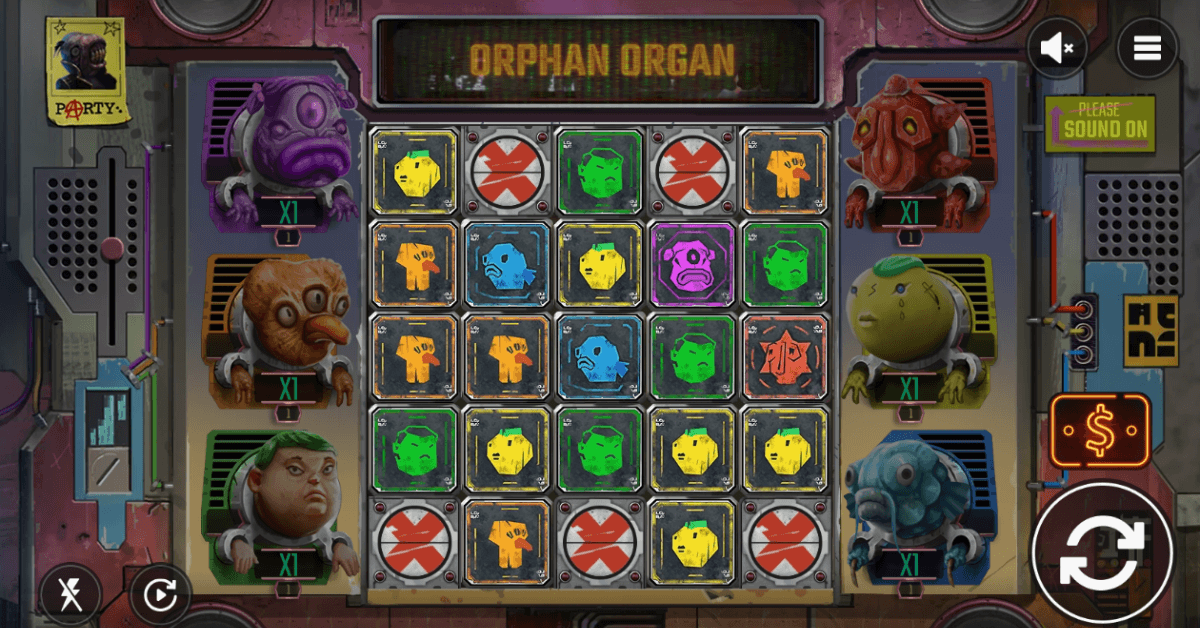
Why it’s effective: the aesthetic isn’t just set dressing. It cues you to watch the meters, not the reels. You’re not hunting fixed paylines; you’re curating chain reactions that can spill into consecutive cascades.
4) How wins work: Meter Pay (the beating heart)
Meter Pay is the game’s identity. Each orphan (symbol type) has a dedicated meter beside the reels. When that symbol lands anywhere on the grid, it adds to its meter. On any spin/cascade, if a meter reaches 8+ symbols collected, it pays a fixed amount × its current multiplier, then removes matched symbols from the grid (triggering a cascade). Any count beyond 8 carries over to the next cascade, and after each payout the meter’s multiplier steps up (faster at higher meter levels). Meters can also be linked so one fill triggers payouts on multiple meters.
Think of it as match-8 clusters—but persistent within the spin/cascade and synergized by multipliers. The satisfaction loop is different from classic ways/lines:
- You’re stacking potential rather than chasing one-off hits.
- Carryover beyond 8 creates momentum.
- Post-payout multiplier upgrades turn “one more fill” into absurd spikes.
Takeaway: In Orphan Organ, you’re always asking: Which meters are primed? Can I goose a multiplier/level/link to tip several meters over the 8+ threshold?
5) The Airlock features: red eye, five doors, four kinds of chaos
Land the Airlock activator (a red eye) and the five airlocks open, each granting one of four effects:
- Multiplier upgrade — Add +1 to +16 to a random meter’s multiplier.
- Meter Level upgrade — Multiply a random meter’s level by 2× to 10× (which in turn accelerates future multiplier stepping).
- Wild — Drops a rogue Wild and adds one extra symbol to every meter’s collector (a subtle yet huge nudge toward multiple 8+ triggers).
- Harmony Facehugger — Links a random additional meter to the existing link group; any linked meter reaching 8+ pays all linked meters (chain reaction central).
Why this matters: Airlocks reframe the board in one swoop. Even modest boards can snowball when a Wild pushes meters to 7–8 and a Facehugger suddenly binds 2–3 meters together. In practice, Airlocks are where base-game “nothing” turns into a highlight.
6) Live in Concert bonus: persistence is the headline
Trigger Live in Concert by landing three Conductor scatters: you normally get 8 free spins, but if one scatter is the Golden Conductor, you get 15. During the bonus, the state persists:
- Meter multipliers persist.
- Meter levels persist.
- Linked meters persist.
That means every spin borrows the entirely upgraded board from the last one—compounding chances to chain multiple meters and turning medium setups into out-of-hand crescendos. The bonus is where 20,000× becomes a realistic target (still rare, but mechanically supported).
Bonus pacing: With bonus frequency ~1 in 192–200 spins and average bonus ≈83×, expect long walks between concerts and volatile concert performance during. If you hit early and the board doesn’t upgrade, it can feel tame; if Airlocks pre-stack your board, even 8 spins can feel like a mini-epic.
7) The Store: buys & boosters for people who hate waiting
For those who prefer agency over variance drift, the Store offers:
- Bonus Boosters & Bonus Buy — Increase your bet to boost feature odds or buy straight into Bonus or Super Bonus (RTP contribution for bonus features sits around ~40–42.5% depending on set).
- Highlight Reels — Purchase a batch of spins, receive the top three presented in ascending order of win size. This is made for content creators: it filters noise and surfaces the spikes.
- Loot Boxes — Buy a randomized Enhanced Bonus (Bronze/Silver/Gold). On average, each Enhanced Bonus outperforms a regular bonus, with Gold capable of session-defining runs. (Randomness still rules; “enhanced” ≠ guaranteed.)
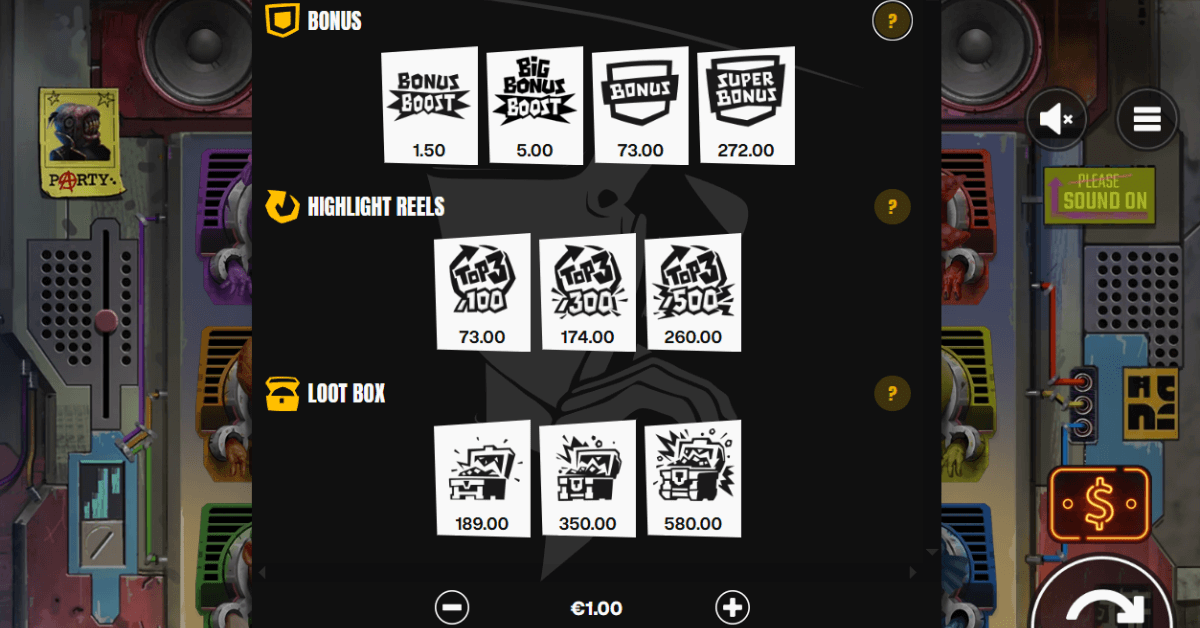
Practical note: Buys shift variance forward—you’re compressing the “wait” into a higher upfront cost. Great for testing or controlled sessions, but respect your spend.
8) Math model: RTP choices, hit/bonus frequency & session shape
- RTP sets: 96.17% / 94.15% / 92.14%. If you have the option, prefer 96.17% for long-run expectation. (Operators may choose lower profiles; always check.)
- Volatility: High (9/10). Bankroll swing is part of the design.
- Hit frequency: ≈23%, so about 1 in 4–5 spins shows a return, but many hits will be small meter nudges rather than full payouts.
- Bonus frequency: ~1 in 192–200 spins on average. Short sessions may miss; budget for droughts.
- Average bonus win: ~83×, with wide variance. Persistent state is a multiplier—once multipliers/levels/links stack, the tail gets fat.
- Max win: 20,000× is the hard cap—rare by definition; mostly realized through multi-meter link spikes in bonus.
Session shape (what it feels like):
- Base build—small adds to meters; you’re “priming the pump.”
- Airlock swing—one red eye and the board can transform: a +Wild to all meters, a lucky Level ×, and a new Facehugger link can tip multiple meters over 8 in quick succession.
- Bonus compounding—if your entry has decent levels/multipliers/links, persistence lets you iterate toward bigger spikes. If not, 8 spins can whiff.
9) Bankroll & play-style guidance (smart, not superstitious)
Stakes & session planning
- If your typical stake is €0.20–€0.50, plan 400–800 spins to sample base+bonus cycles (given the ~1/192–200 bonus frequency). At €1, you’ll feel the variance more; keep the same spin count but budget accordingly.
- Stop-loss & stop-win: pick both. High-vol games can give back quickly.
- Don’t chase “almosts” on meters; remember 8+ is the threshold. A meter at 6-7 feels close—but Airlocks/links matter more than one symbol short.
When to consider buys
- Testing days: Buy a regular or enhanced bonus to study how persistence behaves.
- Content runs: Highlight Reels showcase the game’s best three moments from a batch—perfect for recaps.
- Self-control: Pre-set a buy cap (e.g., 2–3 per session). Don’t let one more become ten more.
Reality checks
- Orphan Organ’s appeal is compounding states, not frequent line pays. If you prefer steady drips, look elsewhere.
- RTP is long-run math; variance is today’s experience. Align your expectations.
10) Streamer & community appeal (why it gets clips)
- Highlight Reels turn mediocre sessions into tight highlight packages—ideal for Kick/YouTube spots.
- Loot Boxes & Enhanced Bonuses create clear narrative hooks (“Bronze → Silver → Gold chase”).
- Facehugger links deliver multimeter blowouts—the clip moment.
- Persistent bonus lets audiences watch a board evolve, not just a one-and-done burst.
11) Who will love it vs. who should skip it
Perfect for:
- Players who enjoy state-building (meters, multipliers, persistent bonuses).
- High-volatility fans seeking multi-meter chain reactions.
- Streamers and viewers who want dramatic, explainable spikes.
Probably not for:
- Players who want frequent, small base-game wins.
- Anyone uncomfortable with long bonus droughts or swingy returns.
12) Tips, misplays to avoid, and sensible “rules of thumb”
Do:
- Track which meters sit at 6–7 and consider how Wild or Facehugger could convert two or more at once.
- Enter Live in Concert with something (even small level/multiplier gains) to exploit persistence.
- If buying, sample a regular bonus, then an enhanced—compare feel vs. cost.
Don’t:
- Over-weight a single meter. Linking two modest meters can out-earn one tall one when the linked 8+ trigger fires.
- Assume a Golden Conductor will appear often; bank on 8 spins as baseline and be pleasantly surprised by 15.
- Treat RTP like a session guarantee; it isn’t.
13) Pros & cons
Pros
- Original Meter Pay engine with smart carryover & multiplier leveling.
- Airlocks meaningfully reshape boards (Wild to all meters; Level × up to 10×; Facehugger links).
- Persistent bonus state feels great and tells a story across spins.
- 20,000× max win provides real headroom.
- Highlight Reels & Loot Boxes add agency and stream-friendly moments.
Cons
- High volatility plus bonus ~1/192–200 can test patience/bankroll.
- If you enter bonus under-upgraded, persistence may not save it.
- Wild to all meters can still whiff if symbols don’t follow; variance remains variance.
14) Final verdict
Orphan Organ is what happens when a studio designs for compounding states instead of one-off line hits. The result is a coherent, high-risk carnival where Airlocks and Facehugger links build real, visual momentum, and where Live in Concert transforms setup into show. If your taste leans toward edgy math and big moments, this is Shady Lady at full volume.
If you’re variance-averse, try it in small doses or via Highlight Reels to enjoy the spectacle without overcommitting. For everyone else: tune the meters, open the Airlocks, and hope the Organ screams in your favor.
FAQ - Orphan Organ Slot Review
What is the Orphan Organ slot’s RTP?
Operators can run different RTP profiles. The game supports 96.17% / 94.15% / 92.14%. Prefer the highest available where you play.
How volatile is it?
High (9/10). Expect swings and long gaps between bonuses.
How does Meter Pay work?
Each symbol type feeds its own meter. At 8+ in a single spin/cascade, that meter pays × its multiplier, removes those symbols (cascade), and upgrades its multiplier for future fills—faster if its level is higher. Counts above 8 carry over within the spin. Meters can be linked to trigger together.
What are the Airlock features?
On a red-eye trigger, five airlocks open to award one of: Multiplier +1–16, Level ×2–10, a Wild that adds +1 symbol to every meter, or Harmony Facehugger that links another meter to the group.
How do I trigger the free spins?
Land three Conductor scatters for 8 spins; if one scatter is the Golden Conductor, you get 15. In the bonus, multipliers, levels, and links persist across spins.
What’s the max win?
20,000× your bet. Rare, typically tied to linked meters and stacked multipliers during the bonus.
Are there bonus buys?
Yes. You can boost odds or buy regular/super bonuses, Highlight Reels, and Loot Boxes with Enhanced Bonuses.
What bet range can I use?
Typically €0.10–€50 (default €1), subject to operator.
Conclusion: A Carnival for State-Builders, Not Line-Chasers
Orphan Organ is the rare slot that pays you for building a position, not just surviving to the next spin. When it hits, it’s because you set the stage: meters nudged to 7s, multipliers creeping up, levels quietly doubled, and a Facehugger link waiting to turn one 8+ into three. The Airlocks are the accelerant; Live in Concert is the payoff—persistence turns last spin’s work into this spin’s chain reaction, and the show can go from odd to operatic in a heartbeat.
That said, the personality here is high volatility with bonus droughts that will test anyone who expects constant pats on the head. It demands patience, a plan, and limits. Play it like a strategy game: budget a real sample of spins, track which meters are live, and understand that RTP is long-run math—your short-run results will swing.
If you love compounding states, visible progress, and moments that feel earned, this is Shady Lady at its most confident. If you prefer frequent small line hits and low stress, you’ll be happier elsewhere. For streamers and highlight-hunters, the package is tailor-made: Highlight Reels for curated spikes, Loot Boxes for enhanced bonuses, and a bonus round that actually tells a story.
Bottom line: Orphan Organ isn’t cozy; it’s a controlled riot. Learn the meters, respect the variance, and you’ll get what this design does better than most—turn one good setup into a full-blown finale. Set a stop-loss, set a walk-away, and let the Organ sing when the board is ready.