
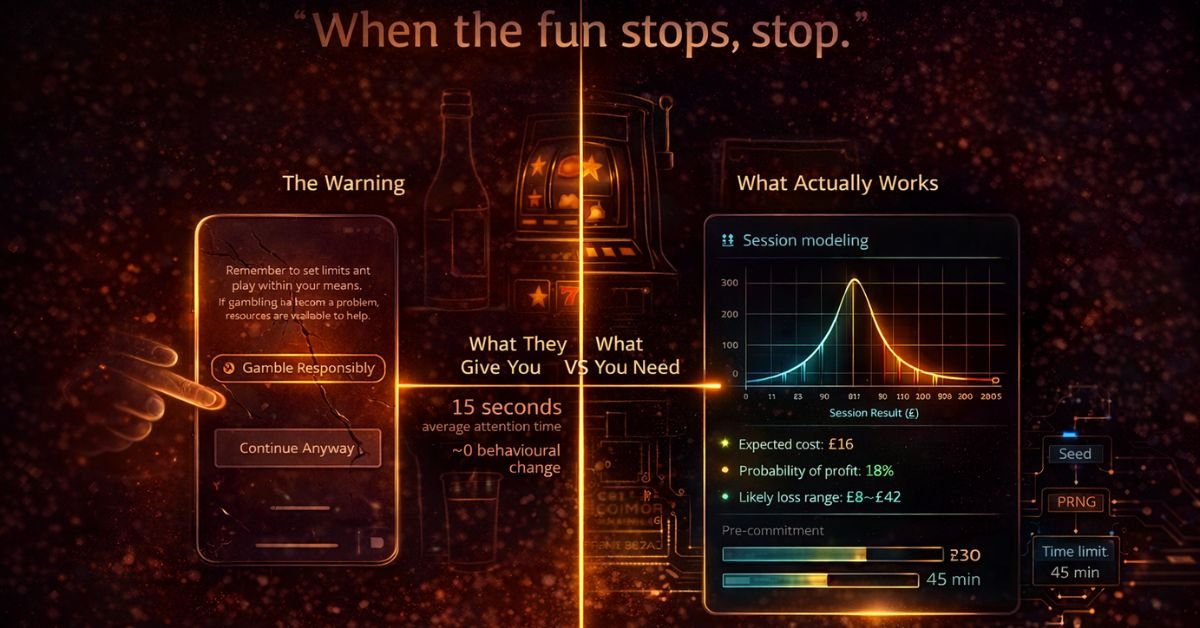
Responsible gambling warnings — “Gamble responsibly,” “18+,” “When the fun stops, stop” — are the most visible intervention in the problem gambling prevention toolkit. They appear on every slot game, every casino homepage, and every advertisement in regulated markets. They are legally mandated in most jurisdictions. And the research evidence on how effectively they actually change gambling behaviour is, at best, deeply inconclusive and, at worst, a case study in applying the wrong framework to the wrong problem. This article examines what the research actually shows about why standard responsible gambling warnings fail for slots specifically, what structural feature of gambling makes it fundamentally different from every other addiction that these warnings were designed for, and what kinds of intervention the evidence does support.
What Responsible Gambling Warnings Are Built to Do
To understand why responsible gambling warnings often fail, you first need to understand what they were designed to do — and what underlying assumptions that design reflects. Standard responsible gambling messaging sits within a well-established tradition of public health harm communication: identify the hazard, communicate it clearly, create awareness of consequences, and trust that awareness will modify behaviour. It is the model that produced graphic health warnings on cigarettes, drink-drive campaigns, and drug awareness programmes. The logic is familiar: people engage in harmful behaviour partly because they underestimate or ignore the risks, so making the risks visible and salient should reduce harmful behaviour.
Applied to gambling, this produces warning messages focused on the consequences of problem gambling — financial damage, relationship breakdown, mental health impact — and calls to action framed around harm reduction: set limits, know when to stop, seek help if you have a problem. The messages communicate harm, assume the player understands the reward, and attempt to shift the cost-benefit calculation toward restraint.
Responsible Gambling Warnings — What the Research Shows
What the Evidence on Warning Effectiveness Actually Shows
The empirical record on responsible gambling warning effectiveness is not a case of mixed results where some studies show strong effects and others do not. The dominant pattern across systematic reviews is that standard warning messages reliably improve stated awareness of gambling risks while producing little or no measurable change in actual gambling behaviour.
Steenbergh et al. (2004) found that brief warning messages improved knowledge of gambling risk but did not significantly change irrational gambling beliefs or actual behaviour. Multiple reviews of school-based gambling education programmes — which are essentially extended warning interventions — found that while participants could correctly answer questions about gambling risks after the programme, their gambling behaviour in follow-up assessments was not significantly different from controls. Grande-Gosende et al. (2019) conducted a systematic review of prevention programmes for young adults and found the evidence base was insufficient to identify reliably effective approaches. Armstrong et al. (2018) tested an “intelligent messages framework” for developing gambling warnings and found promising results only for highly personalised, contextually relevant messages — not for generic harm-communication formats.
The picture that emerges is consistent: the further a warning message is from the player’s actual gambling context, the weaker its effect. Generic warnings on casino homepages are at the furthest remove. Brief in-game messages are marginally better. Personalised, contextually timed messages that engage the player at a specific decision point show more promise. But even the most effective formats in the research produce modest effects that fall well short of what the volume of warning messaging deployed across the industry might lead you to expect.
The Gap Between Awareness and Behaviour
The consistent finding that warnings improve awareness without changing behaviour is not a puzzle to be explained away — it is the central data point that reveals a structural problem with the harm-communication model as applied to gambling. Awareness of a risk changes behaviour when the person receiving the warning is weighing up whether to engage in a behaviour whose benefits they could take or leave. But gambling, at the point where warnings matter most, is not a cost-benefit calculation being made by a neutral observer. It is a compulsion being managed by someone in an active psychological state shaped by structural features of the game itself — variable ratio reinforcement, engineered near-misses, losses disguised as wins — that operate below the level of conscious rational assessment. Delivering more harm information into that state does not give the person better reasons to stop. It gives them more content to mentally push aside in order to continue.
The Wrong Model: Why Gambling Was Treated Like Smoking
The harm-communication model applied to responsible gambling warnings was not developed for gambling. It was developed for substance addictions — tobacco in particular — and adapted to gambling on the assumption that the addictive mechanisms were similar enough that the same framework would apply. The research evidence increasingly suggests that assumption was wrong in a specific and important way.
Consider what happens when a smoker receives a graphic health warning on a cigarette packet. The warning communicates harm: cancer, cardiovascular disease, premature death. The smoker already experiences the reward — the neurochemical effect of nicotine, the ritual, the stress reduction — as a real, immediate, and subjectively valuable sensation. The warning adds information about the cost of that reward. The smoker’s rational system must now weigh the subjective reward (real and experienced) against the communicated harm (abstract and future). The problem, of course, is that this calculation rarely produces behaviour change, because the reward is immediate and the harm is distant. But the harm-communication model at least makes contact with the right structure: reward is real, harm is the thing being communicated.
Now consider what happens when a slot player receives a “When the fun stops, stop” message. The message communicates harm awareness and calls for self-regulation. But what is the player’s reward at the moment the warning appears? It is not a neurochemical sensation that they are actually experiencing. It is the prospect of a monetary win — a future event whose probability can be precisely calculated, whose expected value is negative, and whose occurrence in any given session is governed by a certified mathematical model. The reward is not a felt experience. It is a belief about an expected future event. And unlike the smoker’s nicotine sensation, a belief about an expected future event can be interrogated with mathematics.
Smoking
Reward: neurochemical — real, immediate, felt. Cannot be mathematically falsified. Harm messaging targets the cost of a real reward. Behaviour change requires overcoming the immediate pull of an actual physiological experience.
Alcohol
Reward: neurochemical + social + psychological — real and immediate. Cannot be mathematically falsified. Standard harm messaging addresses the cost of a multi-dimensional real reward. Similar structural limitations to smoking warnings.
Slot Gambling
Reward: monetary expectation — a belief about a future probabilistic event. Uniquely deconstructable with mathematics. Harm messaging addresses the cost while leaving the reward belief intact. This is the structural failure standard warnings make.
The critical difference is this: the gambling reward is a mathematical construct that can be examined and falsified, while the smoking and drinking rewards are felt experiences that resist mathematical interrogation. Standard responsible gambling warnings apply a framework designed for the latter to an addiction that uniquely permits the former. That mismatch is the structural reason warnings fail for gambling in ways that do not have direct analogues in tobacco or alcohol harm communication.
The Unique Feature of Gambling No Warning Addresses: The Deconstructable Reward
The most important insight from the academic research on responsible gambling is this: the primary reward in slot gambling — the expectation of winning money — is mathematically deconstructable in a way no other addiction reward is. This single property creates a harm-prevention opportunity that standard responsible gambling warnings have almost entirely failed to exploit.
When a player sits down at a slot, the reward they are chasing is not something they are experiencing in the present moment. It is a belief: “I might win, and if I win, it will have been worth it.” That belief can be examined. The probability of winning can be estimated from published RTP and volatility data. The expected monetary value of the next spin — and the next 100, and the next 200 — can be calculated. The realistic range of session outcomes, including the probability that a given session ends in profit, can be modelled. When these numbers are made concrete and personal — not as abstract percentages but as “at your stake level, over your intended session length, here is what the math says is likely to happen” — the reward itself is interrogated rather than merely weighed against a cost.
The Deconstructable Reward Argument
A smoker’s reward cannot be mathematically falsified. The physiological sensation of nicotine, the perceived stress relief, the social dimension — these are real experiences that resist quantitative deconstruction. Telling a smoker “the probability that this cigarette is worth it is X%” is meaningless because the reward is not a probabilistic expectation. It is a felt reality.
A slot player’s reward is fundamentally different. “I might win” is not a felt experience — it is a belief about a future probabilistic event. That belief can be replaced with a probability. That probability can be combined with the stake and the session length to produce an expected value. That expected value is negative for every licensed slot ever produced. The belief that continued play will produce a net monetary benefit is mathematically falsifiable — and standard responsible gambling warnings never attempt to falsify it.
This is the specific opportunity that the research identifies and that responsible gambling messaging has almost universally failed to exploit. The most effective intervention for slot gambling is not “be aware this is risky.” It is “here is the math that shows why the reward you are chasing is not what you think it is.”
This is why tools that model expected session outcomes — not as abstract RTPs but as concrete expected losses and outcome distributions — represent a qualitatively different type of responsible gambling intervention. The volatility and RTP calculator and the session risk analyser embody this principle: they translate the game’s certified probability architecture into player-level expected outcomes, turning the abstract reward belief into a concrete mathematical picture. That picture does not guarantee behaviour change. But it addresses the reward structure directly — which standard responsible gambling warnings have never done.
The Wrong Dimension: Why Math-Based Warnings Miss the Cognitive Distortions
If the deconstructable reward argument suggests that math-based warnings should replace harm-based warnings, a second body of research raises an important qualification: the specific type of mathematical understanding delivered matters enormously, and most math-based interventions have targeted the wrong dimension.
The cognitive distortions most closely associated with problem gambling — the gambler’s fallacy, the near-miss effect, hot and cold streak beliefs, the illusion of control — do not primarily operate in the mathematical dimension of the player’s understanding. They operate in the epistemic dimension: how the player perceives and reasons about randomness during a session. Teaching someone the mathematical rules of probability — that spins are independent, that RTP is a long-run average — delivers facts about abstract structures. It does not necessarily change how randomness feels during an active session, or why a near-miss creates urgency to continue, or why a losing run generates the conviction that a win is imminent.
This is why multiple empirical studies of gambling math education have found no significant change in gambling behaviour even when participants correctly learned the mathematical content. The information went into the mathematical dimension of their understanding while the distortions continued operating in the epistemic dimension — largely untouched. Standard responsible gambling warnings that incorporate mathematical content (displaying RTP percentages, stating the expected loss per hour) face the same problem: the information is accurate but it operates at the wrong cognitive level to address the distortions that drive problematic play.
| Warning Type | What It Addresses | What It Misses | Effect on Behaviour |
|---|---|---|---|
| Generic harm message (“Gamble responsibly”) | General awareness of gambling as risky | The reward belief; cognitive distortions; specific game risks | Minimal — too abstract and remote from the decision context |
| RTP display on game screen | Long-run return percentage | What RTP means for this session; that it applies to an infinite run; the reward deconstruction; distortions | Weak — typically misunderstood as applying to every session |
| Math-based education (probability, expected value) | Mathematical facts about the game | The epistemic dimension where distortions live; the reward deconstruction; how these facts apply to this specific session | Inconsistent — improves knowledge without reliably changing behaviour |
| Personalised in-session pop-up (spend to date) | Actual money spent in current session | Expected future loss; reward deconstruction; distortions operating right now | Moderate — contextually relevant but still does not address the reward belief |
| Pre-session expected outcome modelling | Concrete expected loss, range, and bust probability for this session | Distortions that arise in-session — requires pre-commitment to function | Most promising — addresses reward directly, before emotional state of play begins |
| Pre-commitment tools (loss limits, session timers) | Structural constraint that operates before play affects cognition | The understanding that motivates voluntary pre-commitment | Consistently most effective — operates structurally, not cognitively |
Why Slot-Specific Warnings Face Additional Structural Problems
Beyond the general framework problems, slots present specific additional challenges for responsible gambling warnings that are not shared by table games or sports betting. These challenges are direct consequences of the structural features built into slot design through the PAR sheet — features that responsible gambling messaging has not been designed to address.
The Timing Problem
Responsible gambling warnings appear before or during a session — typically at login, on the game loading screen, or as periodic in-session pop-ups. But the cognitive state that makes warnings least effective is the active-play state: elevated arousal, reward anticipation, variable ratio reinforcement creating compulsive continuation. The player who most needs the warning is in the worst cognitive state to receive it. Pre-session warnings are seen by a player not yet in that state. In-session warnings interrupt a player already in it. Neither timing is optimal for the harm-communication model.
The Near-Miss Problem
The near-miss effect is the single most powerful driver of continued play in slot gambling and is directly engineered into game design through asymmetric reel strip weighting. Near-misses occur at rates higher than pure probability would produce because early reels carry more premium symbol positions than late reels — the game is designed to produce the near-miss experience frequently. No standard responsible gambling warning explains this. The message “When the fun stops, stop” gives no cognitive resource for recognising that the urgency generated by a near-miss is responding to a designed structural feature of the game rather than a genuine proximity signal. The warning and the mechanism that overrides it exist in entirely separate cognitive registers.
The RTP Miscomprehension Problem
Even when slots display RTP percentages as required by regulation, the research consistently shows that players systematically misinterpret what they mean. Studies by Collins et al. (2014) and Harrigan (2007), among others, demonstrate that players tend to interpret RTP as meaning they will get back that percentage of their deposit in any given session — rather than as a long-run statistical average across an infinite series of plays that has essentially no predictive value for any individual session. The RTP display functions as a responsible gambling warning but creates a false sense of calculability: “I know this is a 96% game, so I have a good chance of getting most of my money back.” That interpretation is incorrect. And no standard warning message corrects it, because doing so would require explaining what statistical averages mean in the context of a finite session — which is a different order of information from a percentage on a screen.
The RTP display as accidental misinformation. Displaying RTP without explaining what it means in the context of a finite session is not just insufficient — the research suggests it may actively create misleading expectations. A player who interprets “96% RTP” as “I’ll probably get 96p back for every £1 I spend today” is materially misinformed about the game they are playing. The responsible gambling system has mandated a disclosure that, without context, produces a false sense of mathematical clarity. The full explanation of what RTP does and does not mean for individual sessions is covered in the RTP guide.
The Variable Ratio Reinforcement Problem
Slot machines use variable ratio reinforcement schedules — the same schedule used in the most compulsive behavioural patterns studied in psychology — because this schedule produces the highest rates of continued behaviour and the greatest resistance to extinction. Unlike fixed reward schedules, variable ratio schedules make behaviour highly resistant to any single negative event (a loss, a warning, a moment of rational assessment) because the player has no way to know whether the next trial will be the one that delivers the reward. This is not a design flaw that regulators have overlooked. It is the core commercial mechanic of the product. Standard responsible gambling warnings are delivered into an environment that is specifically engineered to override them. The warning system and the product design are pulling in directly opposite directions, and the product design has 60+ years of behavioural psychology research optimising it for engagement.
What the Research Says Actually Works — and Why
The picture so far is critical of standard responsible gambling warnings — but the research is not without positive findings. Several types of intervention show consistent enough evidence of effect to be meaningfully distinguished from the general pattern of weak results.
Pre-Commitment Tools: The Most Consistent Performer
Deposit limits, loss limits, session time limits, and cooling-off periods consistently appear in the research as the most reliably effective responsible gambling interventions available. The reason is structural: they operate before the player is in the active-play psychological state that makes cognitive interventions ineffective. A loss limit set at account login cannot be overridden by the near-miss urgency of an active session. It is an earlier, calmer version of the player making a binding decision on behalf of the player who will be in a worse cognitive position later. The research and clinical evidence for pre-commitment are stronger than for any warning message format. The responsible gambling planner operationalises this principle before you open a game.
Personalised, Contextually Relevant Feedback
Warnings that reference the player’s actual behaviour — current session spend, time elapsed, comparison to previous sessions — consistently outperform generic harm messages. The research by Armstrong et al. (2018) on intelligent message frameworks suggests that contextual relevance is the critical variable: a message that tells you specifically what you have spent and how that compares to your stated limits is more effective than a message that tells you gambling can cause financial harm. The latter is abstract and could apply to anyone. The former applies to you, now. This is the direction the most effective in-session responsible gambling systems are moving — real-time behavioural feedback rather than static harm warnings.
Reward Deconstruction: The Underexplored Opportunity
The intervention with the strongest theoretical justification — and the least developed evidence base, because it has rarely been tried — is what the academic research calls reward deconstruction: making the expected monetary value of continued play concrete and personal before the session begins. This is the direct application of the deconstructable reward argument. Showing a player that their intended 200-spin session at £2 per spin has an expected cost of £16, with a 20% probability of ending in profit and an 80% probability of ending in loss, is not a harm warning. It is a mathematical examination of the reward itself. The session risk analyser is built on this principle.
Critical Thinking Curricula
Turner et al. (2008) found that curricula focused on critical thinking skills — rather than purely on probability facts — showed more promise for changing gambling behaviour than standard mathematical education. Critical thinking about gambling means developing the capacity to examine your own reasoning in real time: to ask “what am I responding to right now, and is that response based on the math or on something the game is designed to make me feel?” This is the epistemic dimension at work. It is harder to teach than probability, but the research suggests it operates at the right cognitive level to address the distortions that mathematical facts alone cannot reach.
What Players Can Do With This Knowledge Now
The responsible gambling system will not be redesigned overnight. But knowing why standard responsible gambling warnings fail gives you a specific toolkit for going beyond them. Use pre-commitment tools — deposit and loss limits — before every session: this is the single most evidence-backed protective intervention available to you as an individual. Use session modelling tools to make the expected value of your session concrete before it begins — this addresses the reward directly. Learn to name the structural features of slots that generate urgency during play: near-misses as reel strip design, losses disguised as wins, variable ratio reinforcement. Naming them correctly in the moment reduces their power over your decisions. And treat any generic warning message for what it is — a regulatory compliance mechanism that does almost nothing for you as an individual — rather than as a meaningful safeguard.
A Framework Players Can Use Now, Before the Industry Catches Up
Given that the responsible gambling warning system as currently designed has significant structural limitations, the most useful thing this article can do is give you a framework that works better — one grounded in what the research identifies as actually effective, applied at the individual level.
Step 1: Pre-Session — Deconstruct the Reward
Before opening any slot game, make the expected value of your session concrete. This means: what is the game’s certified RTP? What is the volatility? What stake per spin are you planning? How many spins in your session? Multiply: stake × spins × (1 − RTP) = expected cost. That is not a warning. That is a number. Then use the volatility and RTP calculator or session risk analyser to see the realistic distribution of outcomes around that expected cost — because high volatility means your actual session result could be far above or far below the expected value. When you see both the expected cost and the realistic outcome range before starting, you are making an informed decision rather than acting on the reward belief that the game has not yet had a chance to reinforce.
Step 2: Pre-Session — Set Structural Limits
Set a deposit limit, session loss limit, and session time limit at your casino before starting. These limits do not depend on your cognitive state during play. They are a commitment device — an earlier, more rational version of yourself making a decision that protects the version of you who will be in the game. This is the single most effective intervention identified in the research. The responsible gambling planner walks you through setting these concretely.
Step 3: During Play — Name What the Game Is Doing
During the session, apply the epistemic framework: name what the game is doing when it does it. Two high-value symbols on the first two reels, blank on the third: “reel strip asymmetry — engineered near-miss, not proximity to winning.” A 0.30× return on a 1.00× spin with a win sound: “loss disguised as win — 0.70× net loss.” A losing run that feels like a win must be coming: “gambler’s fallacy — the RNG has no memory and no debt.” These labels are not magic. But they shift your cognitive relationship to what is happening from passive experience to active assessment. That shift is where the protective effect lives.
Step 4: At Break Points — Re-evaluate With Math, Not Mood
When you naturally pause — a bonus feature ends, a session limit is approaching — do not evaluate whether to continue based on how you feel about the session. Evaluate based on what the math says: have you exceeded your pre-set loss limit? What is your actual net position? Apply the expected value calculation again. The mood-based assessment (“I’m down but I feel like it’s going to turn”) is exactly what variable ratio reinforcement is designed to produce. The math-based assessment (“I’m at my limit, the expected cost of continuing is the same as it was at the start”) is what the research suggests actually helps.
The core principle: Standard responsible gambling warnings address harm. The framework above addresses the reward. Both matter — but for slot gambling specifically, the reward is where the most important cognitive work needs to happen, and the reward is the dimension that the existing warning system almost entirely ignores. Until the system catches up, individual players who understand this have a meaningful advantage over those who rely on “Gamble responsibly” as a meaningful safeguard.
Further Reading
The research basis for this article spans several bodies of work. The mathematical specificity argument — that gambling addiction’s unique feature is the mathematical deconstructability of the reward — is developed in Bărboianu’s work on the mathematics-related specificity of problem gambling awareness. The broader review of prevention programme ineffectiveness is covered in Williams, West, & Simpson (2012) and Grande-Gosende et al. (2019). The RTP miscomprehension research is documented in Collins et al. (2014) and Harrigan (2007).
On the site, the articles that provide the full context for each section of this piece are: Player Psychology in Slot Games for the full landscape of how slot design affects player behaviour; Variable Ratio Reinforcement in Slots for the specific mechanism that makes in-session warnings so difficult to act on; Near-Miss Effect in Slots for how engineered near-misses operate and why no standard warning addresses them; Losses Disguised as Wins for the multi-line PAR sheet construction issue that produces the LDW phenomenon; Illusion of Control in Slots for the stop-button and ritual-belief distortions; and Gambler’s Fallacy in Slots for the overdue-win belief and its epistemic roots. For the practical tools that operationalise the pre-session framework described in Section 8, the Responsible Gambling Planner, Session Risk Analyser, and Volatility and RTP Calculator are the starting points. The full responsible gambling guide provides the broader framework within which all of these tools and approaches sit.
Do What Responsible Gambling Warnings Should Have Done
The Session Risk Analyser deconstructs the reward before you play — showing you the expected cost, the realistic outcome range, and your bust probability at your stake level. That is a responsible gambling intervention. The warning on the casino homepage is not.
Deconstruct My Session Risk →Responsible Gambling Warnings — FAQ
Do responsible gambling warnings actually work?
The research evidence shows they consistently improve awareness of gambling risks but produce little or no reliable change in actual gambling behaviour. The dominant finding across systematic reviews is that knowledge and stated intentions improve while behaviour does not follow. The gap between awareness and behaviour change is the central data point that reveals the structural problem: harm communication was designed for addictions where the reward is a felt experience, not a mathematical expectation. For gambling, the reward is a belief about future monetary gain that can be interrogated mathematically — and standard warnings never do this.
Why are gambling warnings less effective than anti-smoking campaigns?
Because the reward structures are fundamentally different. A smoker’s reward — the neurochemical effect of nicotine, the perceived stress relief — is a real, immediate, felt experience that cannot be mathematically falsified. Anti-smoking warnings communicate harm against a real reward, and the difficulty of behaviour change comes from the immediate pull of that experience. A slot player’s reward is a belief about a future probabilistic event — the possibility of winning money. That belief can be replaced with a calculation: expected value, session outcome probabilities, realistic loss distribution. Standard gambling warnings communicate harm but never deconstruct the reward, which is the unique opportunity that gambling addiction presents and that the system has not exploited.
What does “deconstructable reward” mean in gambling?
It means the primary motivation for continued gambling — the expectation of winning money — is not a felt sensation but a probabilistic belief that can be examined and falsified with mathematics. The expected monetary value of any licensed slot game is negative across any finite session. The probability that a given session ends in profit is calculable from RTP and volatility data. When these calculations are made concrete and personal before a session begins, the reward belief is interrogated rather than merely weighed against a communicated harm. No other major addiction has this property — the gambling reward uniquely permits mathematical examination, and responsible gambling warnings have almost entirely failed to exploit it.
Why is displaying RTP on a slot game not enough as a responsible gambling measure?
Because RTP without explanation of what it means in a finite session context is routinely misinterpreted. Research consistently shows players interpret RTP as applying to their individual session — “96% RTP means I’ll probably get 96% of my money back today” — when it actually describes a statistical average across an effectively infinite number of plays with essentially no predictive value for any individual session. The displayed number is accurate; the understanding players bring to it is systematically wrong. Without context — what RTP means for session variance, the realistic range of outcomes, the expected cost at a given stake level — RTP display can create false confidence rather than informed caution.
What responsible gambling interventions does the research say actually work?
Pre-commitment tools — deposit limits, loss limits, session time limits — show the most consistent positive evidence across the research. They work because they operate structurally before the active-play psychological state that makes cognitive interventions difficult. Personalised, contextually relevant feedback (spending your actual session money relative to your stated limits) outperforms generic harm messages. Pre-session expected outcome modelling — making the expected cost and realistic outcome range concrete before you start — addresses the reward structure directly. Critical thinking frameworks that help players examine their own in-session reasoning in real time show promise in the research but are the least developed in practice.
Why do near-misses keep driving play even when players know what they are?
Because the near-miss effect operates in the epistemic dimension of how players experience randomness — not in the mathematical dimension where facts about reel strip design sit. Knowing that a near-miss is an engineered consequence of asymmetric symbol weighting across the reels is accurate mathematical and structural knowledge. But the emotional urgency a near-miss produces is generated by a different cognitive system — one that responds to proximity cues as signals regardless of their mathematical meaning. The knowledge and the response operate at different levels. What helps is regular, repeated practice of naming the near-miss correctly as it happens — “reel strip asymmetry, not proximity to winning” — which gradually builds the epistemic habit of applying the correct frame in real time. No standard responsible gambling warning teaches this.
What can individual players do that responsible gambling warnings fail to do?
Four things: First, model the expected cost and realistic outcome distribution of your intended session before you start — this deconstructs the reward directly. Second, set structural limits (deposit and loss limits) before opening a game — these operate before your cognitive state is altered by play. Third, learn to name the structural features of the game that generate urgency — near-misses, losses disguised as wins, variable ratio reinforcement — so you can identify them correctly in the moment. Fourth, evaluate whether to continue at break points using math (actual position relative to pre-set limits) rather than mood (how the session feels). Together these four steps do what responsible gambling warnings are supposed to do but rarely achieve.
Is the problem with responsible gambling warnings that there aren’t enough of them?
No. The problem is structural, not quantitative. More of the same type of warning — more generic harm communication in more locations — will not produce meaningfully different results from what the research already shows. The research consistently finds that the content and timing of warnings matter more than their frequency. A well-designed pre-session intervention that deconstructs the reward and supports pre-commitment is worth more than a hundred “Gamble responsibly” messages. The industry and regulators need frameworks that address the reward structure specifically — the deconstructable nature of the gambling reward — rather than applying the harm-communication model that was developed for addictions with a fundamentally different reward architecture.