
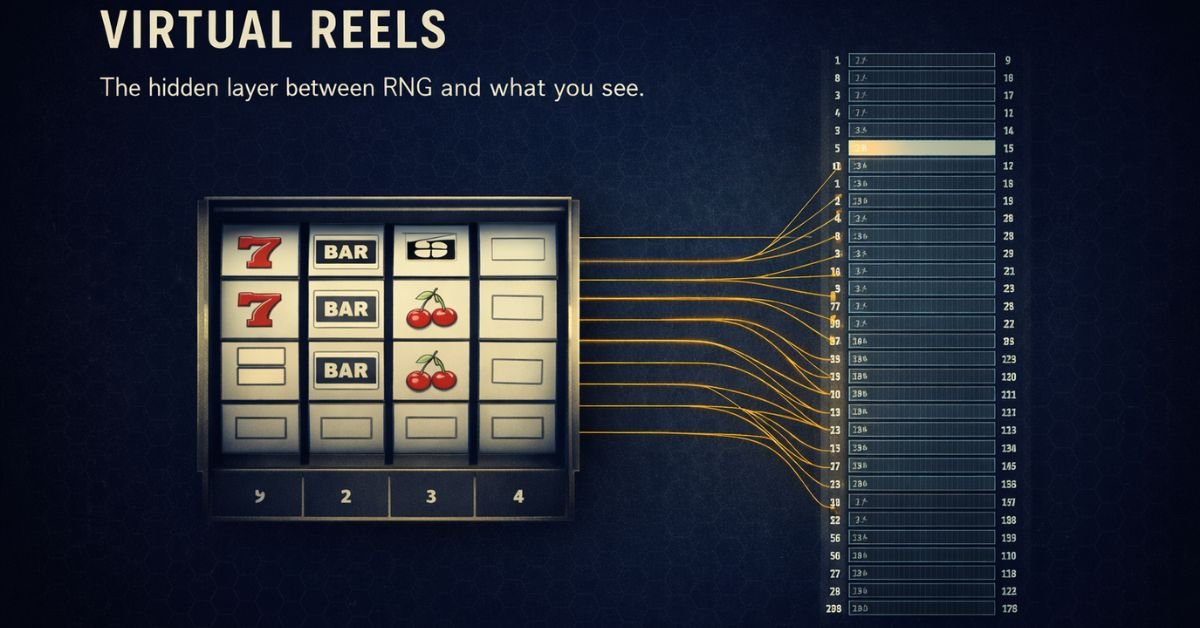
Virtual reels slots — the mechanism that sits invisibly between the RNG and the symbols you see — is the foundational reason why a slot’s true odds are impossible to read from the display. Every symbol appears to occupy equal space in the reel window. The math model behind it assigns each symbol a completely different probability. That gap is not accidental. It is the engineered product of the virtual reel: a data structure that maps what the RNG generates to what the display renders, and that controls every probability in the game while remaining entirely hidden from the player. This article explains exactly what virtual reels are, how they work mechanically, why they exist, and what they reveal about the relationship between what you see and what the math actually produces.
Physical Reels vs Virtual Reels: Why the Shift Changed Everything
In the mechanical slot machines that preceded online gambling, the reels were physical objects. A reel with 20 stops had 20 actual positions — each one a physical notch where the reel could come to rest. Every symbol was printed on the physical strip in the number of positions it occupied. If the cherry symbol appeared on 3 of 20 stops, it had a 15% probability per reel. A player who counted the physical symbols could, in principle, calculate the probability of any combination. The configuration was visible. It was the game.
Virtual slots changed this completely. In a video slot or online slot, there is no physical reel. The RNG generates a number. That number is mapped — through the virtual reel — to a symbol. The symbol the player sees is not selected directly. It is the output of a two-step process: first a number is generated, then that number is translated into a symbol position. The virtual reel is the translation table for that second step.
This two-step process created something that had not existed in mechanical gambling: a layer of mathematical specification that is entirely separate from the visual display and that controls the game’s probability architecture invisibly. The virtual reel is that layer. Its configuration — how many positions it has, which symbols are assigned to which positions, how many positions each symbol occupies — determines every probability in the game. And it is never shown to the player.
Virtual Reels Slots — Core Facts
How Virtual Reels Work: The Mapping Mechanism
The virtual reel works through a simple but consequential mapping. The RNG generates a large integer — continuously, many times per second, from the moment the game loads. When the player presses spin, the current number is captured for each reel. That number is then mapped to a stop position on the virtual reel through a modulo operation or lookup table, and the symbol at that stop position is displayed.
Here is the mechanical sequence for a single reel:
RNG generates a number
The RNG produces a large pseudo-random integer — for example, 2,847,392. This happens continuously. The value at the exact moment the spin button is pressed is captured for this reel.
→ Raw output: an integer
Number is mapped to a stop position
The integer is divided by the number of stops on the virtual reel and the remainder is taken (modulo operation). If the reel has 64 stops: 2,847,392 mod 64 = 32. Stop position 32 is selected. Each stop position therefore has an equal probability of 1/64 of being selected on any spin.
→ Selected stop: position 32 of 64
Stop position is looked up in the reel strip
The virtual reel strip is a list of 64 entries. Position 32 contains the symbol “Mid A.” This is the symbol the RNG selected for this reel on this spin.
→ Symbol assigned: Mid A
Display renders the symbol
The display engine shows “Mid A” in the reel window for this reel. The rows above and below the active payline show the symbols adjacent to stop 32 on the reel strip — creating the visual impression of a spinning reel that “stopped” at this position.
→ Player sees: Mid A in reel window. Adjacent symbols visible above and below.
Process repeats independently for all five reels
Steps 1–4 happen independently and simultaneously for each reel. Five separate RNG numbers are captured. Five separate stop positions are selected. Five separate symbols are displayed. The outcome is the combination of all five, evaluated against the paytable.
→ Five independent results combine to produce the displayed spin outcome
Why Steps 3 and 4 Together Create the Display Gap
The critical point is between Steps 3 and 4. In Step 3, probability is determined entirely by how many stop positions each symbol occupies on the reel strip. In Step 4, the display renders the symbol — and all symbols are rendered the same size, in the same visual space, with no indication of how rarely or frequently they occur. The display is a probability-neutral rendering: it does not show that the premium symbol has 2 stops out of 64, making it 23 times rarer than the blank with 15 stops. Step 3 is the math model. Step 4 is the presentation layer. Virtual reels slots exist in the gap between them.
Anatomy of a Virtual Reel Strip
The virtual reel strip is the data structure that defines symbol weighting. It is a sequential list of stop positions — 32, 64, 128, or more entries — each assigned a symbol. The number of times a symbol appears in that list is its weight, and weight equals probability because all stop positions are equally likely to be selected.
Illustrative Virtual Reel Strip — 32 Stops Shown
Reel 1 (early)
Reel 3 (middle)
Reel 5 (late)
Illustrative first 16 stops of three reels from a hypothetical game. Gold outline = premium (★) symbol positions. Notice Reel 1 has 2 premium stops in the first 16 shown; Reel 3 has zero; Reel 5 has zero. The display shows all three reels identically — same window, same symbol size, same visual weight. The probability architecture is invisible in the display.
Three things are immediately visible from even this partial reel strip view. First, blank positions are the most common entry — more than any individual symbol tier. Second, premium symbol positions are scarce and clustered on the early reel. Third, Reels 3 and 5 carry no premium positions in this partial strip, which directly controls how rarely the premium combination can complete across all five reels. The display will never show you any of this. It will show the premium symbol landing on Reel 1 and make it look like it has roughly the same probability as Mid A or High A. It does not.
Worked Example: From RNG Number to Display Symbol
The following uses a simplified 8-stop reel to make the full chain concrete. Real games use 32–512 stops; the mechanism is identical.
| Stop # | Symbol Assigned | Probability (1/8) | What Player Sees |
|---|---|---|---|
| 1 | ★ Premium | 12.5% | ★ in reel window |
| 2 | High A | 12.5% | High A in reel window |
| 3 | Blank | 12.5% | Blank in reel window |
| 4 | Blank | 12.5% | Blank in reel window |
| 5 | Mid A | 12.5% | Mid A in reel window |
| 6 | Blank | 12.5% | Blank in reel window |
| 7 | Low A | 12.5% | Low A in reel window |
| 8 | Blank | 12.5% | Blank in reel window |
On this simplified 8-stop reel, all symbols appear equally probable because each has exactly 1 stop. The premium symbol has the same probability as a blank. This is what a uniform weighting looks like — and it produces a game with relatively similar occurrence frequency for all symbols. Now observe what happens when the math designer changes the stop assignments without changing the display at all:
| Stop # | Symbol Assigned (Weighted) | Probability | What Player Sees |
|---|---|---|---|
| 1 | ★ Premium | 12.5% | ★ in reel window |
| 2 | Blank | 12.5% | Blank in reel window |
| 3 | Blank | 12.5% | Blank in reel window |
| 4 | Blank | 12.5% | Blank in reel window |
| 5 | Low A | 12.5% | Low A in reel window |
| 6 | Blank | 12.5% | Blank in reel window |
| 7 | Low A | 12.5% | Low A in reel window |
| 8 | Blank | 12.5% | Blank in reel window |
In the weighted version, the math designer has replaced Mid A and High A with additional blanks and added a second Low A position. The premium symbol still appears exactly once — 12.5% probability — but now 50% of stops are blank and Low A has doubled to 25%. The display is completely unchanged. The same symbols appear in the reel window. The same animations play. A player watching both versions side by side could not distinguish them visually. The probability architecture is entirely different.
The Core Implication for Players
You cannot read a slot’s probability from its display. Two games with identical visual symbol sets — the same premium symbol, the same scatter, the same wild, the same card suit symbols — can have radically different probability architectures because their virtual reel strips assign those symbols to completely different numbers of stop positions. The display is a probability-neutral presentation. The virtual reel strip is where probability lives. And the virtual reel strip is hidden in the PAR sheet.
The Display Gap: Why Equal-Looking Symbols Are Not Equally Probable
The display gap is the systematic difference between the probability implied by the visual presentation and the probability encoded in the virtual reel. It exists on every virtual slot ever made — because every virtual slot uses stop position weighting to achieve its certified RTP and volatility profile, and the display never shows those weightings.
On a physical mechanical reel, the display was an accurate probability guide. If you saw 3 cherry symbols and 17 blanks on a 20-stop reel, you knew the cherry had a 15% probability per reel and the blank had an 85% probability. The display and the math model were the same thing. The visual representation was also the probability representation.
On virtual reels slots, these two representations are decoupled. The display shows a symbol set. The virtual reel strip assigns probabilities to that symbol set. The player sees the first; the math model operates on the second. The gap between them — the display gap — is where the player’s intuitive probability assessment goes wrong.
What Players Typically Infer From the Display
When the premium symbol appears in the reel window once during a session of 50 spins, it looks like it has a roughly 1-in-50 probability. When blanks appear roughly 3 times as often as mid symbols, blanks look like they have 3× the probability of mid symbols. These visual frequency estimates feel like evidence. They are not. The display is a sample from the virtual reel’s probability distribution — a sample that is too small to be reliable and that is systematically shaped by the weighting to create specific visual impressions.
What the Virtual Reel Strip Actually Encodes
The premium symbol might occupy 1 stop out of 128 — a 0.78% probability per reel. The blank might occupy 60 stops out of 128 — a 46.9% probability. The mid symbol might occupy 8 stops — a 6.25% probability. None of these are visible. None are disclosed. The player’s display-based inference is operating on a sample from a distribution they cannot see, producing systematic underestimates of how rarely premium symbols land and overestimates of how balanced the symbol distribution is.
How Virtual Reel Weighting Shapes Everything You Experience
The virtual reel strip configuration is the primary design variable that determines a game’s character. Every aspect of how the game feels during play — the frequency of any return, how often premium symbols appear, the length of zero-return streaks, the frequency of near-misses, the probability of large wins — is directly controlled by the stop assignments in the virtual reel strips. This is why volatility and hit rate are not independent game properties that a designer sets separately — they are emergent statistical properties of the virtual reel strip configuration.
Same RTP — radically different reel strip configurations
Two games can both carry a certified 96% RTP. One achieves it with frequent small returns (high hit rate, low volatility) — many symbols spread across many stops. The other achieves it with rare large returns (low hit rate, high volatility) — few symbols on sparse stops, many blanks. The display tells you neither. The published RTP tells you neither. Only the virtual reel strip configuration tells you — and that is in the PAR sheet.
Volatility Is a Property of the Reel Strip
High volatility is not a label the designer applies after building the game. It is the mathematical consequence of a specific type of reel strip configuration: premium symbols on very few stops (low weight), blanks on many stops (high weight), with the RTP budget concentrated in the rare premium events. Low volatility is the consequence of the opposite: more balanced weighting, more symbols per tier, fewer blanks. The label describes the statistical output of the configuration. The configuration is in the virtual reel strips.
Hit Rate Is a Property of the Reel Strip
The hit rate — the proportion of spins returning any positive amount — is the sum of all combination probabilities in the statistical model. Every one of those combination probabilities is calculated from the stop counts in the virtual reel strips. Increase blank density across all reels and the hit rate falls. Increase low-symbol density and the hit rate rises. The designer controls hit rate by controlling how stops are allocated in the virtual reel strips. It is not a separate setting.
Maximum Win Is Constrained by the Reel Strip
The maximum win is the highest-paying combination in the paytable multiplied by any active multipliers. For that combination to exist, the premium symbol must occupy at least one stop on every reel in the combination. A game with a 25,000× maximum win necessarily has a reel strip configuration where the premium symbol appears on every reel — but typically on just 1 stop each, making the five-reel alignment vanishingly rare. The maximum win is achievable by the virtual reel design. Its probability is determined by the stop counts.
The Near-Miss Connection: Virtual Reels and Engineered Proximity
Virtual reels enabled a design possibility that mechanical reels could not support: asymmetric symbol weighting across the reel set. In a mechanical reel game, a player could count the stops and notice if the premium symbol appeared more on Reel 1 than Reel 5. In virtual reels slots, no such count is possible — the reel strip data is hidden and the display renders all reels identically.
This made it possible to engineer near-misses at above-chance frequency by a simple mechanism: assign more premium symbol stops to early reels than late reels. Reel 1 gets 4 premium stops; Reel 3 gets 1. Early reels display the premium symbol frequently enough to generate the visual tease of an approaching combination. Late reels suppress the completion probability, keeping the full win rare while maintaining the near-miss frequency at a commercially useful level.
Near-miss multiplier from asymmetric weighting
Assigning the premium symbol to 4 stops on Reel 1 and 3 stops on Reel 2 but only 1 stop on Reel 3 (out of 64 each) produces near-misses approximately 3 times more often than a symmetric configuration with 2 stops on every reel. The full-win probability remains unchanged or lower. The near-miss experience is amplified by a specific virtual reel design decision, not by random chance.
The display cannot reveal this asymmetry. Both the heavily weighted Reel 1 and the lightly weighted Reel 3 look identical in the window — same size, same symbols, same visual presentation. A player watching the game has no way to observe that Reel 3 almost never completes the premium combination compared to how often Reels 1 and 2 start it. The near-miss math model article covers the full probability mechanics of this. The virtual reel strip is the enabling mechanism.
What Players Can Infer Without Seeing the Reel Strip
Since virtual reel strip data is never published, players cannot directly access the probability configuration of any online slot. But the published statistical outputs — RTP, volatility, hit rate where available, and max win — constrain what the virtual reel configuration must look like. The decoding approach is to read from these outputs backwards to the implied reel strip characteristics.
High Volatility + High Max Win → Reel Strip Implications
Premium symbol stops: very sparse, likely 1–2 per reel on most reels. Blank stops: dense, likely 35–55% of all stop positions. Symbol distribution: heavily skewed toward low-value symbols and blanks. Near-miss engineering: probable — early-reel premium weight likely higher than late-reel. What this means for your session: long zero-return sequences between rare large events, frequent near-misses on early reels, very low probability of the maximum win in any finite session.
Low Volatility + Moderate Max Win → Reel Strip Implications
Premium symbol stops: relatively more common, likely 4–8 per reel. Blank stops: less dominant, likely 20–35% of positions. Symbol distribution: more balanced across tiers. Near-miss engineering: less pronounced — more uniform weighting means less reel asymmetry. What this means for your session: frequent small returns, shorter zero-return sequences, premium symbol visible more often across all reels, lower maximum win ceiling.
Neither inference gives you the actual stop counts. But they give you the category of reel strip configuration — sparse and asymmetric vs balanced and uniform — which is sufficient to make meaningfully better game selection decisions than relying on the display alone.
The practical pre-session inference: Before opening a game, check the four published outputs — RTP, volatility label, hit rate where available, max win. Use them to infer the reel strip category: sparse/asymmetric (high vol, high max win, low hit rate) or balanced/uniform (low vol, moderate max win, higher hit rate). Match that category to your bankroll. High-sparsity reel strips require larger bankrolls to survive their inherent dry runs. Use the volatility and RTP calculator to model the outcome distribution before you start.
Further Reading
Virtual reels are the mechanism that makes the hidden slot math possible. For the full probability architecture that virtual reels feed into, the Slot Game Math Models article covers the functional vs statistical model framework and how reel strip configuration generates every downstream statistical output. The PAR Sheet Explained article covers the specific document where virtual reel configurations are specified and certified — understanding what the PAR sheet contains makes the concealment of virtual reel data concrete. For the symbol weighting that the virtual reel strip directly encodes — the stop count per symbol per reel — the symbol weighting article covers the full mechanism and its consequences for probability. ⚠ /symbol-weighting-slots/ — written in a previous session; verify live before publishing as an internal link.
For the near-miss consequence of asymmetric virtual reel weighting, the Near-Miss Effect in Slots and Near-Miss Math Model articles cover the full mechanism. ⚠ /near-miss-display-vs-math-model/ — written in a previous session; verify live before publishing. For the statistical outputs that give the best available inference about virtual reel configuration without access to the PAR sheet, RTP, Volatility, and Hit Rate guides are the starting points. For tools that translate those published outputs into concrete session models, the Volatility and RTP Calculator and Session Risk Analyser apply them to your specific stake and session parameters. For the game creation process that precedes virtual reel configuration — why the math is designed before anything else — How Slot Machines Are Made covers the full production sequence.
Model What the Virtual Reel Configuration Produces
You cannot see the reel strip. You can model what it produces. The Session Risk Analyser uses the game’s published RTP and volatility — the statistical outputs of the hidden virtual reel — to show your realistic outcome distribution before you spin.
Model My Session →Virtual Reels Slots — FAQ
What are virtual reels in slot machines?
Virtual reels are the data structure that maps RNG numbers to the symbols displayed in the reel window. Unlike physical mechanical reels, which had a fixed number of stops printed with symbols, virtual reels are software lists of stop positions — each assigned a symbol. The RNG generates a number, that number maps to a stop position, and the symbol at that position is displayed. The number of times each symbol appears in the list is its weight, and weight equals probability. This configuration is never shown to players — it is specified in the PAR sheet and treated as proprietary.
Why do virtual reels make slot probabilities impossible to read from the display?
Because the display renders all symbols the same size in the same visual space, giving no indication of how many stop positions each symbol occupies. A premium symbol with 1 stop out of 64 (1.56% probability) and a blank with 20 stops out of 64 (31.25% probability) appear identically in the reel window — same size, same visual weight. In mechanical slots, you could count the physical symbols to estimate probabilities. In virtual reels slots, the reel strip is hidden software data. The display is a probability-neutral rendering of the math model’s output.
How many stops does a virtual reel typically have?
Virtual reel strips typically have between 32 and 512 stop positions, though configurations outside this range exist. The most common range for standard 5-reel video slots is 32–128 stops per reel. The number of stops per reel determines the precision with which the math designer can control symbol weighting: more stops allows finer gradation of probabilities. The number of stops is also relevant to regulatory testing — the testing laboratory verifies that the PRNG samples uniformly across the full range of stop positions.
Can different reels in the same game have different weightings?
Yes — and this is standard practice in most slot designs. Each of the five reels has its own independent virtual reel strip with its own symbol assignments. Asymmetric weighting — where premium symbols have different stop counts on different reels — is the primary mechanism for both controlling the probability of full winning combinations and engineering near-miss frequency. Premium symbols are typically weighted more heavily on early reels (1 and 2) than late reels (4 and 5), creating situations where premium symbols appear on early reels more often than they can complete across all five.
Did virtual reels change the odds compared to physical mechanical slots?
Yes, fundamentally. Physical mechanical reels were constrained by the number of physical stops — typically 20–25. This limited both the precision of probability control and the range of achievable RTPs. Virtual reels, with 32–512 stops, allowed math designers to set probabilities with much greater precision, achieve lower premium symbol weights than physically possible, create asymmetric reel configurations invisible to players, and engineer very high maximum win values through extreme symbol sparsity. The shift to virtual reels expanded the probability design space enormously while also making the probability architecture invisible to the player in a way it had not been before.
Is the virtual reel strip ever published for online slots?
Almost never for commercial online slots from international studios. The reel strip configuration is held in the proprietary PAR sheet submitted to regulatory testing laboratories under confidentiality. Some Canadian provincial lottery corporations have historically published PAR sheets for certain land-based machines, providing researchers with real reel strip data. For online slots under MGA, UKGC, or similar licences, virtual reel strip data is not publicly accessible. The published RTP, volatility, hit rate (where available), and max win are the only proxies players have for the hidden configuration.
How does the virtual reel connect to the RNG?
The RNG generates a continuous stream of pseudo-random integers. When the spin button is pressed, the current integer is captured for each reel independently. That integer is mapped to a stop position on the virtual reel — typically by taking the integer modulo the number of stops. The symbol assigned to that stop is displayed. Because the modulo operation produces a uniform distribution across stop positions, each position has an equal probability of being selected (1 divided by total stops). Symbol probability therefore equals the number of stops assigned to that symbol divided by total stops.