
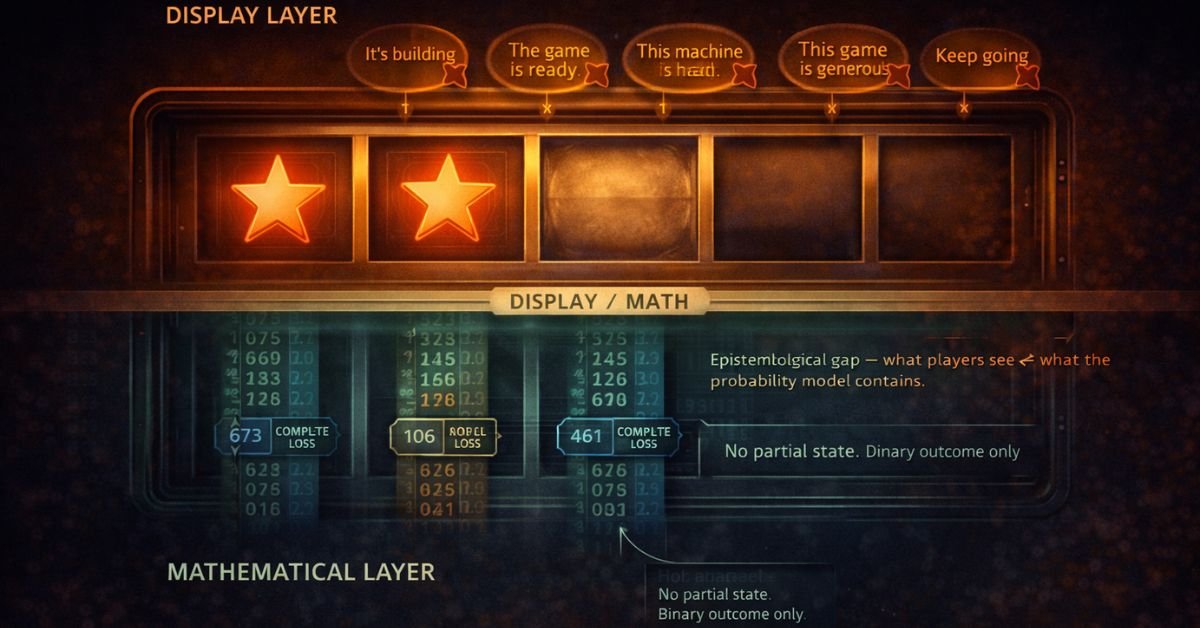
The study of near miss epistemology slots research asks a precise question: what do players actually learn from a near-miss, and is any of it true? The answer, consistently, is that near-misses generate a rich set of player beliefs about proximity to winning, game patterns, and session momentum — and that none of those beliefs are supported by the underlying mathematics. A near-miss contains zero information about future outcomes.
It is a display event, not a probability signal. Understanding why players form false beliefs from near-misses — and what the actual mathematical reality is — is the central problem of near miss epistemology in slots, and it has direct consequences for anyone who plays.
What Epistemology Means in This Context
Epistemology is the branch of philosophy concerned with knowledge — what it is, how it is formed, and when it is justified. Applied to near miss epistemology in slots, the question becomes: does a near-miss constitute genuine evidence about anything? Does it justify updating your beliefs about your chances of winning?
Does it carry information you did not have before it appeared?
These questions are at the heart of near miss epistemology slots research, because players routinely treat near-misses as informative events. A sequence of two premium symbols on the first two reels, with the third reel showing a non-premium outcome, feels like meaningful feedback. It feels like the game came close.
That feeling generates a set of downstream beliefs — about the game’s state, about proximity to a win, about what the next spin is likely to produce.
Near miss epistemology in slots examines whether any of that belief formation is epistemically justified. The conclusion from the research is that it is not. A near-miss is a display outcome — a product of how the visual interface renders an RNG result.
It is not a window into the game’s underlying probability state, which does not change between spins.
Near Miss Epistemology Slots — Core Research Findings
The Two-Layer Structure That Creates the Epistemic Problem
The epistemological problem with near-misses in slots originates in a structural feature of how modern slot machines work: there are two distinct layers between the player’s bet and the displayed outcome, and players conflate them.
Layer 1 — The Display Layer
- What the player sees on screen
- Symbols rendered in the reel window
- Near-miss: two premium symbols visible, third not completing
- Feels like proximity to a win
- Generates the experience of “almost”
- Subject to reel strip asymmetry engineering
- The source of all near-miss belief formation
Layer 2 — The Mathematical Layer
- The RNG draw that determined the outcome
- A number generated independently per reel
- Maps to a stop position via the virtual reel strip
- Completed before the display renders
- Has no memory of previous draws
- Produces a win or a loss — nothing in between
- Near-miss has same probability status as full loss
A near-miss is exclusively a Layer 1 phenomenon. By the time the display shows two premium symbols on early reels, the RNG draw is complete. The mathematical outcome has already been determined — it is a loss.
The display renders a sequence of symbols that creates the visual impression of proximity, but the probability space does not contain “almost winning.” The draw either aligns the required combination or it does not.
This two-layer structure is the origin of the near miss epistemology problem in slots. Players observe Layer 1. They form beliefs about Layer 2 based on what they see.
But Layer 1 is not a transparent window into Layer 2 — it is a rendering that can be engineered, as asymmetric reel weighting demonstrates, to produce Layer 1 patterns that diverge from what the Layer 2 probability structure would produce by chance alone.
The Conflation Error
The core epistemic error in near miss epistemology — the one that generates all five false beliefs — is treating display proximity as probability proximity. “Two out of three premium symbols” feels like being two-thirds of the way to a win. But winning requires all three.
A partial alignment is a complete loss. There is no two-thirds state in the probability model. The display created the impression of a gradient; the mathematics contains only a binary.
5 False Beliefs Near Miss Epistemology Slots Research Identifies
The most fundamental false belief produced by near miss epistemology slots research identifies is spatial or temporal proximity — the idea that a sequence of near-misses moves the player progressively closer to an actual win. This belief treats the slot’s outcomes as a converging sequence with a win as its eventual limit.
This is a complete misreading of how the RNG works. Each spin draws independently. No state is accumulated between spins.
A sequence of ten near-misses carries exactly as much predictive information about the eleventh spin as a sequence of ten full losses — which is none. The game does not “build toward” a win. The probability of each spin’s outcome is reset on every draw.
A second false belief central to near miss epistemology in slots is that near-misses reveal something about the game’s current internal state — that showing premium symbols on early reels indicates the game is in a phase where premium combinations are more likely. This belief treats the display as diagnostic output rather than rendered appearance.
Modern slots have no “pay cycle,” no accumulating state, and no phase that makes premium combinations more likely. The certified RNG draws fresh numbers continuously. The probability of any combination is fixed by the reel strip configuration and is constant across all spins.
The fact that premium symbols appeared on early reels is a consequence of those reels’ stop count distribution — not a signal about the game’s readiness to complete a combination.
A related false belief in near miss epistemology involves the “hot machine” interpretation — reading a sequence of near-misses as evidence that the game is currently in a generous phase that will soon resolve into an actual win. This is the display-layer pattern being mistaken for a probability-layer signal about variance phase.
The hot and cold slots research consistently finds no evidence for machine phases or warm-up cycles. What appears to be a “hot” near-miss phase is in many cases a direct product of asymmetric reel weighting — the engineering decision to place more premium stops on early reels than late reels. This produces a statistically predictable pattern of early-reel premium displays without late-reel completions.
It looks like heat. It is architecture.
A subtler false belief identified in near miss epistemology slots research is the quality inference — that frequent near-misses indicate a game with better odds or more generous behaviour. Players who experience many near-misses in a session sometimes interpret the game as “generous” or “responsive” compared to a game that produces flat losses with no visible near-misses.
Frequent near-misses are not a quality indicator — they are a design choice. Studios engineer near-miss frequency as a player engagement tool precisely because near-misses produce exactly this inference. A game engineered for high near-miss frequency may have a lower RTP and higher house edge than a game producing flat losses.
The display pattern carries no information about the underlying return percentage.
The most behaviourally consequential false belief in near miss epistemology is the continuation justification — the inference that a near-miss provides a rational basis for continuing to play. If beliefs 1–4 are true (proximity, game state, heat, quality), then continuing play after a near-miss seems reasonable. The near miss epistemology problem in slots ultimately converges on this belief, because it is the one that produces financial harm.
Since beliefs 1–4 are all false, the continuation justification built on them is also false. A near-miss provides no rational basis for continued play beyond whatever basis existed before the spin. The next spin’s probability is unchanged.
The session cost per spin is unchanged. The only thing that has changed is the player’s emotional state — arousal has increased, the sense of proximity has intensified, and the cognitive threshold for stopping has risen.
This is the mechanism through which near miss epistemology in slots converts a display event into extended play, increased session cost, and in some cases the onset of loss-chasing behaviour that characterises disordered gambling patterns.
Why These Beliefs Form Despite Being False
The persistence of false beliefs in near miss epistemology slots is explained by the same cognitive architecture that produces the gamblers fallacy and other gambling-related cognitive distortions. Near miss epistemology in slots is not a problem of intelligence or education — it is a problem of cognitive architecture meeting a specifically engineered stimulus environment.
Pattern Recognition Operating on the Wrong Layer
Human visual cognition is highly optimised for pattern detection in sequences. Two matching symbols on a payline register as a partial pattern — the same cognitive process that would correctly identify a partially completed sequence in any physical domain. The brain’s pattern-detection circuitry cannot distinguish “two of three symbols on a payline” from “two of three steps toward a goal” in a physical process.
It responds to the surface structure of the display, not to the underlying independence of the draws.
This is not a correctable error in the sense that education can disable the pattern-detection response. The response is automatic and fast — what Kahneman’s dual-process theory calls System 1 thinking. Knowing that near-misses are epistemically empty does not prevent the automatic pattern-completion inference from forming.
It only gives System 2 reasoning a basis to correct the inference after the fact — and only if System 2 is engaged, which active gambling conditions tend to suppress.
The Representativeness Heuristic Applied to Partial Outcomes
The representativeness heuristic produces the expectation that a random process generating two-thirds of the required symbols is somehow representative of a process that is two-thirds of the way to producing a win. This is a direct extension of the near miss epistemology error — the display looks like two-thirds of a win, and the heuristic treats appearance as probability. The illusion of control literature documents this pattern extensively: players form beliefs about skill, sequence, and probability based on display features that are either engineered or statistically irrelevant.
Arousal Amplifying Belief Persistence
Near-misses produce measurable physiological arousal — elevated skin conductance, increased heart rate, heightened attentional focus. This arousal state has a documented effect on belief persistence: beliefs formed under arousal are more resistant to subsequent correction. The near-miss generates the arousal; the arousal amplifies the belief in the near-miss’s informativeness; the amplified belief motivates continued play; continued play generates more near-misses.
The cycle is self-reinforcing.
Research by Dixon et al. — central to the near miss epistemology slots literature — documented this reinforcement structure directly, finding that near-misses produced arousal responses comparable to actual wins, and that this response was associated with increased motivation to continue playing. Near miss epistemology in slots is therefore not just a static belief error — it is a dynamic process in which false beliefs and arousal reinforce each other across a session.
The Engineered Near-Miss: Deliberate Asymmetry
The near miss epistemology slots problem is complicated by one specific design practice: asymmetric reel weighting. Most players encountering near miss epistemology research assume that near-misses are simply a natural byproduct of random draws — that a random process will sometimes produce partial alignments, and players just misinterpret them.
This is only partially correct. Near-misses do occur naturally in any random draw process. But in many modern slots, near-miss frequency is elevated above what a symmetrically weighted reel strip would produce by design.
Studios assign more premium symbol stops to early reels (Reels 1 and 2) and fewer to late reels (Reels 4 and 5). This means premium symbols appear on early reels more frequently than they complete as combinations on late reels.
| Reel | Symmetric weighting | Asymmetric weighting (engineered) | Effect on near-miss frequency |
|---|---|---|---|
| Reel 1 | 2 premium stops / 64 | 4–5 premium stops / 64 | Premium displays on early reels increase — creates frequent partial alignments |
| Reel 2 | 2 premium stops / 64 | 3–4 premium stops / 64 | Second premium appears more often — deepens the near-miss impression |
| Reel 3 | 2 premium stops / 64 | 2 premium stops / 64 | Neutral — same as symmetric |
| Reel 4 | 2 premium stops / 64 | 1–2 premium stops / 64 | Completion rate drops — combination fails at late reels more than expected |
| Reel 5 | 2 premium stops / 64 | 1 premium stop / 64 | Final reel rarely completes — produces maximum “so close” sensation |
This asymmetric configuration produces the same certified RTP as a symmetrically weighted configuration with the same total premium symbol count — because the probability of a full five-reel alignment is the product of all five reels’ premium probabilities, and the product is preserved across redistributions. But the player experience is radically different. Asymmetric weighting produces a dramatically higher rate of partial alignments (near-misses) while maintaining the same frequency of actual wins.
The epistemological consequence is significant: players who correctly observe that premium symbols are appearing frequently on early reels are right. They just draw the wrong conclusion. The frequent early-reel premium display is a feature of the configuration, not evidence of an approaching win.
Near miss epistemology slots analysis must account for this engineered dimension — the false beliefs are not formed in a neutral environment but in one specifically designed to produce them.
The regulatory status of engineered near-misses is contested. The UK Gambling Commission has published guidance indicating that near-miss frequency in excess of what would arise by chance constitutes a design feature that must be disclosed. Other jurisdictions apply no specific constraint.
Whether the practice is regulated or not, the epistemological consequence for players is the same: the near-miss display frequency is a deliberate design output, not a natural consequence of randomness, and it is specifically calibrated to maximise the false beliefs described in this article.
What a Near-Miss Actually Tells You
Given the near miss epistemology analysis above, a precise answer to “what can you know from a near-miss?” is available.
What a Near-Miss Does NOT Tell You
That a win is approaching. That the game is in a generous phase. That your probability of winning is increasing.
That continuing play is more justified now than before the near-miss. That the game is “hot.” That this was “close” in any probabilistic sense.
That the session is about to turn. None of these inferences are epistemically justified.
What a Near-Miss DOES Tell You
That this spin’s RNG draw produced a stop combination that rendered premium symbols on visible early reels without completing a winning alignment. This is the complete informational content of a near-miss. It tells you about the completed draw — not about any future draw.
It may also tell you that the game uses asymmetric reel weighting, if near-misses appear at above-chance frequency across a session.
The only epistemically valid response — the one near miss epistemology slots research supports — to a near-miss in a slot session is to treat it exactly as you would treat a full loss — as a completed spin that produced no return, with no implications for subsequent spins. This is harder than it sounds, because the arousal response to near-misses is automatic and the false beliefs it generates are cognitively compelling. But it is the only response consistent with the mathematical reality of near miss epistemology in slots.
Practical application: If you find yourself using a near-miss as a reason to continue a session you were about to end — or as a reason to increase your stake — you are acting on false epistemology. The near-miss contained no information that changes the rational decision you were about to make. Name the error explicitly: “This is a near-miss false belief.
The next spin’s probability is unchanged.” Then make the decision you were going to make before the near-miss appeared.
Further Reading
Near miss epistemology in slots sits at the intersection of the psychology cluster and the mathematical model cluster. For the broader documented effect of near-misses on player behaviour — the empirical research on arousal, session continuation, and motivation — the Near-Miss Effect article covers the full literature. For the gamblers fallacy connection — how near-miss false beliefs feed the overdue-win fallacy — the gamblers fallacy article covers the mechanism and why mathematical knowledge fails to fix it. ⚠ /gamblers-fallacy-why-math-doesnt-fix-it/ — session-published, verify live before linking.
For the cognitive distortions that near-miss epistemology connects to — illusion of control, variable ratio reinforcement, and the broader player psychology landscape — those articles cover the interrelated mechanisms. For the reel strip asymmetry that produces engineered near-misses above chance frequency — the architectural feature behind the epistemological problem — the PAR sheet article covers the configuration, and the How Slot Machines Are Made article covers the design process. For the losses disguised as wins mechanism — the multi-line parallel of the near-miss false belief — that article covers the display-layer epistemology problem in a different context.
For tools that replace near-miss-driven intuition with statistical modelling — removing the subjective session assessment that near-miss false beliefs distort — the Volatility and RTP Calculator and Session Risk Analyser provide probability-grounded session expectations.
Replace Near-Miss Intuition With Statistical Modelling
Near-misses distort your sense of how the session is going. The Session Risk Analyser builds a probability-grounded picture of expected outcomes before you play — so your session decisions are based on statistics, not on display events designed to mislead you.
Analyse My Session Risk →Near Miss Epistemology Slots — FAQ
What is near miss epistemology in slots?
Near miss epistemology in slots is the study of what players believe they learn from near-miss outcomes — partial symbol alignments that look close to a win but mathematically are complete losses. The epistemological question is whether near-misses constitute genuine evidence about the game’s state, probability, or future behaviour. The research answer is that they do not: near-misses are display events that contain zero information about future outcomes, because each spin draws independently from a fixed probability distribution.
Does a near-miss mean you were close to winning?
No, in any meaningful probabilistic sense. The display shows partial symbol alignment — two premium symbols on early reels, for example. But “close” in display terms does not correspond to “close” in probability space.
The RNG draw produced a complete loss. There is no partial win state in the mathematics.
The impression of proximity is a display-layer phenomenon, not a probability-layer signal. The probability of winning on the next spin is identical to what it was before the near-miss occurred.
Are near-misses random or engineered?
Both. Near-misses occur naturally in any random draw process — partial alignments are statistically inevitable. But in most modern slot designs, near-miss frequency is elevated above what a symmetrically weighted reel strip would produce.
Studios assign more premium stops to early reels than late reels, producing above-chance rates of partial alignments. The certified RTP remains the same — the premium stop count is redistributed, not increased. But the player experience changes dramatically: more near-misses, more false proximity signals, more motivation to continue play.
Why do near-miss false beliefs persist even when players know they are wrong?
Because the false beliefs are generated by System 1 — fast, automatic cognitive processing — rather than the deliberate System 2 reasoning that can hold the correct mathematical knowledge. The pattern-detection response to two matching symbols is automatic and happens before conscious analysis. Knowing that near-misses are epistemically empty does not disable this automatic response.
Arousal generated by near-misses also amplifies belief persistence, making in-session correction harder even for analytically informed players.
What is the correct response to a near-miss during a session?
Treat it identically to a full loss — as a completed spin that produced no return, with no implications for subsequent spins. If you find yourself using a near-miss as a reason to continue play you were about to end, or to increase your stake, you are acting on one of the five false beliefs near miss epistemology research identifies. Explicitly naming the error — “this is a near-miss false belief; the next spin’s probability is unchanged” — activates deliberate reasoning and creates a gap between the automatic impulse and the action.
Is near-miss engineering regulated?
Inconsistently. The UK Gambling Commission has published guidance indicating that near-miss frequency above what would arise by chance is a design feature requiring disclosure. Several other regulated markets have begun addressing the practice.
In loosely regulated markets, no specific constraint applies. Whether or not it is regulated, the epistemological consequence for players is the same: near-miss frequency in most modern slots reflects deliberate reel strip design, not neutral randomness, and it is calibrated to produce exactly the false beliefs this article describes.
How does near miss epistemology connect to the gambler’s fallacy?
Near miss epistemology is the mechanism through which the gambler’s fallacy is fed during active slot play. The gambler’s fallacy — the belief that a correction is overdue after a losing run — requires a subjective sense that outcomes are building toward something. Near-misses provide exactly this sense by creating the impression of proximity and progression.
A session with frequent near-misses is one in which the gambler’s fallacy is continuously reinforced by the display, even though the underlying mathematics is identically independent on every spin.