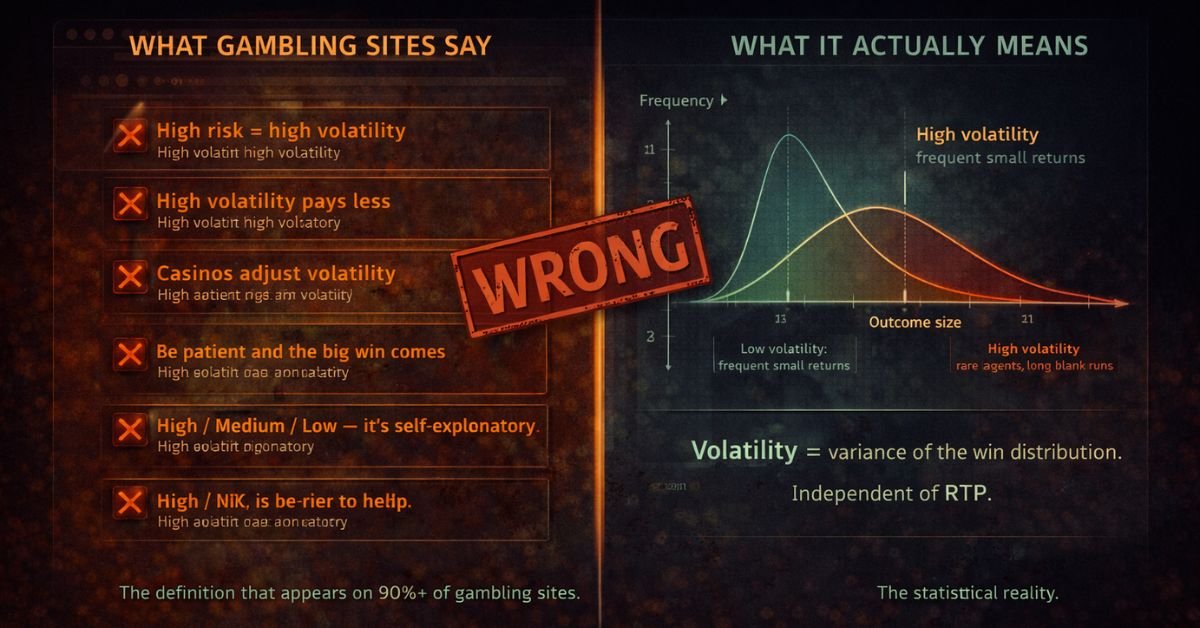
The volatility definition gambling sites give players is almost always wrong. Not slightly wrong — structurally wrong in ways that cause players to misunderstand what volatility actually controls about a game. Across review sites, casino lobbies, and game information panels, the same five errors appear again and again: conflating volatility with return-to-player, treating it as a simple risk label, describing it as something “the casino sets,” claiming it predicts session outcomes, and omitting the statistical variance concept entirely.
This article names all five errors in the volatility definition gambling content uses, explains the correct definition, and shows what the difference means for anyone actually choosing a slot.
The Correct Volatility Definition: What It Actually Means
Volatility is the statistical variance of a slot game’s win distribution. It describes how spread out the possible outcomes are around the expected return. A high-volatility game has a wide distribution — most spins return zero, and the return is concentrated in rare large events.
A low-volatility game has a narrow distribution — returns are more frequent and more evenly sized.
Volatility is not a measure of how generous a game is. It is not a measure of how often a game pays. It is not a risk label in the colloquial sense.
It is a specific statistical property: the variance of the probability distribution from which every spin outcome is sampled. Two games with identical RTP can have completely different volatility profiles because their win distributions have different shapes — same mean, different spread.
The formal definition matters because it determines what volatility actually tells you. It tells you about the shape of outcomes you should expect in a session — how long losing runs are likely to be, how rare large wins are, how dependent the game’s return is on infrequent events. It does not tell you what will happen in any specific session, because variance means that outcomes around the mean can range widely.
Volatility Definition Gambling Sites — What Is Correct vs Wrong
5 Shocking Errors in the Volatility Definition Gambling Sites Use
The most prevalent error in the volatility definition gambling sites publish is stripping the statistical content entirely and replacing it with a subjective risk label. “High volatility = high risk. Low volatility = low risk.” This formulation is not wrong in a vague colloquial sense — high-variance games do produce more extreme session outcomes.
But “risk” without statistical grounding is meaningless as a decision-making input.
This tells a player nothing actionable. It does not tell them what to expect from a specific session length. It does not tell them how long blank runs will be.
It does not help them match a game to their bankroll. “Risky” is a value-laden word that implies the player can manage the risk through choices — when in reality volatility is a fixed mathematical property of the game that the player cannot influence.
The second major error in the volatility definition gambling content uses is treating volatility and RTP as the same dimension — implying that high volatility means lower return or that choosing high volatility is a worse financial decision than low volatility. This is mathematically false.
A “better return for your money” is an RTP claim — not a volatility claim, and not something the volatility definition gambling sites mean when they write about “value.” Two games at 96% RTP have identical expected return regardless of their volatility profiles. What differs is the distribution of that return across events — frequent small returns (low volatility) or infrequent large returns (high volatility).
Neither is a “better return” in expected value terms. They are different shapes of the same aggregate.
This error matters particularly because it leads players to choose low-volatility games on the false premise that they are financially superior, when the actual choice is between different session textures at the same long-run expected cost.
A recurring error in the volatility definition gambling sites publish is describing volatility as a setting that operators configure — something the casino “chooses” or “sets” for a game. This fundamentally misunderstands where volatility comes from.
Volatility is a mathematical property of the game’s reel strip configuration — specified in the PAR sheet and certified by a testing laboratory before the game goes live. It is not a casino-adjustable setting. An operator can choose between different certified builds of a game (which may have different RTP and variance profiles), but they cannot arbitrarily dial a volatility number up or down independently of the certified configuration.
This error is significant because it implies players should be wary of casinos “turning up” volatility against them — a mechanism that does not exist. It also obscures what actually is adjustable: the active RTP variant, which is a real operator configuration choice. Misdirecting suspicion toward volatility distracts from the actual information asymmetry that exists.
Some of the most practically damaging content in the volatility definition gambling industry produces implies that volatility can be used to predict what will happen in a specific session. “High-volatility slots pay out big wins if you’re patient enough” is a typical example — implying that patience (continued play) reliably produces the large wins that volatility describes.
Volatility describes a statistical distribution — not a guarantee. “Eventually” in a random process means “with some probability, across a sufficient number of trials.” It does not mean “if you play long enough in one session, you will receive the large win.” The large win event on a high-volatility game may have a probability of 1 in 200,000 spins. A player with a £500 bankroll at £1 per spin will exhaust their budget in 500 spins — approximately 0.25% of the way to the expected frequency of the win they were told would “eventually” arrive.
This formulation directly feeds the gamblers fallacy — the belief that continued play makes a correction more likely. Volatility does not work this way. A high-volatility game’s rare large win has the same probability on the 10,000th spin as on the first.
The fifth systemic error in how the volatility definition gambling sites apply it is treating the Low / Medium / High classification as self-explanatory and universally standardised — when it is neither. The three-point volatility scale is an industry convention with no regulatory definition. Different studios, different review sites, and different comparison tools apply the labels inconsistently.
A game classified as “High” volatility by one studio may be classified “Medium-High” by another, or “High” by a review site that uses a different benchmark.
Without specifying what “High” means in quantitative terms — what hit rate range it corresponds to, what the typical blank-run length is, what the max win range implies about the reel strip — the label carries limited actionable information. Two “High” volatility games can have dramatically different probability architectures, different hit rates, different blank-run distributions, and different bankroll requirements.
The correct approach is to use the volatility label as a coarse first filter and then seek additional data — hit rate, max win, bonus frequency — to understand the specific game’s variance profile rather than relying on the label alone.
Why Getting the Definition Wrong Costs Players
The errors in the volatility definition gambling industry propagates are not purely academic. Each wrong volatility definition gambling sites publish produces a specific, predictable decision error. Each one produces specific, predictable decision-making failures that affect real session outcomes.
The “Risk” Framing Produces False Confidence in Low-Volatility Games
When players absorb the “high volatility = risky, low volatility = safe” framing, they systematically underestimate the financial cost of low-volatility games and overestimate the additional danger of high-volatility ones. The reality is that both carry the same expected cost in RTP-equivalent terms. Low-volatility games are not “safer” — they produce losses at the same expected rate, just in smaller, more frequent increments.
The practical result: players with limited bankrolls choose low-volatility games believing they are making the conservative choice, when what they are actually doing is choosing a different loss pattern at the same long-run cost. Meanwhile, they may miss genuinely relevant information — like the hit rate, which tells them how often any return will occur regardless of its size.
The Conflation Error Drives Wrong Game Selection Decisions
Players who believe volatility and RTP are related will attempt to use volatility as a proxy for value — choosing low-volatility games because they believe those games “return more.” This produces systematic game selection errors on false grounds. The RTP guide covers the correct way to use return percentage as a cost comparison tool — volatility is a separate dimension that should be evaluated against bankroll, not against value.
The “Casino Sets Volatility” Error Misdirects Appropriate Scepticism
Players who believe casinos can adjust volatility may focus their scrutiny on an aspect of games that operators cannot actually change, while remaining unaware of what operators genuinely do control: the active RTP variant, which is a real and consequential configuration decision. Misplaced scepticism is a form of misdirection — it absorbs analytical attention without producing actionable insight.
The “Patience Pays” Error Enables Loss Chasing
The implication that high-volatility games eventually reward patient play is perhaps the most behaviourally harmful error in the standard volatility definition gambling content produces. It gives a rational-sounding justification for continuing to play through a losing run — “the big win is coming if I stay.” This is structurally identical to the gamblers fallacy, dressed in volatility terminology. Each spin is independent.
The probability of the large win is fixed by the reel strip configuration and is identical on every spin regardless of session history.
How to Read Volatility Correctly Before Choosing a Game
Given the limitations of the standard volatility label, the correct approach is to use it as one input among several — combining it with other published data to build a more complete picture of the game’s probability architecture.
What the Volatility Label Tells You
A coarse indicator of win distribution shape. High = outcomes concentrated in rare large events, long blank runs, bonus-dependent return, larger bankroll required relative to stake. Low = more frequent smaller returns, shorter blank runs, more base-game-accessible return.
Use as a first filter only — not a complete description of the game.
What to Check Beyond the Label
Hit rate: how often any return occurs per spin (published by some studios). Max win: constrains premium symbol scarcity and peak-event concentration. Bonus trigger frequency: how often the bonus features that carry most of the RTP in high-volatility games actually appear.
Base game RTP split: what proportion of the certified return is accessible without a bonus trigger.
The combination of volatility label, hit rate, and max win narrows the game’s probable probability architecture from a vague category to a meaningful session profile. A “High” volatility game with 14% hit rate and 25,000× max win is a very different product from a “High” volatility game with 22% hit rate and 5,000× max win — even if both carry the same volatility label and the same RTP.
| Signal | What it tells you about variance | What it doesn’t tell you |
|---|---|---|
| Volatility label | Broad category of distribution shape — coarse and unstandardised | Exact blank-run length, hit rate, bankroll requirement, bonus dependency |
| Hit rate | How often any return occurs per spin — most direct variance texture signal | How large returns are when they occur, whether returns beat the stake |
| Max win | Premium event scarcity — high max win implies very sparse premium coverage | When the max win will arrive, or whether it will arrive in any given session |
| Bonus frequency | How often the bonus triggers — critical for bonus-dependent high-volatility games | Whether the bonus will trigger in your specific session |
| RTP | Long-run average return — the mean of the distribution volatility describes the spread of | Session texture, blank-run frequency, or how returns are distributed by size |
Practical pre-session protocol: Look up the game’s volatility label, hit rate (where published), and max win before opening it. Feed the RTP and volatility into the volatility and RTP calculator to model the realistic session distribution at your stake and session length. If the hit rate is unavailable, treat a “High” volatility label as implying approximately 15–22% hit rate and calibrate your bankroll accordingly — minimum 100× your stake for a meaningful number of spins on a high-volatility game.
Volatility vs RTP: The Relationship Most Sites Misrepresent
Because the conflation of volatility and RTP is the most structurally damaging error in the volatility definition gambling content produces, it deserves a precise treatment.
RTP is the mean of the win distribution. Volatility is the variance — the spread around that mean. These are two independent statistical properties.
The same mean can produce an infinite number of different variance profiles. The same variance can produce different means. They measure different things about the same distribution.
A game can be designed at any combination of the two: low RTP with low volatility, low RTP with high volatility, high RTP with high volatility, high RTP with low volatility. All four combinations exist in commercially available games. Volatility does not constrain RTP and RTP does not constrain volatility.
They are specified independently in the PAR sheet through the reel strip configuration and paytable structure.
The Practical Consequence of Conflation
When a player chooses between two games at 96% RTP — one high volatility, one low volatility — and believes the low-volatility game “offers a better return,” they have made a false comparison. The expected return is identical. What differs is the distribution of that return: concentrated in rare large events (high volatility) or spread across frequent small events (low volatility).
Neither is financially superior. The correct choice is based on bankroll size and psychological tolerance for blank-spin sequences — not on a false belief that one RTP delivers more than the other.
This is why the volatility guide treats volatility and RTP as separate inputs to game selection — not as a single combined rating. Understanding them as independent dimensions is the minimum mathematical literacy required to use either number correctly when choosing a slot.
Further Reading
The five errors in the volatility definition gambling industry uses sit at the intersection of the gambling language problem and the mathematical accuracy problem identified in Bărboianu’s iGaming content audit research. For the correct, detailed treatment of what volatility means and how it interacts with the reel strip configuration that produces it, the Volatility Guide covers the full concept. For the RTP confusion addressed in Error 2, the RTP Guide covers the correct interpretation and its independence from volatility.
For the “patience pays” narrative addressed in Error 4 — its connection to the gamblers fallacy and loss chasing — the Gambler’s Fallacy and Player Psychology articles cover the mechanisms. For the hit rate signal that supplements the coarse volatility label, the Hit Rate guide covers what it means and where to find it. For the max win signal that constrains premium symbol scarcity, Max Win Explained covers the inference.
For how volatility and RTP together produce a session outcome distribution, the Volatility and RTP Calculator translates both inputs into a concrete model. For the slot math models underlying the probability architecture that volatility describes, that guide covers the full two-layer framework. For the near-miss and losses disguised as wins mechanisms that high and low volatility games respectively amplify, those articles cover the behavioural consequences.
Use Volatility the Right Way — Not the Way Sites Describe It
The volatility label alone is too coarse to make a good game selection decision. The Volatility and RTP Calculator combines both published numbers into a concrete session distribution — showing you realistic outcomes at your stake, not a vague risk label.
Run the Calculator →Volatility Definition Gambling Sites — FAQ
What is the correct volatility definition in gambling?
Volatility is the statistical variance of a slot game’s win distribution — how spread out possible outcomes are around the expected return. High volatility means outcomes are concentrated in rare large events with most spins returning nothing. Low volatility means returns are more frequent and more evenly distributed.
It is not a risk label, not an RTP indicator, and not a setting casinos can adjust — all common errors in the volatility definition gambling sites promote. It is a fixed mathematical property of the game’s certified reel strip configuration.
Why is the volatility definition gambling sites give so often wrong?
Because most volatility definition gambling content is written for general audiences without statistical grounding, and the five errors described in this article are simpler to write than the correct definition. Describing volatility as a “risk level” requires no mathematical understanding and superficially makes sense. The academic audit of 247 iGaming sites by Bărboianu found that mathematical terms including volatility were among the most frequently misrepresented concepts across reviewed content.
Does volatility affect how much a slot pays back overall?
No. Volatility and RTP are independent mathematical properties. A 96% RTP game can be high, medium, or low volatility.
The RTP determines the aggregate average return per unit wagered over many spins. Volatility determines how that return is distributed — concentrated in rare large events or spread across frequent small ones.
Neither is financially superior. The expected cost per session is the same at a given RTP regardless of volatility. What differs is how that cost arrives — a distinction the volatility definition gambling sites confuse most frequently.
Can casinos change the volatility of a slot game?
No. Volatility is inherent to the game’s certified reel strip configuration — specified in the PAR sheet and verified by a testing laboratory. It cannot be adjusted by the casino independently of the certified configuration.
Operators can choose between different certified builds of a game (which may have different RTP and variance profiles), but they cannot freely dial volatility up or down. What operators do genuinely control is the active RTP variant — a different parameter from volatility.
Does high volatility mean you will eventually win big if you play long enough?
No. High volatility means large wins are rare in any given session — it describes the statistical distribution of outcomes, not a payment schedule. A high-volatility game’s rare win event has the same probability on the 1,000th spin as on the first.
There is no guarantee that a large win will arrive within any finite bankroll you bring to the game. Treating volatility as a promise that patience will be rewarded is a form of gamblers fallacy thinking, and it is one of the most financially harmful narratives in standard gambling content.
Are Low / Medium / High volatility labels standardised?
No. Volatility labels are an industry convention without a regulatory definition or standardised methodology. Different studios, review sites, and comparison tools apply the labels inconsistently.
A game classified as “High” by one source may appear as “Medium-High” on another. The labels serve as a coarse first filter and should always be cross-referenced with other published signals — hit rate, max win, and bonus frequency — rather than relied upon as precise descriptions of a game’s variance profile.
How should I use volatility when choosing a slot game?
Use the volatility label as a coarse first filter to narrow the field, then cross-reference with hit rate (where published), max win, and bonus trigger frequency for a fuller picture. Match the volatility profile to your bankroll: high-volatility games require a larger bankroll relative to your stake to survive their inherent blank-run sequences. Never use volatility as a return indicator — use RTP for that.
Run both RTP and volatility through a session modelling tool to see the realistic outcome distribution before you play.