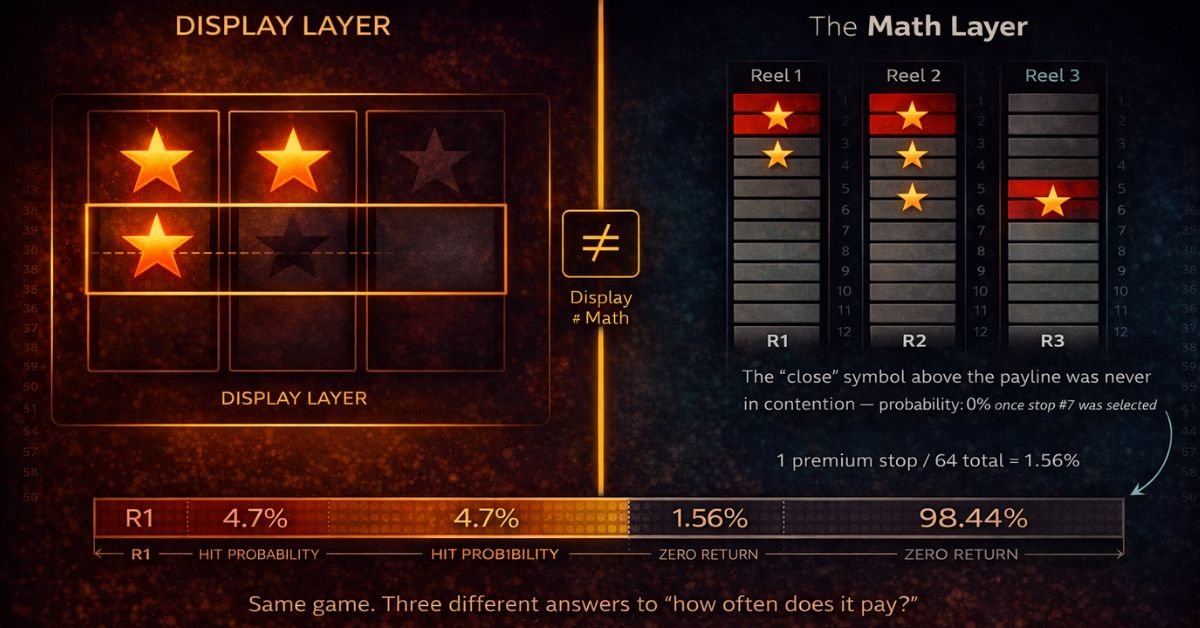
Near miss math model — the relationship between the near-misses you experience and the probability architecture running beneath them — is the clearest proof that the slot display and the slot math model are two different things operating by different rules. When two premium symbols land on the first two reels and the third shows a blank, the display tells a story of proximity: you were close. The math model tells a completely different story: the blank on Reel 3 was the statistically expected outcome of a reel strip where premium symbols occupy far fewer stop positions on late reels than on early reels. There was no proximity. There was deliberate asymmetric weighting, specified in the PAR sheet before the game was built, producing near-misses at rates higher than chance would ever generate. This article explains exactly how that works and what it proves about the gap between what you see and what the math produces.
The Two Layers Every Slot Runs On
Every online slot operates on two distinct layers that run simultaneously but follow completely different rules. The display layer is what you see: symbols appearing in the reel window, win animations triggering, near-misses resolving with two premium symbols visible and a third just out of alignment. The math layer is what actually determines those outcomes: a certified probability architecture encoded in the PAR sheet, specifying exactly how many stop positions each symbol occupies on each virtual reel, what combinations pay what amounts, and what the aggregate return across all outcomes equals.
The display layer is a rendering of the math layer — a presentation of its outputs. But it is not a transparent rendering. The display layer is specifically designed to make certain outputs from the math layer feel meaningful in ways that the math layer itself does not support. The near-miss is the most important example of this. The display renders two premium symbols on Reels 1 and 2 as a near event — something that almost happened, something close. The math layer has no concept of “close.” It has stop positions, symbol weights, and independent probability calculations. The third reel’s blank was not close to being a premium symbol. It was a 96.9% probability event on a reel with 2 premium stops out of 64, landing exactly as the probability architecture predicted it usually would.
Near Miss Math Model — Core Facts
What a Near-Miss Actually Is in the Math Model
In everyday language, a near-miss means something almost happened. Two cars nearly collide. A penalty shot hits the post. The word carries information: the event was close, the gap was small, proximity was real. This intuitive definition is what makes near-misses feel significant in slots. But it is entirely disconnected from what a near-miss represents in the slot math model.
In the math model, a “near-miss” — two premium symbols landing on early reels without completing across all five — is simply an outcome. It is a specific combination of stop position selections from five independent RNG draws. Reel 1 selected one of its 3 premium stops (probability: 3/64 = 4.7%). Reel 2 selected one of its 3 premium stops (probability: 4.7%). Reel 3 selected one of its 61 non-premium stops (probability: 61/64 = 95.3%). The outcome is the product of these three independent events. The probability of this exact combination — premium on R1, premium on R2, blank on R3 — is 4.7% × 4.7% × 95.3% ≈ 2.1%.
The word “near” in “near-miss” implies something about Reel 3’s result — that it was close to being premium. It was not. There is no mathematical sense in which a blank stop is “close to” a premium stop. The RNG selected from 64 equally probable positions. The 62 non-premium positions each had exactly the same probability of being selected as the 2 premium positions divided by the total. Closeness is a spatial metaphor that the display layer projects onto an outcome that the math layer produced through independent random sampling.
The Fallacy the Display Creates
The display presents the reel strip as if it were a physical strip of symbols passing through a window — suggesting that if the premium symbol was “just above” or “just below” the visible position, it nearly landed. This is visually coherent but mathematically false for virtual reels. The RNG selects a stop number. The display then shows the symbol at that stop and the symbols adjacent to it on the virtual reel strip. The adjacent symbols are not “almost what was selected” — they are the next numbers in the reel strip data structure. Showing them creates the visual impression of a near-miss, but those adjacent symbols had zero probability of being selected on that spin. Only the selected stop position had probability — and its probability was equal to every other stop’s probability.
The Probability Proof: Why Near-Misses Are More Frequent Than Chance
If near-misses in slots were purely the result of independent random draws — with premium symbol weighting identical on every reel — their frequency would be predictable from the reel’s uniform probability alone. But near-misses in well-documented slot designs occur significantly more often than a uniform distribution would produce. This is not a theoretical claim. It follows directly from asymmetric reel weighting, which is the standard design pattern in the PAR sheets of high-volatility games.
The Uniform Baseline
Suppose a slot with 5 reels, each with 64 stops and 2 premium symbol positions (weight: 2/64 = 3.125% per reel). Under a uniform, symmetrical weighting model — the same weight on every reel — the probability of the premium symbol landing on exactly Reels 1 and 2 but not Reel 3 is:
P(R1=★) × P(R2=★) × P(R3≠★) = 0.03125 × 0.03125 × 0.96875 ≈ 0.095%
That is the near-miss probability if the game were symmetrically weighted. Roughly 1 in 1,050 spins would produce this specific two-reel landing pattern.
The Asymmetric Reality
Now apply the asymmetric weighting pattern common in high-volatility designs: premium symbol weight higher on early reels, lower on late reels. Using illustrative but realistic values — Reel 1: 4 stops (6.25%), Reel 2: 3 stops (4.69%), Reel 3: 1 stop (1.56%):
P(R1=★) × P(R2=★) × P(R3≠★) = 0.0625 × 0.0469 × 0.9844 ≈ 0.288%
The asymmetric design produces near-misses approximately 3× more frequently than the symmetric baseline — without any change to the 5-of-a-kind win probability (which is further suppressed by Reels 4 and 5 also having reduced premium weight). The player experiences premium symbols on early reels more often, generating the visual tease of an approaching win, while the probability of that win completing remains low because the later reels carry sparse premium coverage.
Worked Example: Reading a Near-Miss Through the Math Model
The following illustrates how the same spin looks from the display layer and from the math layer simultaneously. The game is a 5-reel, 3-row slot. Reel strips have 64 stops. Premium symbol (★) positions: Reel 1 = 4 stops, Reel 2 = 3 stops, Reel 3 = 1 stop, Reel 4 = 2 stops, Reel 5 = 1 stop.
The Near-Miss Spin — What the Display Shows
Reel 1
Reel 2
Reel 3
Reel 4
Reel 5
Gold outline = the active payline row. The display shows two premium symbols on the payline on Reels 1 and 2. Reel 3 shows a blank on the payline. Adjacent rows on Reel 3 also show non-premium symbols — there is no premium symbol “almost” in position. This is what the display communicates: proximity. Two symbols landed. The third did not.
Reel 1 selected stop #12 from 64 → ★ (one of 4 premium stops). Probability this stop was selected: 1/64 = 1.56%.
Reel 2 selected stop #38 from 64 → ★ (one of 3 premium stops). Probability: 1/64 = 1.56%.
Reel 3 selected stop #7 from 64 → Blank (one of 47 blank stops). Probability: 1/64 = 1.56%.
Each reel selected exactly one stop. Each stop had 1/64 = 1.56% probability. No stop was “closer” to being selected than any other. The blank on Reel 3 was not close to being a premium symbol. It was a 1.56% event — exactly as probable as any premium stop.
The Math Layer’s View: No Proximity Exists
The critical insight from reading this spin through the math model is that the concept of proximity does not exist at the RNG level. The RNG selected three stop numbers. Each number was drawn from a uniform distribution across 1–64. Stop number 7 (blank) had exactly the same probability of being drawn as stop number 12 (premium). There is no sense in which stop 7 was “close to” stops 12, 38, or any premium stop. The RNG does not operate in the spatial dimension the display creates. It operates in a probability space where each stop is equally accessible on each draw.
The display takes three independent probability events — three RNG samples from three different reel strips — and renders them as a visual narrative of proximity and near-completion. That narrative is entirely a product of the display layer. The math model did not produce a near-miss. It produced three independent outcomes. The display layer assembled them into a story.
Display Layer vs Math Layer: What Each One Shows
| Aspect | Display Layer (What You See) | Math Layer (What Actually Happened) |
|---|---|---|
| The near-miss event | Two premium symbols on visible payline — third reel shows blank. Adjacent symbol on Reel 3 (row above/below) may show premium symbol — visual suggestion of “just missed.” | RNG selected a non-premium stop on Reel 3. That stop had 1/64 probability. Premium stops had combined 1/64 probability each. No stop was more or less likely than any other. |
| Frequency of near-misses | Appears frequently during sessions — enough to feel like wins are imminent. The experience suggests good things are coming. | Frequency is the direct result of asymmetric premium weighting across reels. Higher early-reel weight produces more two-reel landings. Near-miss frequency is higher than symmetric probability would generate. |
| What the near-miss signals | Proximity to a win. A pattern. Momentum. Something about to happen. The machine is “warming up.” | Nothing. Three independent RNG draws were made. The outcomes carry no information about the next spin. Statistical independence means the probability on the next spin is identical to every previous spin. |
| The adjacent symbols on Reel 3 | Premium symbol visible in row above or below the payline — makes the near-miss look even closer. “One position off.” | Adjacent symbols on the reel strip are displayed for visual presentation only. They had zero probability of landing on this spin. The RNG selected one stop. The stops above and below it were never in contention for this draw. |
| The emotional response | Urgency to continue. Belief that a win is close. Increased engagement. Feeling of building momentum. | No mathematical basis. The urgency is produced by the display layer’s narrative, not by any change in the game’s probability architecture. The next spin’s probability is identical to the spin before the near-miss. |
The Regulatory Status of Engineered Near-Misses
The regulatory treatment of engineered near-misses varies significantly by jurisdiction and has evolved as regulators have engaged more closely with the functional model behind them.
In Canada, certain provincial lottery corporations prohibit deliberate near-miss weighting on their Class III gaming machines. The British Columbia Lottery Corporation’s technical standards specifically restrict the use of reel weighting configurations designed to produce above-chance near-miss frequencies on Class II and III games. These restrictions emerged from academic and regulatory recognition that engineered near-misses represent a form of systematic player manipulation — the display communicates something (proximity to winning) that the math model does not support.
In the United Kingdom, the Gambling Commission’s technical standards require that slot outcomes be determined by a certified RNG and that the visual display accurately represent those outcomes. However, the standards do not explicitly restrict asymmetric reel weighting, which is the mathematical mechanism that produces above-chance near-miss rates. The distinction matters: displaying a near-miss that accurately reflects the RNG’s output (a blank did land on Reel 3) is technically compliant even if the asymmetric weighting that makes such events frequent was deliberately designed.
In most other jurisdictions, near-miss engineering remains unregulated at the functional model level. The RNG fairness requirements are met — the outcomes are genuinely random given the certified reel strip configuration — and the design of that configuration is treated as proprietary intellectual property rather than a consumer protection concern.
The regulatory gap. Regulations typically require that slot outcomes be random and that the display accurately represent them. Near-miss engineering satisfies both requirements — the outcomes are random (selected from the certified reel strips by a fair RNG), and the display accurately shows which symbols landed. The gap the regulation leaves open is the design of the reel strips themselves: placing more premium symbol stops on early reels than late reels is a legitimate design choice, not a manipulation of the RNG. The manipulation, if that word applies, is structural — it is built into the probability architecture before the game is certified, not applied to the RNG during play.
The Cognitive Consequences: What the Near-Miss Math Model Does to Your Brain
The reason the near-miss math model matters for responsible gambling is not abstract. It is the direct connection between an engineered structural feature of the game and the cognitive mechanisms that drive extended — and potentially harmful — play.
The Near-Miss Effect and Continued Play
Research into the near-miss effect consistently finds that near-miss outcomes increase the motivation to continue playing more than full misses do. The subjective experience of “almost winning” generates an urgency to continue that an outright loss does not produce at the same intensity. This effect holds even when participants are explicitly told that outcomes are random and that near-misses carry no information about future results. Knowing the fact does not neutralise the response.
This is significant for the near-miss math model specifically because the near-miss frequency is not set by chance — it is set by the PAR sheet. A designer who increases early-reel premium symbol weighting increases near-miss frequency and, by extension, the frequency with which players experience the motivation to continue. The near-miss math model is therefore a direct mechanism connecting PAR sheet design decisions to player retention behaviour.
The Gambler’s Fallacy Connection
Near-misses interact with the gambler’s fallacy in a specific way. The gambler’s fallacy — the belief that after a losing run, a win is overdue — operates on the ordering property of randomness: the player expects the aggregate to correct toward the mean. Near-misses provide a different but compatible cognitive trigger: not “a win must come eventually” but “a win must come soon, because I was just this close.” The two distortions compound each other — the losing run and the near-miss both become evidence, in the player’s perception, for an imminent win that the math model does not support.
The Illusion of Control Amplification
Near-misses also interact with the illusion of control. Players who believe timing, stake sizing, or stopping behaviour influences outcomes interpret near-misses as evidence that their strategy is working — they were “almost there,” and the next attempt with a slight adjustment might close the gap. The math model offers no support for this: the blank on Reel 3 was a 95%+ probability event regardless of when the button was pressed, and the next spin begins with identical probability. But the display layer has created a narrative of proximity that the illusion of control inhabits.
What the Near-Miss Makes You Feel
Urgency. Proximity. Momentum. The sense that a win is building toward you. Increased motivation to spin again immediately. The belief that stopping now would mean missing the win that was coming. These responses are produced by the display layer’s narrative — they are real psychological experiences responding to a designed visual story.
What the Math Model Actually Tells You
Three independent draws were made. The third drew a non-premium stop, as it does approximately 95% of the time. The next spin will make the same three draws, with the same probabilities. Nothing has changed in the probability architecture. No win is closer now than it was before the near-miss. The game’s certified math is identical on spin N+1 to what it was on spin N.
How to Use This Knowledge During a Session
Understanding the near-miss math model gives you a specific cognitive tool: the ability to name what is happening when you experience a near-miss, replacing the display layer’s narrative with the math layer’s reality.
The Naming Practice
When two premium symbols land and the third reel shows a blank — before the urgency to spin again takes hold — apply the correct label: “Asymmetric reel weighting. Early reels have higher premium weight than Reel 3. This combination was more probable than the full win because the PAR sheet designs it to be. The next spin has identical probability to every spin before this one.”
This labelling practice is the epistemic version of what the math model actually says. Research on cognitive distortions in gambling suggests that naming a distortion correctly, in the moment it occurs, reduces its motivational power — not to zero, but meaningfully. The near-miss urgency is generated by the display layer’s story. Replacing that story with the math layer’s account interrupts the mechanism, even if it does not eliminate the emotional response entirely.
Reading Adjacent Symbols Correctly
Pay specific attention to what the display shows in the rows above and below the active payline on the reel that broke the combination. If a premium symbol appears in an adjacent row — “just one position above the payline” — recognise this for what it is in the math model: that symbol occupied a different stop position, one that had zero probability of being selected on this spin (the RNG already selected one stop; all other stops had zero probability for this draw). The visual proximity is a display artifact. The math proximity is non-existent.
Setting Pre-Session Limits That Near-Misses Cannot Override
The most important structural protection against the near-miss effect is the pre-commitment limit — a session loss limit set before the game begins, at account level, that operates regardless of in-session cognitive state. The urgency produced by a near-miss operates during play, in the psychological state created by active gambling. A loss limit set before play began cannot be overridden by that urgency — it is a decision made by a calmer version of yourself, binding the decision-making of the version of you that will be affected by near-misses. Use the responsible gambling planner to set these before every session.
The two-sentence reframe for every near-miss: “The blank on that reel was a 95%+ probability event — it was the expected outcome, not the exception. The next spin begins with the same probabilities as every spin before this one.” Repeat this as a practice until the math layer account becomes the instinctive response to the display layer’s narrative. It takes repetition, but the mechanism is sound: you are replacing a false story with a true one.
Further Reading
This article connects two clusters: the math model cluster and the player psychology cluster. For the foundational treatment of the two-layer model that produces the near-miss gap, the Slot Game Math Models article covers the functional vs statistical model distinction. The PAR Sheet Explained article covers the specific document where reel strip weighting — the mechanism behind engineered near-misses — is specified. For the symbol weighting asymmetry that makes early-reel premium symbol weight higher than late-reel weight, the symbol weighting article covers the full mechanism and how different weighting strategies produce different game characters. ⚠ Link: /symbol-weighting-slots/ — written in this session, verify live before publishing.
For the psychological dimension — what the near-miss does to player cognition and motivation — the Near-Miss Effect in Slots article covers the full behavioural research. The Gambler’s Fallacy and Illusion of Control articles cover the two distortions that near-misses most directly amplify. For the broader landscape of how slot display design shapes player psychology, Player Psychology in Slot Games is the hub. For the regulatory context — how RNG certification requirements relate to (and leave gaps around) engineered near-miss design — Are Online Slots Fair covers the certification system and its limits. For pre-session tools that protect against in-session near-miss urgency, the Responsible Gambling Planner and Session Risk Analyser operationalise the pre-commitment structure.
Set a Limit the Near-Miss Cannot Override
Near-miss urgency operates during play. A pre-session loss limit operates before play starts — and cannot be overridden by what the display makes you feel. Set it before you open the game.
Set My Session Limit →Near Miss Math Model — FAQ
What is the near miss math model in slots?
The near miss math model describes what is actually happening in a slot’s probability architecture when a near-miss occurs — as opposed to what the display layer shows. In the math model, a near-miss is three independent RNG draws: early reels selected premium symbol stops, a later reel selected a non-premium stop. No stop is “close to” another in the probability space — each has identical probability of selection (1 divided by total stops). The display renders this as proximity to winning. The math model produces no such concept.
Are near-misses in slots random or engineered?
Both — they are random outcomes of a certified RNG operating on reel strips that are deliberately engineered to produce above-chance near-miss rates. The RNG itself is fair — it samples uniformly from the certified stop positions. But the reel strip configuration, specified in the PAR sheet, places more premium symbol stops on early reels than late reels. This asymmetric weighting means early reels display premium symbols more frequently than the combination can complete across all five reels, producing near-misses more often than a symmetrical, uniform weighting would generate.
Does a near-miss mean a win is coming soon?
No. Each spin is statistically independent — the outcome of any spin has no effect on the probability of the next. A near-miss carries zero information about the next spin’s outcome. The urgency to continue that near-misses produce is a response to the display layer’s narrative of proximity, not to any change in the game’s probability architecture. The next spin’s probability is identical to every spin before the near-miss.
Why do near-misses occur more often than pure chance would suggest?
Because reel weighting is typically asymmetric — premium symbols have higher stop counts on early reels (Reels 1 and 2) than on later reels (Reels 3, 4, and 5). This makes early-reel premium landings more probable than late-reel completions. The result is that the first two or three reels show premium symbols relatively often, while the combination fails to complete across the full five reels at a much lower rate. Near-miss frequency is a designed mathematical consequence of this weighting strategy, not an emergent effect of pure randomness.
What does the adjacent symbol on Reel 3 actually represent?
When a premium symbol appears in the row just above or below the active payline on the reel that broke the combination, it creates the visual impression of being “one position away.” In the math model, that adjacent symbol occupied a different stop position that the RNG did not select on this spin. Once the RNG selects a stop, all other stops had zero probability of being selected for that draw. The adjacent premium symbol was not “almost selected” — it was never in contention for this spin’s outcome. The display shows it because the reel strip is rendered as a continuous visual strip, but the math model selected one position only.
Are engineered near-misses regulated?
Regulation varies by jurisdiction. Some Canadian provincial lottery corporations explicitly restrict above-chance near-miss weighting. Most online gambling jurisdictions — including the UK, Malta, Gibraltar, and Curaçao — regulate RNG fairness and display accuracy but do not restrict the asymmetric reel weighting that produces engineered near-miss rates. The regulatory gap exists because the near-miss outcomes are genuinely random given the certified reel strips — the engineering is in the design of those strips, which is treated as proprietary intellectual property rather than a consumer protection issue in most markets.
How does understanding the near miss math model help during a session?
It gives you a specific, accurate account to replace the display layer’s proximity narrative. When a near-miss occurs, instead of responding to “I was so close,” you can name what actually happened: “Early-reel premium weight is higher than late-reel weight by PAR sheet design — this combination was engineered to appear more often than the full win. The next spin has the same probability as every spin before it.” This labelling practice does not eliminate the emotional response to near-misses. It provides the correct mathematical frame to evaluate it against, reducing its power to drive irrational decisions.