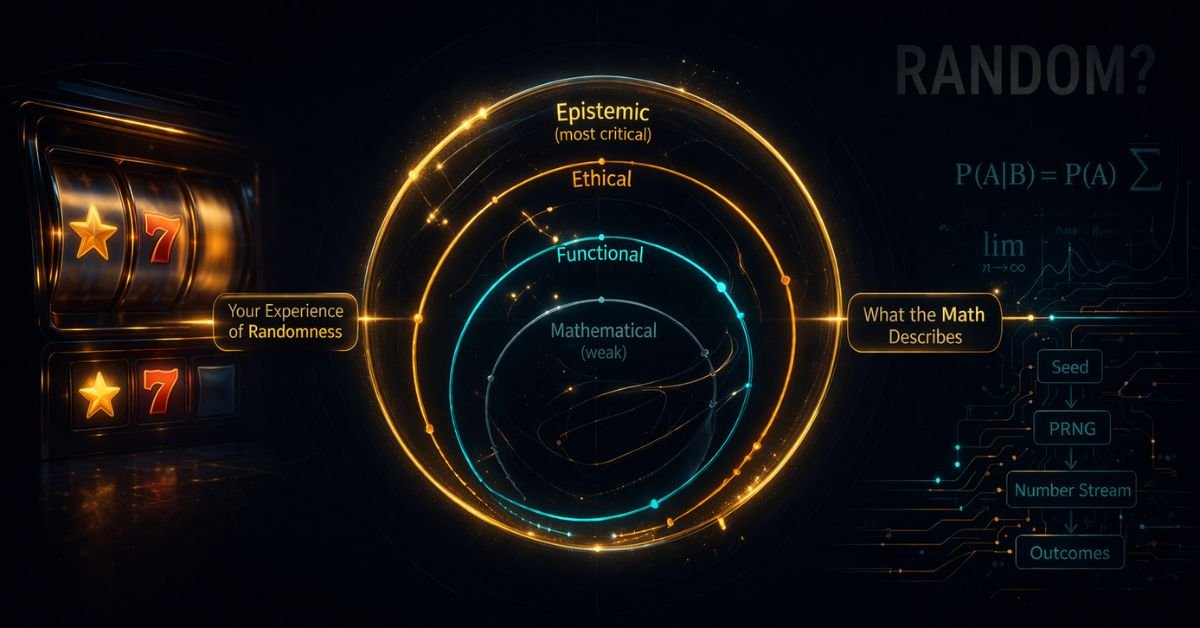
Randomness in slots is one of the most misunderstood concepts in gambling. Most players treat it as a simple, self-evident idea — “the machine picks outcomes at random, meaning each spin is unpredictable and the results are fair.” That definition captures something real. But it leaves out most of what randomness actually is, why mathematicians have never been able to fully define it, and — most importantly — which dimensions of randomness in slots actually matter for how you play and how vulnerable you are to harmful patterns. This article gives you the full picture, grounded in the academic research that most gambling content ignores entirely.
What Players Think Randomness in Slots Means
Ask any slot player what randomness in slots means and you will get a version of the same answer: the machine picks outcomes by chance, no spin is connected to the previous one, and the results cannot be predicted. That answer is not wrong — but it is drastically incomplete in ways that have real consequences for how players interpret their sessions.
Most players collapse “random” into two things: unpredictable and fair. Unpredictable because the next outcome cannot be known in advance. Fair because no player or outcome is systematically favoured. From there, the logic extends naturally: if the game is truly random, then a sequence of losses says nothing about the next spin, near-misses are as meaningless as any other losing outcome, and there is no such thing as a slot “running hot” or “running cold.”
All of that is mathematically correct. The problem is that knowing it intellectually does not prevent players from responding to their sessions as if it were not true. Near-misses still create urgency. Losing runs still create the feeling that a win is overdue. Hot streaks still feel like momentum. Understanding randomness in slots at the surface level — as a fact about probability — does not reach the part of your cognition where those responses are generated. And that gap between what you know and how you respond is where the research on randomness and problem gambling becomes genuinely important.
Randomness in Slots — What the Research Reveals
Why Randomness Is Not a Mathematical Concept
This is the point that surprises most people — including many who have studied probability. Randomness is commonly assumed to be a mathematical idea, since probability theory is built on it. But that assumption inverts the actual relationship. Randomness is a primitive notion for probability theory — a starting assumption that probability theory uses but does not define. It is not a mathematical concept. It is the pre-mathematical foundation on which mathematical probability rests.
Mathematicians have known this for over a century and have repeatedly tried to fix it. The attempts to formally define randomness — to give it a rigorous mathematical definition that would elevate it from primitive assumption to defined concept — represent some of the most serious work in 20th-century mathematical foundations. Richard von Mises proposed axiomatic definitions of random sequences in 1919. Alonzo Church and Abraham Wald refined the approach through the 1930s and 1940s. Andrey Kolmogorov, who provided the axiomatic foundations for modern probability theory, worked on algorithmic randomness from a different angle. None of these attempts succeeded in capturing randomness in its full generality. Every formal definition was either internally inconsistent, incomplete, or captured only a subset of what we intuitively mean by “random.”
The conclusion from this century-long effort is stark: real randomness — randomness as it exists in the physical world and as players experience it at the reels — cannot be fully mathematically defined. It has a mathematical dimension, because probability theory uses it as a foundation. But randomness itself is more complex than any mathematical structure that has been devised to contain it.
Why This Matters Beyond Philosophy
The non-mathematical nature of randomness is not just a philosophical curiosity. It has a direct practical implication for gambling: when responsible gambling programmes tell players to “learn the math” as the cure for irrational gambling beliefs, they are assuming that randomness is a mathematical concept that can be corrected through mathematical education. But the cognitive distortions most associated with problem gambling — the gambler’s fallacy, the near-miss effect, the belief that losses are “due” to be corrected — operate in the epistemic dimension of randomness, not the mathematical one. Teaching someone the independence formula does not reach the perception of randomness that generates those responses. This is one of the strongest explanations for why multiple empirical studies of gambling math education have found no significant change in gambling behaviour.
The Four Dimensions of Randomness That Matter in Gambling
Rather than treating randomness in slots as a single, simple concept, the research identifies four distinct dimensions. Each one operates differently, and understanding which dimension you are dealing with in any given moment changes how you should respond to it.
1. The Mathematical Dimension
Randomness has a mathematical dimension because of its foundational relationship with probability theory. But this relationship is indirect and weak — randomness is a primitive notion that probability theory assumes rather than defines. The word “randomness” has largely disappeared from formal probability theory and statistics precisely because the mathematical framework works without a definition of it. For slot players, this dimension is the least useful: it tells you that probability calculations are legitimate tools for describing game outcomes, but it does not tell you how to interpret or respond to those outcomes in the real-world experience of a session.
2. The Functional Dimension
In gambling, randomness serves a specific functional purpose: it ensures the game operates as a genuine game of chance. This requires two things simultaneously. First, unpredictability — no outcome of a single spin can be predicted or determined in advance by any participant. Second, equal chances — all equally-theoretically-possible outcomes must remain equally possible in practice. Together these two requirements mean that luck — not skill, information, or prior results — is the decisive factor in the short run. The functional dimension is what certifying laboratories test when they audit a slot’s RNG. It is the dimension that makes slots function as the category of game they are supposed to be.
3. The Ethical Dimension
The ethical dimension of randomness in slots covers fairness — and it has two distinct facets. Fairness between players: no participant should have any informational or mechanical advantage over another with respect to predicting or influencing outcomes. Fairness of the operator: outcomes that are theoretically equally possible must remain equally possible in practice — the operator cannot weight the game in practice differently from how it is specified in the certified PAR sheet. This is the dimension that regulatory frameworks and independent testing laboratories address. When players worry about whether slots are “rigged,” they are operating in the ethical dimension of randomness. That concern is legitimate in principle — but the research suggests players significantly overinvest attention here relative to the actual risk, at the expense of more actionable concerns about their own cognition.
4. The Epistemic Dimension
The epistemic dimension is how randomness is perceived, conceptualised, and reasoned about — the cognitive relationship between a player and the randomness of the game. This is the dimension that is almost entirely absent from standard gambling education and responsible gambling messaging, and it is the dimension where the most consequential errors occur. When a player believes a win is “overdue” after a losing run, they are misinterpreting the epistemic dimension of randomness — treating it as an ordering force that must eventually correct an imbalance, rather than as the disordered, independent process it actually is. The epistemic dimension is where the gambler’s fallacy, the near-miss effect, and hot-and-cold beliefs all live. Correcting them requires understanding randomness at this level, not just knowing the mathematical rules.
The practical takeaway: When you feel, during a session, that a win is close or overdue — you are experiencing a failure of the epistemic dimension of your understanding of randomness in slots. When you wonder whether the casino has rigged the game — you are in the ethical dimension. When you look up the RTP of a game — you are using the functional dimension. Each requires a different response. Conflating them is the source of most of the cognitive errors players make.
The PRNG Reality: Is Your Slot “Truly” Random?
Modern online slots use a Pseudo-Random Number Generator (PRNG) to produce outcomes. The prefix “pseudo” unsettles many players — it sounds like an admission that the randomness is fake. Understanding what PRNG actually means, and what it does not mean, is essential for correctly placing RNG concerns within the right dimension of randomness.
What a PRNG Actually Is
A PRNG is a deterministic mathematical algorithm that takes an input — a number called the seed — and produces a sequence of numbers with specific statistical properties. The two critical properties are independence (each number in the sequence is not determined by or dependent on the previous numbers through any extractable rule) and uniformity (the numbers are distributed evenly across the output range). These two properties, when satisfied, produce a sequence that is operationally indistinguishable from “true” randomness for the purposes of a casino game.
The “pseudo” prefix acknowledges that the sequence is technically determined by the algorithm and seed — in theory, if you knew both, you could reproduce it. But the seed is generated with high-entropy inputs (typically derived from unpredictable system events), the algorithm generates thousands of numbers per second, and independent auditors test the statistical properties of the output to verify they meet the regulatory standards for “sufficient randomness.” The full mechanics of RNG operation in online slots cover this process in detail.
What this means: PRNG randomness is not the same as the theoretical ideal of “true” randomness (which, as we established, cannot even be fully defined mathematically). But it is sufficiently random for gambling. It satisfies the functional and ethical dimensions of randomness that matter: unpredictability for individual outcomes, and equal chances in practice. Independent auditing by certification laboratories specifically tests for this sufficiency. A slot that passes certification is operating within an acceptable definition of randomness for its commercial purpose. The philosophical gap between algorithmic randomness and “true” randomness is real but irrelevant to your session outcomes.
What the Seed Question Actually Means
Player concerns about PRNG frequently focus on the seed — the initial input to the algorithm. The concern is that the operator controls the seed and could therefore manipulate the outputs. This concern drove the development of “provably fair” systems that incorporate a player-supplied seed alongside the operator’s seed, producing outputs neither party can unilaterally control. These systems represent genuine progress in the ethical dimension of randomness. However, research notes that newer concerns have already emerged about how player habits are tracked through seed selection and how algorithms can be run under specific conditions. The honest answer: regulatory-certified PRNGs operating under third-party audit are sufficiently random for fair play. The concern for seed manipulation is a legitimate category of inquiry but represents a small risk compared to the cognitive distortions that affect every session regardless of whether the game is perfectly certified.
The Difference Between “Sufficiently Random” and “Perfectly Random”
No physical or computational process produces perfect randomness in the theoretical sense — including the physical spin of a roulette wheel, which is subject to measurable physical variables that technically make it deterministic. The relevant question for gambling is not whether randomness is perfect but whether it is sufficient: unpredictable in practice, equally distributed in practice, and free from manipulation. Certified slots meet this standard. Understanding this removes the “but it’s not truly random” objection from the centre of player attention — where it consumes cognitive energy that would be better directed elsewhere.
The Concern-for-Fairness Paradox — Why RNG Worries Backfire
Here is the most counterintuitive finding in the academic research on randomness in slots: players who are both concerned about whether the game is fair and subject to the gambler’s fallacy find themselves in a state where rational decision-making becomes literally impossible.
Consider the scenario: A player suspects — but is not certain — that a slot might be biased to favour certain outcomes. They also believe (fallaciously) that after a long losing run, a win is overdue. Now they face a decision about whether to continue playing or stop. If the game is biased, they should track the pattern and bet on outcomes the bias favours. If the game is unbiased, the gambler’s fallacy tells them the “overdue” outcome is more likely on the next spin. These two lines of reasoning point in opposite directions. The fairness concern and the cognitive distortion are in direct conflict. Neither provides a coherent basis for action.
The Concern-for-Fairness and Gambler’s Fallacy Paradox
When a player is simultaneously concerned about whether a game is fair and subject to the gambler’s fallacy, they cannot make a rationally grounded decision about continued play — regardless of how much information they have. The concern for fairness and the cognitive distortion produce contradictory action recommendations, and no amount of additional information about the game resolves the contradiction.
The practical conclusion from this analysis: for a player who experiences the gambler’s fallacy, worrying about RNG fairness does not help them — it actively makes their cognitive position worse. The effort and attention invested in tracking game fairness is effort diverted from what would actually help: recognising and addressing the gambler’s fallacy itself.
This does not mean fairness concerns are invalid. It means the industry and regulators should address those concerns — through certification, auditing, and disclosure — so that players do not need to. Players’ cognitive resources are better deployed understanding their own responses to randomness, not auditing the algorithm.
The research conclusion is clear: concern for the fairness of the game is the industry’s responsibility, enforced through regulatory certification and independent auditing. It is not an effective focus for individual players, especially those who are already experiencing cognitive distortions about randomness. A player who has internalised this — who trusts certified randomness as sufficient and directs their attention instead toward their own responses — is in a substantially better cognitive position than one who maintains active fairness suspicions while also experiencing fallacy-driven play patterns.
The Epistemic Gap: Where Randomness and Cognitive Distortions Meet
The epistemic dimension of randomness in slots — how you perceive and reason about it — is where the gap between knowing and doing opens up. Every major gambling cognitive distortion can be mapped onto a specific failure in how players process the epistemic dimension of randomness.
Randomness as Both Order and Disorder
One of the most useful insights from the philosophy of randomness is that it is simultaneously an ordering and a disordering force — and most cognitive distortions in gambling come from players implicitly treating it as only one or the other.
Randomness as disorder: outcomes are unpredictable, there is no determining pattern, no result can be derived from previous results. This is the correct perspective for evaluating individual outcomes — each spin is its own isolated event, uncaused by prior spins.
Randomness as order: over a large enough sample, outcomes converge on their mathematical probabilities. The law of large numbers means the aggregate is orderly even though individual events are disordered. This is the correct perspective for understanding RTP, expected value, and long-run return.
The gambler’s fallacy arises when players confuse these two perspectives — applying the ordering property (convergence to averages) to individual outcomes, which are governed by the disordering property (independence). “A win is overdue” is exactly the error of importing the long-run ordering logic into a single-event context where it does not belong.
| Cognitive Distortion | How It Misreads Randomness in Slots | Correct Epistemic Frame |
|---|---|---|
| Gambler’s Fallacy | Applies the long-run ordering property to individual outcomes — “the average must correct itself soon” | Individual spins are in the disorder dimension — fully independent, with no obligation to correct the short-run sequence |
| Near-Miss Effect | Interprets structural reel design as a proximity signal — “that was almost a win” | Near-misses are a functional consequence of asymmetric reel weighting by design — not random proximity to a winning outcome |
| Hot/Cold Slot Beliefs | Treats the ordering property as operating on individual sessions — “this machine is in a winning phase” | Session-level patterns are within the disorder dimension — no phase structure exists in an independent sequence |
| Illusion of Control | Treats the physical interaction (timing, stop buttons) as influencing the disordered outcome | The RNG samples the outcome at button press; physical interaction timing has no connection to the probability space |
| Chasing Losses | Treats the ordering property as imminent — “my losing run must balance out soon if I keep playing” | Expected value is negative on every additional spin regardless of session history; no mathematical compensation is owed |
Why “I Was So Close” Is Never Mathematically True
The near-miss is the clearest example of how randomness in slots produces epistemic failures. When two high-value symbols land and the third reel shows a blank, the emotional experience is genuine proximity — “that was almost a win.” The mathematical reality is that the blank on the third reel was produced by exactly the same probability process as every other outcome. It was not “almost” anything. The combination that did not land has no relationship to the combination that will land on the next spin.
But there is a further layer: as the PAR sheet analysis shows, near-misses in slots are not even purely random occurrences. They are the direct consequence of asymmetric symbol weighting across reels — premium symbols are deliberately placed more frequently on early reels than late reels, producing situations where early reels display premium symbols more often than the combination can be completed. Near-misses are more frequent than a uniform probability distribution would produce. They are designed into the game’s probability architecture. The “I was so close” feeling is responding to an engineered structural feature, not to random proximity to a win.
What Randomness in Slots Actually Implies for Your Session
Putting all four dimensions together, here is what randomness in slots actually implies — stated as concrete practical facts rather than abstract principles.
What Randomness Guarantees
That no spin is predictable in advance by any participant. That the probabilities specified in the certified PAR sheet apply equally to every player on every spin. That no player’s previous outcomes, bet size, loyalty status, or any other variable changes the probability of the next spin. That the game operates as the category of game it claims to be — a game of chance where luck, not skill or information, is decisive in the short run.
What Randomness Does Not Guarantee
That any particular session will produce outcomes near the theoretical RTP. That a losing run will be followed by compensating wins. That a near-miss means anything about the next outcome. That playing longer increases your probability of recovering losses. That any pattern you perceive in outcomes reflects a real structure in the sequence rather than your brain’s tendency to find patterns in genuinely random data.
What “Equal Chances” Means Exactly
Equal chances means that every theoretically possible outcome combination is equally possible in the probability model. This is a theoretical idealisation — it means no known evidence favours one outcome over another for any given spin. It does not mean that every spin is equally likely to produce a profit. Reel strip weighting means outcomes differ enormously in probability — the premium symbol combination has a probability that may be 1 in 40 million, while a low-symbol win may occur 1 in 15 spins. Equal chances applies at the level of equally possible positions on each reel, not equal distribution of outcomes.
What Statistical Independence Really Means
Statistical independence means the probability of Outcome B is completely unaffected by the occurrence of Outcome A. In mathematical terms, P(B|A) = P(B). This is not just a rule the machine follows — it is an implication of how randomness is built into the RNG seeding process and the slot’s operational design. The machine does not remember previous spins because the architecture explicitly prevents any carry-over from one spin to the next. Independence is a designed property, not an incidental one.
Where Players Should Direct Their Attention Instead
The research on randomness in slots arrives at a clear practical recommendation: players who currently spend cognitive energy worrying about whether their game is rigged would be significantly better served by directing that energy toward understanding their own cognitive responses to randomness.
This is not dismissiveness about the ethical dimension of randomness. It is a prioritisation argument. Certified slots operating under regulatory oversight represent a functional and ethical standard that has been independently verified. The probability of encountering a manipulated RNG in a licensed, certified, audited game is genuinely small. The probability of experiencing gambler’s fallacy thinking, near-miss urgency, hot/cold streak beliefs, or chasing behaviour during a session is genuinely high — these affect the overwhelming majority of regular players to some degree.
The asymmetry is stark: RNG integrity is the industry’s problem, addressed through regulation and auditing. Cognitive distortions about randomness are every individual player’s daily reality, and they are far less well-addressed by the available tools and messaging. Understanding randomness in slots at its full depth — including its epistemic dimension, its dual order-disorder character, and the specific ways each cognitive distortion misreads it — is a more immediately useful investment of attention than questioning whether the PRNG seed is manipulable.
The Practical Reorientation
Before your next session: read the game’s certified RTP and volatility rating — these are the functional outputs of the certified randomness operating through the game’s probability architecture. Trust them as accurate representations of what the randomness in this specific slot produces across a large number of plays. Use the session risk analyser to model what that randomness is likely to produce for your specific stake and session length. Then commit to the correct epistemic frame before you start: individual outcomes are in the disordering dimension of randomness — independent, unpredictable, and not obligated to correct any sequence. The urge to see patterns, proximity, or momentum in your results is your brain imposing order on disorder. That imposition is the error. Naming it correctly as it happens is the correction.
For players who find these responses genuinely difficult to manage — where the near-miss urgency or losing-run spiral overrides rational assessment despite understanding the math — that is a signal that the neurological dimension of variable ratio reinforcement may be involved, which operates beyond the reach of cognitive reframing alone. The responsible gambling guide and the responsible gambling planner provide the structured tools for that situation.
Further Reading
The research base for this article is primarily Bărboianu’s work on the non-mathematical dimensions of randomness and their implications for problem gambling — a body of work that argues directly against the dominant assumption in gambling education that randomness is a mathematical concept correctable through probability instruction. The companion articles on this site that engage with each dimension of randomness as it applies to specific player experiences are: Gambler’s Fallacy in Slots for the epistemic dimension operating in the “overdue win” belief; Near-Miss Effect in Slots for how structural reel design exploits the epistemic gap between experienced randomness and mathematical independence; Illusion of Control in Slots for the functional dimension misapplied to player interaction; and Hot and Cold Slots for the order-disorder confusion applied to session sequences.
For the technical architecture of how randomness is implemented in slots, How RNG Works in Online Slots covers the PRNG mechanism and Seed in Slot Games covers the seeding process and what the “provably fair” claim actually means. For the certified mathematical outputs of the randomness system — the numbers players can actually use — RTP Guide, Volatility Guide, and Slot Hit Rate provide the practical framework. For the broader question of how understanding the math relates to safer play, Slot Math Education and Responsible Gambling covers the evidence base on what type of mathematical understanding actually produces protective effects and what does not.
Apply What You Know About Randomness Before Your Next Session
The Session Risk Analyser turns the functional outputs of certified randomness — RTP and volatility — into a concrete model of what your specific session is likely to produce. See the realistic distribution before the game is emotional.
Model My Session Risk →Randomness in Slots — FAQ
Is randomness in slots truly mathematical?
No — this is one of the most common misconceptions. Randomness is a primitive notion for probability theory, meaning it is a starting assumption that probability theory uses but does not formally define. Every serious mathematical attempt to define randomness in the 20th century either produced inconsistent results or captured only a subset of what randomness means in reality. This is important for gambling: because randomness is not purely mathematical, the cognitive distortions related to randomness — the gambler’s fallacy, near-miss responses — cannot be fully corrected through mathematical education alone.
What does “sufficiently random” mean for a slot machine?
“Sufficiently random” means that the PRNG algorithm produces outcomes that are unpredictable in advance, statistically independent from previous outcomes, and uniformly distributed across the possible output range — satisfying the functional and ethical dimensions of randomness that matter for a fair game of chance. It does not mean the sequence is random in the philosophical absolute sense (which no physical or computational process achieves). Regulatory certification specifically tests for this sufficiency, and a certified slot meets the standard. The gap between “sufficiently random” and “perfectly random” is philosophically interesting but operationally irrelevant to your session outcomes.
If randomness in slots is independent, why does the gambler’s fallacy feel so convincing?
Because the gambler’s fallacy operates in the epistemic dimension of randomness — how you perceive and reason about it — not in the mathematical dimension. You can know the mathematical rule (each spin is independent) while simultaneously experiencing the epistemic pull of pattern recognition, which is a deeply ingrained cognitive tendency. Your brain is exceptionally good at finding patterns in genuinely random data, and the “overdue win” feeling is that pattern-finding applied where no pattern exists. The correct epistemic frame is that randomness operates in its disordering mode at the level of individual outcomes — independent, uncaused, and under no obligation to correct the short-run sequence.
Should players worry about whether their slot’s RNG is rigged?
Not as a primary focus. The ethical dimension of randomness — ensuring fair operation — is the responsibility of the regulatory framework: independent auditing, certification by testing laboratories, and licensing conditions that require ongoing compliance. Slots operating under recognised licences (MGA, UKGC, etc.) are subject to these requirements. The concern for fairness paradox shows that players who simultaneously worry about RNG manipulation and experience gambler’s fallacy thinking find themselves in a cognitively incoherent position where rational decision-making becomes impossible. Players’ attention is better directed toward their own epistemic relationship with randomness — where cognitive distortions are genuinely common — than toward the technical implementation of an audited algorithm.
What is the difference between the functional and ethical dimensions of randomness in slots?
The functional dimension addresses whether the game operates as a game of chance — whether outcomes are unpredictable and equally possible in each spin, making luck the decisive factor. The ethical dimension addresses fairness — whether no player has an informational or mechanical advantage over others, and whether the operator honours the probability architecture specified in the certified PAR sheet. The functional dimension ensures the game works correctly. The ethical dimension ensures it is operated honestly. Both are necessary, and both are addressed through regulatory certification — the functional dimension through statistical testing of RNG outputs, the ethical dimension through requirements about what variables are permitted to influence outcomes.
Why do near-misses in slots feel like proximity to winning if randomness is independent?
Because near-misses are not purely a product of random independent outcomes — they are an engineered structural feature of the game’s reel strip design. Premium symbols are weighted more heavily on early reels than on later reels, which means the first two reels display premium symbols more often than the combination can be completed across all five. Near-misses therefore occur more frequently than a uniform probability distribution would produce. They feel like proximity to winning because the visual presentation suggests it. But they are a designed consequence of PAR sheet architecture, not a random signal about the next outcome. Independence still applies: the next spin has exactly the same probability as every previous spin.
How does understanding randomness in slots connect to safer gambling?
The epistemic dimension of randomness is where most gambling cognitive distortions — the fallacies, the near-miss responses, the chasing behaviour — originate. Understanding randomness at this level means being able to correctly identify what you are experiencing when you feel “overdue,” “close,” or “on a run” — and to apply the correct epistemic frame: individual outcomes are in the disordering dimension of randomness, independent and uncaused. This does not eliminate the emotional responses. But naming them correctly — as properties of your cognitive processing of randomness, not as properties of the game — changes their weight and their power to drive irrational decisions.