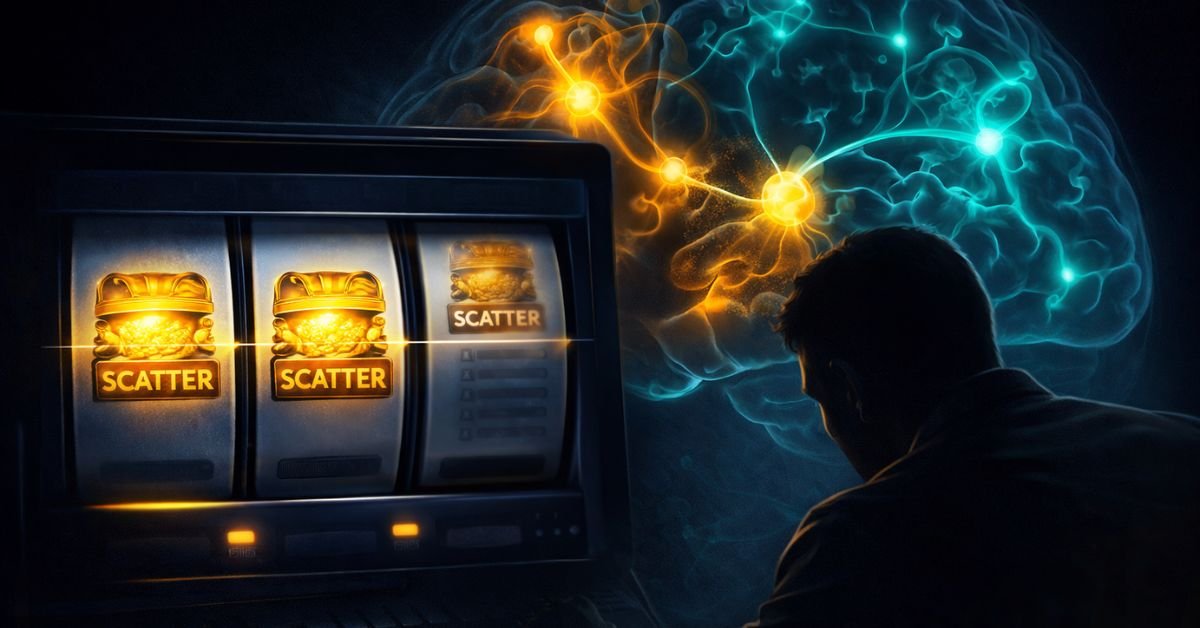
The near-miss effect in slots is the single most powerful psychological mechanic keeping you spinning after you should have stopped. Two scatter symbols land — you needed three. The jackpot symbol sits one position above the payline. The bonus round almost triggered but didn’t. Your brain reads these outcomes as “close” — as evidence that a win is coming soon, that you nearly cracked it, that one more spin might be the one. But here is what the near-miss effect in slots actually is: a mathematical non-event that your brain cannot help but misinterpret as progress. This article explains exactly how the near-miss effect in slots works, why your brain falls for it even when you know the trick, how slot designers use it deliberately, what the research says, and — most importantly — how to recognise it in real time so it stops controlling your behaviour.
What the Near-Miss Effect in Slots Actually Is
A near-miss is any slot outcome that looks like it was close to a win but produced no payout. Two jackpot symbols on the payline with the third one position away. Two scatter symbols landed when three were needed to trigger the bonus. A winning combination on 4 of 5 reels. These are all examples of the near-miss effect in slots — and they are all mathematically identical to any other losing spin.
The near-miss effect in slots creates a subjective feeling of proximity to winning that has zero correlation with actual proximity. On a modern video slot powered by a random number generator, each spin’s outcome is determined the instant you press the button. The reel animation you see is a visual representation of an outcome that has already been decided. The symbols “landing” one position away from a win were never going to land on the win — the RNG had already selected a losing combination. The display just makes it look close.
The Core Deception of the Near-Miss Effect in Slots
In skill-based activities — darts, basketball, archery — a near-miss genuinely is evidence of proximity to success. You almost hit the bullseye, so your technique is close. In slots, there is no technique. There is no trajectory that was “almost right.” The RNG does not care what happened on the previous spin, does not reward persistence, and does not move you closer to a win with each attempt. The near-miss effect in slots exploits a cognitive shortcut evolved for skill-based environments and applies it to a domain where it is completely invalid.
Why Your Brain Misreads the Near-Miss Effect in Slots
The near-miss effect in slots works because of how the human brain processes outcomes. Cognitive psychology identifies several mechanisms that conspire to make near-misses feel meaningful even when they are not.
Counterfactual Thinking
Your brain automatically generates “what if” scenarios. When two scatters land and you needed three, your mind constructs the scenario where the third one did land — and the contrast between that imagined win and the actual loss creates frustration and motivation to try again. The near-miss effect in slots hijacks this process by making the counterfactual feel plausible and close, when in reality the “almost” outcome was never a possible result of that spin.
Illusory Control
Near-misses create a feeling that you are “getting closer” — that your choices (bet timing, game selection, when you press spin) are influencing outcomes. This is the same illusion behind “hot” and “cold” slot beliefs. In reality, every spin on a certified slot is an independent RNG event. Your previous spins do not influence the next one. The near-miss effect in slots just makes it feel like they do.
Dopamine Response
Neuroscience research has shown that near-misses activate the brain’s reward system similarly (though not identically) to actual wins. The ventral striatum — the brain region associated with reward processing — shows increased activity during near-misses compared to clear losses. Your brain partially “rewards” you for almost winning, reinforcing the behaviour that led to the near-miss and motivating continued play. The near-miss effect in slots is literally neurochemical.
Gambler’s Fallacy Reinforcement
A near-miss reinforces the belief that you are “due” for a win. If the bonus almost triggered three times in a row, the near-miss effect in slots makes it feel like the next trigger is inevitable. But the hit rate does not change based on previous results. A slot with a 1-in-200 bonus trigger rate has exactly a 1-in-200 chance on every spin, regardless of how many near-misses preceded it. See gambling math explained.
The Near-Miss Effect in Slots vs the RNG — What “Close” Really Means
To understand why the near-miss effect in slots is an illusion, you need to understand how the RNG actually determines outcomes.
When you press spin, the RNG generates a number (or set of numbers) in microseconds. That number maps to a specific combination of reel positions. The visual animation — the reels spinning and stopping — is a post-hoc display of a result that has already been determined. The reels do not “land” in the way physical reels do. They are told where to stop by the RNG output.
Near-Miss Effect in Slots — What the RNG Actually Does
This is the crucial point most players miss about the near-miss effect in slots: the symbols surrounding the payline are not “near” outcomes. They are display elements. The math model determines which combinations are possible and how frequently each appears. A near-miss — two jackpot symbols with the third one position away — may be programmed to appear more frequently than you would expect from pure random distribution. This is not illegal in most jurisdictions, and it is one of the ways slot designers engineer the near-miss effect in slots deliberately.
How Slot Designers Engineer the Near-Miss Effect in Slots
The near-miss effect in slots is not an accident of game design. It is an intentional feature built into the math model and feature architecture of modern video slots. Here is how studios create and amplify it.
| Design Technique | How It Creates Near-Misses | Example |
|---|---|---|
| Weighted reel strips | The virtual reel strip contains more instances of high-value symbols in positions adjacent to the payline than on the payline itself. This makes jackpot symbols appear to “just miss” more often than pure random distribution would produce. | A jackpot symbol appears on reel positions 12, 25, and 40 of a 60-position strip. But positions 11, 13, 24, 26, 39, and 41 are also mapped to show the jackpot symbol above or below the payline — creating a near-miss display without an actual near-miss probability. |
| Scatter symbol distribution | Scatter symbols that trigger bonuses are weighted so that 2-of-3 results appear frequently. The player sees two scatters and “almost” got the bonus — generating anticipation and continued play. | In many high-volatility slots, 2-scatter results appear 3–5× more frequently than 3-scatter triggers. This ratio is tuned in the math model — it is not coincidence. |
| Reel animation speed and timing | Reels that stop sequentially (left to right) build anticipation. If the first two reels show a winning pattern, the player watches the third reel with heightened focus. The delay before the third reel stops amplifies the near-miss effect in slots because the brain has already begun anticipating the win. | Most modern slots stop reels with a slight cascade delay. Some add a “slow-down” animation on the final reel when a near-miss is about to display — extending the moment of anticipation before the loss is confirmed. |
| Sound design | Near-misses often trigger partial win sounds, anticipation audio cues, or “almost” sound effects that are distinct from clear-loss silence. These audio signals reinforce the feeling that something almost happened — a sensory near-miss effect in slots on top of the visual one. | The “rising pitch” audio that plays when scatters land on reels 1 and 2 — even before reel 3 stops — primes the player to expect a trigger. When reel 3 misses, the audio cuts abruptly, creating a contrast that feels like a loss of something rather than the absence of a win. |
| Losses disguised as wins (LDWs) | On multi-line/multi-ways slots, a spin that returns less than the total bet is displayed with win animations — flashing symbols, coin sounds, celebratory music — even though the player lost money. This is a cousin of the near-miss effect in slots: the brain registers “win” while the balance decreases. | A €1.00 total bet on a 243-ways slot returns €0.30 on a minor line hit. The game plays a win animation with sound. The player’s balance dropped by €0.70, but the sensory experience was “win.” See addictive slot features for the full breakdown of LDWs. |
Are Near-Misses Regulated?
Regulation varies by jurisdiction. The UKGC requires that game outcomes are genuinely random and that the display accurately represents the RNG output — but “weighted reel strips” that produce more near-miss displays are permitted as long as the underlying outcome is determined by a certified RNG. The MGA has similar standards. Some academic researchers and regulators have called for near-miss frequency to be disclosed or limited, but as of 2026, most jurisdictions do not specifically regulate the rate of near-miss displays in online slots. The near-miss effect in slots exists in a regulatory grey area — the outcomes are fair, but the presentation of those outcomes is designed to exploit cognitive bias.
What the Research Says About the Near-Miss Effect in Slots
The near-miss effect in slots is one of the most studied phenomena in gambling psychology. The research is extensive and the findings are consistent across decades of study.
Near-Misses Increase Play Duration
Multiple experimental studies have shown that participants exposed to higher rates of near-misses play significantly longer than those exposed to standard loss rates — even when the overall payout percentage is identical. The near-miss effect in slots does not change the math, but it changes the behaviour. Players stay longer, which means they spend more.
Near-Misses Activate Reward Pathways
Brain imaging studies (fMRI) have shown that near-misses activate the ventral striatum and insula — regions associated with reward anticipation and emotional arousal. Crucially, the brain’s response to a near-miss is more similar to a win than to a clear loss. The near-miss effect in slots is not just psychological — it is neurological. Your brain literally treats “almost winning” as partial success.
Problem Gamblers Are More Susceptible
Research consistently shows that individuals with gambling problems have a stronger neurological response to near-misses than recreational gamblers. The near-miss effect in slots is stronger in the brains of people who are already vulnerable — which means it disproportionately affects the players who can least afford to be influenced by it. This is one of the key arguments for regulatory attention.
Awareness Does Not Fully Protect You
One of the most important findings: knowing about the near-miss effect in slots does not eliminate it. Studies show that even participants who are explicitly told about near-miss manipulation still show increased arousal and play duration when exposed to near-misses. The response is partly automatic — a pre-conscious neurological reaction that occurs before your rational brain can intervene. Awareness helps, but it is not a complete defence.
Key research source: The foundational work on near-misses in gambling was published by Mark Griffiths and later expanded by Luke Clark at the University of Cambridge. Clark’s fMRI studies demonstrated that near-misses activate reward-related brain regions even in players who recognise the manipulation intellectually. For a deeper understanding of how slot design uses these findings, see addictive slot features and player psychology in slot games.
The Near-Miss Effect in Slots and the Chasing Loop
The near-miss effect in slots does not operate in isolation. It feeds directly into the chasing losses cycle — the pattern where a player continues to play beyond their planned budget because they feel like a win is imminent.
How the Near-Miss Effect in Slots Creates the Chasing Loop
This is the behavioural damage the near-miss effect in slots causes. It is not the near-miss itself that costs you money — it is the decision to continue playing that the near-miss provokes. Every additional spin past your planned stop point is a spin funded by the near-miss effect in slots overriding your rational budget. Over dozens of sessions, this accumulated overspend becomes significant. The Win Per Session Tracker shows the real cost over time — including the sessions where the near-miss effect in slots pushed you past your limit.
How to Spot the Near-Miss Effect in Slots in Real Time
Because awareness alone does not fully protect you from the near-miss effect in slots, you need practical detection signals — moments where you can consciously recognise that the near-miss is influencing you right now.
| Warning Signal | What Is Happening | What to Do |
|---|---|---|
| “I almost had it” | You just verbalised (or thought) a near-miss reaction. This is the near-miss effect in slots creating the illusion of proximity. | Pause. Say out loud: “That was a loss. The RNG does not know what ‘almost’ means.” Then check your balance against your budget. |
| “One more spin” | You are at or past your planned stop point, but the near-miss effect in slots is generating the urge to continue. | This is the single most important moment to stop. Close the game. The RG Planner set your budget for a reason — the near-miss effect in slots is now trying to override it. |
| Elevated heart rate / excitement after a loss | You feel physically aroused — heartbeat, tension, focus — after a spin that paid nothing. This is the neurological near-miss response. Your body is reacting as if something good happened. | Recognise the sensation as a design feature, not a signal. The slot is working as intended. Your excitement is the product, not the precursor to a win. |
| Switching to a higher bet after near-misses | The near-miss effect in slots combined with the “I’m due” fallacy is pushing you to increase stakes. If the bonus is “close,” a bigger bet means a bigger payout when it “finally” hits. | This is the most expensive behaviour the near-miss effect in slots produces. Lock your bet size before the session — the Session Risk Analyzer modelled a fixed bet. Changing it invalidates your risk profile. |
| Continuing past 2 scatter lands | You see 2 scatters and think “the bonus is about to trigger.” In reality, the next spin has the same trigger probability as every other spin. | 2-scatter results are the most common near-miss in high-volatility slots. They are tuned to appear frequently. They are not evidence that the bonus is approaching. Hit rate is constant. |
How to Protect Yourself From the Near-Miss Effect in Slots
Because the near-miss effect in slots is partly neurological and cannot be fully eliminated by awareness, the most effective defences are structural — systems and rules that limit the opportunity for the near-miss effect to influence your behaviour.
1. Set a Hard Budget Before You Play
Use the Responsible Gambling Planner to calculate a session budget based on income — not on “what feels right.” The budget is the firewall. Every near-miss that happens after the budget is exhausted is the near-miss effect in slots trying to get you to break the firewall. If the budget is set correctly, breaking it is never justified — regardless of how “close” the last spin looked.
2. Use Deposit Limits
Casino deposit limits (daily/weekly/monthly) are enforced by the platform and cannot be overridden in the moment. They are the best structural defence against the near-miss effect in slots because they remove the ability to deposit more when the near-miss pushes you to chase. Set them at your planned budget level. UKGC-licensed casinos are required to offer these tools.
3. Track Every Session
The Win Per Session Tracker creates an honest record. Tag sessions where you exceeded your budget — over time, you will see whether the near-miss effect in slots is causing a pattern of overspend. If sessions tagged “over-budget” correlate with your largest losses, the near-miss effect is costing you real money.
4. Pre-Set a Spin Count
Decide before the session how many spins you will play (the Session Risk Analyzer models this). When you hit your spin count, stop — regardless of what the last few spins looked like. A fixed spin count removes the near-miss effect in slots from the stopping decision entirely. You do not stop because you “feel” ready; you stop because the count reached zero.
The Meta-Awareness Strategy
The most effective cognitive defence against the near-miss effect in slots is meta-awareness: not just knowing about the near-miss effect, but actively monitoring your own mental state during play. Before each session, tell yourself: “I will notice when I feel excited after a loss. That feeling is the near-miss effect in slots working as designed. It is not a signal that I am close to winning. It is a signal that the game is doing its job.” This reframe does not eliminate the neurological response, but it gives your rational brain a framework to interpret the feeling correctly — as a design feature, not as evidence.
Near-Miss Effect in Slots — Further Reading
Addictive Slot Features — the full catalogue of design mechanics that sustain play, including losses disguised as wins. Player Psychology in Slot Games — the 8 psychological triggers slot designers use. Chasing Losses — the behavioural loop the near-miss effect feeds. Hot and Cold Slots — why streaks feel meaningful and are not. How RNG Works in Online Slots — the technology that makes “close” impossible. Slot Game Math Models — how studios build the probability distributions that produce near-misses. How Slot Features Affect RTP — the mechanics behind bonus trigger rates. Slot Hit Rate — why trigger probability is constant, not cumulative. Gambling Math Explained — the foundational math that disproves “almost won.” House Edge in Slots — the cost that accumulates on every spin, including the ones the near-miss effect generates. Why We Play Slots — the broader motivational psychology. Responsible Gambling Guide — the full framework for safe play.
Track whether near-misses are pushing you past your budget — see your real session costs over time
Open the Win Per Session Tracker →Frequently Asked Questions — Near-Miss Effect in Slots
What is the near-miss effect in slots?
The near-miss effect in slots is a psychological phenomenon where losing outcomes that look close to a win — two scatters when three are needed, a jackpot symbol one position away — create a subjective feeling of proximity to success. This feeling is an illusion: the RNG determines each spin independently, and a near-miss is mathematically identical to any other loss. The near-miss effect in slots increases play duration and spending by making players feel like a win is imminent when it is not.
Are near-misses in slots rigged?
On licensed slots, outcomes are determined by a certified RNG — so the underlying results are fair. However, the visual display of results can be weighted to show more near-miss patterns than pure random distribution would produce. The reel strips are designed so that high-value symbols appear adjacent to winning positions more frequently. The outcome is fair; the presentation is engineered to exploit the near-miss effect in slots.
Does knowing about the near-miss effect protect you?
Partially. Research shows that awareness reduces but does not eliminate the near-miss response. The neurological component — dopamine release in the ventral striatum — occurs partly before conscious processing. Awareness helps you interpret the feeling correctly (as a design feature, not a signal), but it does not prevent the feeling from occurring. That is why structural defences (deposit limits, session budgets, the RG Planner) are more effective than awareness alone.
Why do near-misses make me want to keep playing?
Because your brain is wired to interpret “almost” as “close to success” — a heuristic that works in skill-based activities (sports, crafts, learning) but is invalid in RNG-determined games. Brain imaging shows the near-miss effect in slots activates reward pathways similarly to actual wins, creating a partial reward signal that motivates continued play. Your brain is treating a loss as partial success because the visual display mimics proximity.
How do slot designers use the near-miss effect?
Through weighted reel strips (high-value symbols placed adjacent to winning positions), scatter distribution (2-of-3 results appear more than you would expect), sequential reel stopping with delays, anticipation sound effects, and losses disguised as wins on multi-line games. The math model and feature design work together to maximise near-miss frequency within the certified RTP framework.
Is the near-miss effect in slots regulated?
As of 2026, most jurisdictions (UKGC, MGA) require RNG certification and fair outcomes but do not specifically regulate the frequency of near-miss displays. The near-miss effect in slots exists in a grey area: the outcomes are fair, but the visual presentation is designed to exploit cognitive biases. Some researchers and regulators have called for near-miss frequency disclosure, but no major jurisdiction has implemented this yet.
How can I stop the near-miss effect from influencing me?
Use structural defences: set a hard budget with the Responsible Gambling Planner, enable deposit limits, pre-set a spin count with the Session Risk Analyzer, and track every session with the Win Per Session Tracker. These systems remove the near-miss effect from the stopping decision. You stop because you reached your limit — not because the last spin “felt” right.
Are some slots designed to have more near-misses than others?
Yes. Slots with high volatility and complex scatter-triggered bonuses typically produce more visible near-misses — 2-of-3 scatter results are frequent by design. The math model determines how often near-miss displays appear. Slots with simpler mechanics (3-reel classics) tend to produce fewer near-miss events because there are fewer components that can “almost” align.
Responsible Gambling: The near-miss effect in slots is the most powerful psychological tool in slot design — and it is specifically designed to keep you playing past your intended stopping point. If you recognise that near-misses are regularly pushing you past your budget, that is a signal to set stricter deposit limits and use the Responsible Gambling Planner to recalibrate. Take a break if gambling stops feeling like entertainment. Help at BeGambleAware.org and GamCare.org.uk.