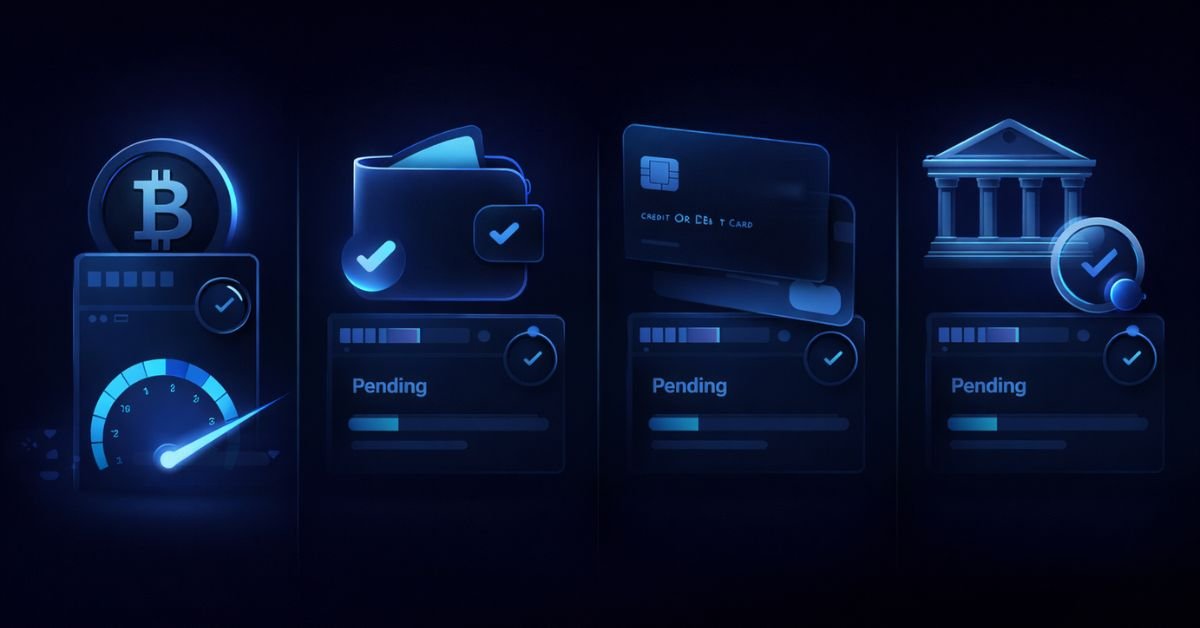
Players often ask the wrong payout question.
They ask, “Does this casino pay fast?” when the better question is: which withdrawal method gives me the cleanest path to actually getting paid?
That difference matters. The same casino can feel smooth for one player and frustrating for another simply because the payment method changes everything. Crypto, e-wallets, cards, and bank transfers all create different levels of speed, predictability, verification friction, and support risk.
If you are trying to work out the best casino withdrawal method, the answer is not just about raw speed. It is about how the full payout process behaves in the real world: operator approval, KYC checks, payment routing, business-day delays, and whether the money arrives cleanly once the casino says it has been processed.
This guide breaks down the real strengths and weaknesses of each major withdrawal method, where the friction tends to show up, and how to compare real player-reported outcomes before you deposit.
Compare payout outcomes by payment method
Use the SlotDecoded tracker to compare community-reported withdrawal friction across crypto, e-wallet, card, and bank transfer methods.
Open the Withdrawal Speed Tracker →Why the Withdrawal Method Matters More Than Most Players Think
Most casino content treats withdrawals as if the operator is the whole story. It is not.
The casino matters, but the payout method shapes the actual experience in a huge way. It affects:
- how fast funds can move once approved
- how much banking friction shows up after approval
- how easy it is to match deposits and withdrawals
- how often extra verification gets triggered
- how predictable the player experience feels
This is why one player can say “they paid me in an hour” while another says “same casino, but I waited three days.” They are often not really reporting the same withdrawal path.
The method changes the route. The route changes the friction.
How to Judge the Best Withdrawal Method Properly
If you only judge by “speed,” you miss too much of the picture.
A better framework is this:
| Factor | Why It Matters |
|---|---|
| Approval speed | How quickly the operator releases the payout request |
| Settlement speed | How fast the payment rail moves the money after approval |
| Verification friction | How likely the method is to trigger matching checks or added review |
| Predictability | Whether the payout path is stable or full of timing uncertainty |
| Practical convenience | How easily you can use, access, and trust the method in your region |
The best payout route is usually the one that balances speed with consistency. That is why the answer often changes depending on whether you are using crypto, a traditional wallet, a bank card, or a transfer directly into your bank account.
Crypto Withdrawals: Fast but Not Always Friction-Free
Crypto is the method most likely to be described as “instant” or “fastest.” Sometimes that is true. Sometimes it is marketing shorthand that ignores the operator side of the process.
Crypto’s real advantage is what happens after the casino approves the payout. Blockchain settlement can be quick compared with traditional banking rails. That makes crypto very attractive for players who care about fast access to funds.
But crypto still has friction points:
- the casino can hold the request in pending review before sending anything
- larger withdrawals may trigger deeper checks
- some operators batch crypto payouts rather than sending instantly
- user error matters more because addresses and wallet handling are less forgiving
When crypto is strongest
Crypto tends to perform best when the account is already verified, the operator is efficient, and the player knows how to manage wallet transfers cleanly.
When crypto is weaker
Crypto feels much less impressive when the operator slows the process before the transaction is even sent. This is why “crypto casino” does not automatically mean “friction-free cashout.”
E-Wallet Withdrawals: Often the Cleanest All-Round Option
If you want the most balanced answer for many players, e-wallets are often the strongest all-round choice.
Why? Because they usually combine decent settlement speed with simpler payout behavior than cards or bank transfers. They are often easier to reconcile from a payment-flow point of view, and they usually avoid some of the heavier banking lag that traditional rails create.
That does not mean e-wallets are magic. The casino can still slow things down before approval. But once approved, the route is often cleaner than a bank transfer and less messy than card payout timing.
When e-wallets are strongest
- the operator supports the wallet properly
- the deposit and withdrawal path match cleanly
- the player wants speed without the extra handling complexity of crypto
When e-wallets are weaker
- some operators limit wallet availability by region
- the player may still face KYC or payment-method proof checks
- not every wallet is equally supported across all brands
For many non-crypto players, e-wallets are often the best casino withdrawal method in practical day-to-day use.
Filter the tracker by payment method
Compare community-reported crypto, e-wallet, card, and bank transfer payouts before you choose how to cash out.
Compare Methods in the Tracker →Card Withdrawals: Familiar but Often Less Efficient
Cards are convenient because most players already use them. That familiarity makes them feel simple. But from a payout point of view, cards are often less clean than they appear.
Why? Because card withdrawals sit between operator processing and banking settlement. Even when the casino approves the payout, the card route may still introduce extra delay, uncertainty, or timing differences depending on the bank and card system involved.
This means cards are often acceptable, but not optimal.
Card strengths
- easy for many mainstream players
- widely available
- familiar and simple to understand
Card weaknesses
- slower settlement than wallets or clean crypto transfers
- more variability after approval
- greater dependence on banking rails outside the casino’s control
If your goal is a clean, low-friction payout experience, cards are often a middle-ground option, not the best one.
Bank Transfer Withdrawals: Reliable but Usually Slowest
Bank transfer is often the most traditional method and, in many cases, the slowest.
That does not make it useless. It can be reliable, straightforward, and suitable for players who prefer direct banking access. But it usually creates the most business-day friction and the weakest feeling of payout speed.
Why bank transfer often feels slower:
- bank rails usually take longer after approval
- weekends and public holidays matter more
- manual review can interact badly with bank-processing timelines
- the player may experience multiple waiting stages rather than one smooth handoff
When bank transfer still makes sense
It can make sense for players who want direct bank settlement and do not mind waiting longer. It is also common where e-wallets are less convenient or where players simply prefer not to use intermediary services.
Why it is usually not the best method
If your main goal is speed, low friction, and predictability, bank transfer is rarely the winning option.
Method-by-Method Comparison Table
| Method | Speed Potential | Predictability | Typical Friction | Overall Usefulness |
|---|---|---|---|---|
| Crypto | High | Medium | Operator approval delays, batching, wallet handling | Excellent for informed users if the operator is efficient |
| E-wallet | High | High | Moderate KYC or method checks | Often the best all-round choice |
| Card | Medium | Medium | Settlement variability and bank timing | Acceptable, but usually not optimal |
| Bank transfer | Low | Medium | Business-day delays, longer settlement path | Reliable but usually slowest |
So Which Method Is Actually Best?
For many players, the best practical ranking looks like this:
- E-wallet — best all-round balance of speed, predictability, and ease
- Crypto — potentially fastest, but more dependent on operator behavior and player competence
- Card — usable, familiar, but often less efficient
- Bank transfer — workable, but usually slowest and least elegant
That said, the right answer still depends on context.
If you are comfortable with crypto and the casino handles crypto well, it may be the best method for you. If you want something cleaner and more predictable without blockchain handling, an e-wallet is often stronger. If you are already deep into a traditional banking setup, card or bank transfer may be acceptable, but they usually come with more timing friction.
The real takeaway is this: there is no universal payout method that overrides operator quality. A weak operator can make a good method feel bad. A strong operator can make a slower method feel manageable.
How the SlotDecoded Tracker Helps
The SlotDecoded Casino Withdrawal Speed Tracker is useful because it lets you move beyond vague payout language and compare what players actually report.
That includes:
- community-submitted payout outcomes
- payment-method differences
- country-specific patterns
- KYC friction indicators
- pending and unresolved reports
- confidence labels and payout scoring
If you want to know whether crypto really looks cleaner than card at a specific brand, or whether bank transfer users are reporting heavier delays, this is exactly the type of comparison the tool is designed to support.
Already withdrawn with one of these methods?
Submit your own payout experience and help improve the public data for other players.
Submit Your Withdrawal Report →Related SlotDecoded Guides
- Casino Withdrawal Delays Explained: What Really Slows Payouts Down
- Why Is My Casino Withdrawal Pending? 9 Real Reasons Payouts Get Stuck
- KYC Withdrawal Delays Explained: Why Casinos Ask for Documents When You Cash Out
- Responsible Gambling: A Safer Play Guide
- Wagering Requirements Explained
- Are Online Slots Fair? How RNG Works
Useful External Resources
Frequently Asked Questions — Best Casino Withdrawal Method
What is the best casino withdrawal method overall?
For many players, e-wallets are the best all-round choice because they usually balance speed, predictability, and convenience better than cards or bank transfers. Crypto can be faster, but it depends more on operator handling and user competence.
Are crypto withdrawals always the fastest?
No. Crypto can settle quickly once sent, but the operator can still delay the payout during the approval stage. Fast blockchain settlement does not eliminate operator-side friction.
Are e-wallet withdrawals better than cards?
Often yes. E-wallets usually avoid some of the settlement friction and variability that cards can introduce after the casino approves a payout.
Why are bank transfer withdrawals slower?
Bank transfers usually involve longer settlement windows, stronger business-day dependence, and more friction after approval than wallets or clean crypto transfers.
Can the same casino perform differently by payment method?
Yes. That is one of the biggest reasons players get confused by broad payout claims. A casino can feel smooth for one method and much slower for another.
How can I compare real payout outcomes by method?
The best way is to look at player-reported data by payment method, country, and outcome. That is exactly what the SlotDecoded Withdrawal Speed Tracker is designed to help with.
Should I submit my own withdrawal experience?
Yes. The more real reports the tracker collects, the more useful it becomes for comparing crypto, e-wallet, card, and bank transfer payout friction across casinos.