A casino bonus can look perfectly reasonable until you discover that the games you actually play barely count toward the rollover.
This is where game contribution rates casino bonus terms start to matter.
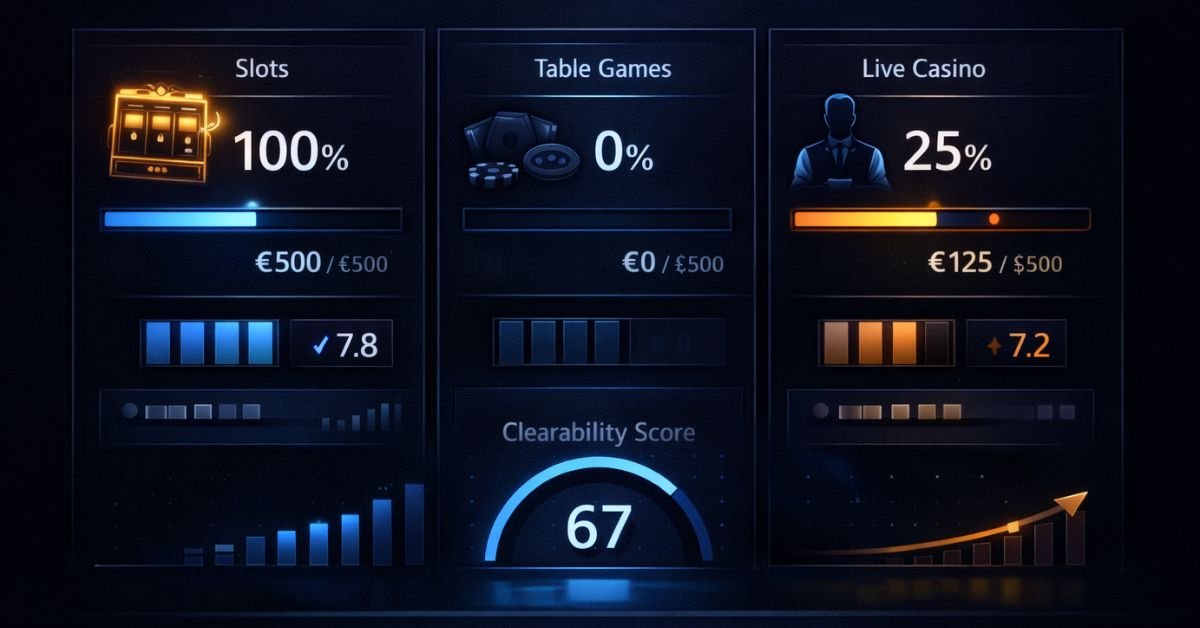
A player sees a welcome bonus, checks the wagering requirement, maybe notices the expiry period, and thinks they understand the offer. But then the casino quietly says slots count 100%, roulette counts 10%, blackjack counts 0%, live casino does not count at all, and bonus buys are excluded. At that point, the player is not dealing with one rollover number anymore. They are dealing with a weighted system that decides which bets actually move the bonus forward.
This is one of the most important bonus mechanics players underestimate because it sounds technical and harmless. It is neither. Contribution rates can completely change how realistic a bonus is to clear. They affect how fast the wagering moves, which games are actually useful, and whether the offer fits the way the player normally plays.
This guide explains what game contribution rates are, why casinos use them, how they interact with wagering requirements, why 100% slots and 0% tables matter so much, and how to judge whether a bonus is broadly usable or narrowly engineered to push players into one specific type of game.
If you want to compare casino bonuses properly, this is one of the terms you need to read before you deposit — not after you realise your preferred games are barely helping.
Compare contribution rates before you claim a bonus
Use the SlotDecoded scanner to compare slots contribution, table-game exclusions, live-casino limits, and other rules that change bonus clearability.
Open the Bonus Terms Scanner →What Contribution Rates Actually Mean
A contribution rate tells you how much a specific game counts toward the wagering requirement.
If a casino says slots contribute 100%, that usually means every €1 wagered on eligible slots counts as €1 toward rollover. If the casino says blackjack contributes 10%, then every €1 wagered on blackjack only counts as €0.10 toward the requirement. If a game contributes 0%, it does not help clear the bonus at all.
This is the part many players miss. They see a wagering requirement like 35x and assume the only question is whether they are willing to complete the volume. But contribution rates change the real speed of that process.
That means two players can have the same bonus, the same starting balance, and the same rollover target, but make completely different progress depending on which games they choose.
This is why contribution rates are one of the core terms behind bonus clearability. They decide whether the bonus is broad, narrow, or quietly stacked against anyone who does not stick to one specific product category.
Why Casinos Use Contribution Rates
Casinos do not apply contribution rates randomly. They use them to control which games are most useful during bonus play.
From the operator’s perspective, this usually serves three purposes:
- it pushes players toward games with the contribution profile the casino prefers
- it limits the use of lower-house-edge or lower-risk games for bonus clearing
- it reduces the chance that a player clears the bonus too efficiently
This is why slots often receive the highest contribution rate while table games and live casino receive reduced or zero contribution. A casino does not want every product category to be equally useful under the bonus if some categories are considered too favourable for clearing.
That does not automatically make contribution rates unfair. It does mean they are part of the core commercial design of the promotion.
From a player point of view, the important question is not whether contribution rates exist. It is whether the contribution profile still leaves the bonus usable for the way you actually play.
Why the Term Gets Overlooked
Because the headline of a bonus is emotional and contribution rates are mechanical.
The promotional copy says:
- 100% up to €500
- 200 free spins
- 30x wagering
The contribution table says:
- slots 100%
- roulette 10%
- blackjack 0%
- live casino 0%
- bonus buys excluded
One is written to make the offer sound attractive. The other explains whether the offer is actually practical. Most players see the first. Too few study the second.
How the Math Works in Practice
The easiest way to understand contribution rates is to compare the same wager through different contribution settings.
Imagine you have a bonus with a wagering requirement that still needs €1,000 of qualifying play.
Now look at three game categories:
- slots contribute 100%
- roulette contributes 10%
- live casino contributes 0%
If you wager:
- €100 on slots → €100 counts
- €100 on roulette → only €10 counts
- €100 on live casino → €0 counts
That is a massive difference.
The player may think they are “wagering” in all three cases, and technically they are. But in bonus terms, only some of that activity is actually moving the rollover.
This is why contribution rates can quietly multiply the practical difficulty of a bonus. A player who spends time on low-contribution games may feel like they are making progress while the bonus meter barely moves.
Why Reduced Contribution Feels Worse Than It Sounds
Because reduced contribution changes the effective workload.
If a player tries to clear a €1,000 requirement using a game that contributes 10%, they do not need €1,000 of play. They need the equivalent of €10,000 in actual wagering to generate the same qualifying progress.
That is not a minor detail. It is a totally different bonus experience.
| Game Type | Contribution Rate | €100 Wager Counts As | Practical Effect |
|---|---|---|---|
| Slots | 100% | €100 | Fastest qualifying progress |
| Roulette | 10% | €10 | Much slower bonus clearing |
| Live Casino | 0% | €0 | No bonus progress at all |
Why 100% Slots and 0% Tables Matter So Much
This is one of the most common bonus structures in the market.
Slots often get full contribution because they are the game type casinos most commonly want to support during bonus play. Table games and live casino frequently receive reduced or zero contribution because the casino wants to stop players using those products to clear bonuses efficiently.
From a player’s point of view, the practical meaning is simple:
- If you are primarily a slot player, a 100% slots contribution rate can make the bonus workable.
- If you prefer roulette, blackjack, baccarat, or live casino, the same bonus may be far less useful than the headline implies.
This is why bonus comparison should never assume “casino” means one uniform thing. The bonus may technically be a casino-wide offer, but the contribution rates often reveal that only part of the casino is really designed to help clear it.
That is also why a 35x bonus can feel manageable for one player and terrible for another. The slot player gets full contribution. The table-game player spends time on games that barely move the meter.
Why This Creates Misleading Bonus Expectations
A player may read “casino welcome bonus” and assume the promotion meaningfully applies across their normal casino activity.
But if:
- slots count 100%
- roulette counts 10%
- blackjack counts 0%
- live casino counts 0%
then the offer is not really broad in practical terms. It is heavily tilted toward slots.
That is not necessarily deceptive if the terms say so clearly. It is still something many players only understand too late.
How Players Get Caught by Low-Contribution Games
Players usually do not get caught because they ignored the bonus entirely. They get caught because they assume their usual play style fits the promotion better than it actually does.
1) They see “casino bonus” and assume all casino games help equally
This is one of the biggest misunderstandings. The bonus may cover the casino vertically, but the contribution rates decide which parts of it are actually useful.
2) They mix game types during the rollover
A player may start on slots, then move to roulette, blackjack, or live casino without realising that the progress rate has dropped sharply or stopped altogether.
3) They focus on total money wagered, not qualifying money wagered
This is a major difference. A player may think, “I have already played through €1,000,” without noticing that only a fraction of that amount counted under the contribution table.
4) They do not notice provider- or feature-level exclusions
Even within slots, some offers exclude:
- jackpot titles
- stateful games
- bonus buys
- certain providers or in-house games
That means even “slots 100%” is not always as clean as it sounds unless the exclusions are light and clearly disclosed.
Common Contribution-Rate Patterns in Casino Bonuses
These are the patterns you will see most often.
Pattern 1: Slots 100%, tables 0%, live 0%
This is one of the most common. It is simple, restrictive, and clearly pushes the player toward slots for bonus clearing.
Pattern 2: Slots 100%, tables 10%–20%, live 0%
This is slightly broader, but still heavily favours slots. Table players may technically make progress, but the speed difference is substantial.
Pattern 3: Slots 100%, selected alternative games partially counted
Some casinos include crash, instant, or in-house games at reduced rates. This can look broader, but the practical value depends on the exact percentages.
Pattern 4: Heavy exclusions even within slots
This is where the bonus looks clean until you read the detail. The casino may say slots contribute fully while carving out:
- bonus-buy features
- progressive titles
- high-profile branded slots
- specific providers
This is why contribution rates should be read alongside the excluded-games section, not in isolation.
Pattern 5: Deposit-only or unlock-style models with unusual contribution logic
Some newer or hybrid bonus structures do not behave like classic rollover bonuses. They may still use contribution logic, but in a different framework. Those should not be treated like simple standard-bonus rows unless the terms are very clear.
Why This Changes Bonus Clearability
Contribution rates are not just a technical note. They are one of the core reasons two bonuses with similar headlines can have very different real-world difficulty.
A bonus is easier to clear when:
- the player’s normal games contribute fully
- the exclusions are light
- the bonus does not force a major shift in playing style
A bonus is harder to clear when:
- the player’s preferred games contribute little or nothing
- the operator excludes key features or providers
- the full-contribution path is narrow
This is one reason SlotDecoded’s bonus tool should not rank offers only by headline size or even by wagering multiplier alone. A 30x bonus with broad 100% contribution can be more usable than a 20x bonus with heavy exclusions and weak contribution outside one narrow set of games.
That is also why contribution rates belong in the same conversation as:
- wagering base
- max-bet rule
- sticky structure
- expiry window
- max cashout
The bonus is not one rule. It is the combined weight of all of them.
A low multiplier can still be a bad bonus
If the games you actually play count poorly, the real bonus workload gets much heavier than the headline suggests.
Compare Contribution Terms →How to Judge Whether Contribution Terms Are Fair
Not every reduced contribution table is automatically bad. The real question is whether the bonus still feels usable for the player the casino is trying to attract.
A cleaner contribution profile usually looks like this
- slots count 100%
- the excluded-games list is not excessive
- bonus-buy treatment is clearly explained
- the player can make normal progress on mainstream play
A more restrictive profile usually looks like this
- only a narrow game set contributes fully
- table games and live casino are zeroed out
- major slot features are excluded
- the exclusions list is long and hard to read
- the contribution rules are vague or fragmented
That does not mean every table-game player should avoid every bonus. It does mean players need to stop assuming the offer fits their play style until the contribution profile proves that it does.
The safest practical question is:
If I play the games I normally enjoy, will this bonus actually move at a reasonable speed?
If the answer is no, then the offer is weaker than it first appears.
How the SlotDecoded Scanner Helps
The SlotDecoded Casino Bonus Terms Scanner helps surface contribution terms alongside the rest of the bonus structure.
That matters because contribution rates are easy to bury and hard to compare manually across multiple casinos.
The scanner helps make it easier to compare:
- slots contribution
- table-game contribution
- live-casino contribution
- excluded-game notes
- max-bet rules
- wagering base
- time pressure and overall bonus friction
That gives players a better way to judge whether a bonus is genuinely usable or only attractive if they happen to play the exact games the casino wants to push.
Want to see which games really count?
Use the scanner to compare contribution rates, exclusions, and bonus-clearability factors before you commit to an offer.
Open the Scanner →Related SlotDecoded Pages
Useful External Resources
Frequently Asked Questions — Game Contribution Rates Casino Bonus
What are game contribution rates in a casino bonus?
Game contribution rates show how much each game type counts toward the wagering requirement. A 100% contribution means the full stake counts. A 10% contribution means only a fraction counts. A 0% contribution means the game does not help clear the bonus at all.
Why do slots often count 100% while table games count less?
Because casinos usually design bonuses to favour slots during bonus clearing. Lower or zero contribution on table games and live casino reduces how efficiently those products can be used for rollover.
Does 0% contribution mean I cannot play the game?
Not always. It usually means the wagers on that game do not count toward clearing the bonus. You may still be able to play it, but it will not help progress the rollover.
Why are contribution rates so important?
Because they change the real workload of the bonus. A bonus can look manageable on paper, but if your preferred games count poorly, the actual effort needed becomes much heavier.
Do all slots always count 100%?
No. Some casinos exclude specific slots, progressive titles, bonus-buy features, or certain providers even when the general rule says slots count fully.
Can a low wagering requirement still be a bad bonus if contribution rates are weak?
Yes. If the games you actually play contribute little or nothing, a low headline multiplier can still translate into poor practical clearability.
How can I compare contribution rates more easily?
The easiest way is to compare the contribution table together with wagering base, exclusions, max-bet rule, and expiry. That is what the SlotDecoded scanner is designed to help with.