Two bonuses can have the same headline, the same match percentage, and the same wagering multiplier — and still be nowhere near equal.
That happens because the multiplier is only half the story. The other half is the wagering base: what the rollover actually applies to. If the casino applies the requirement to bonus only, the workload is one thing. If the casino applies it to deposit and bonus, the workload can become dramatically heavier.
This is one of the most important casino bonus terms players miss. They notice the headline. They notice the multiplier. They often do not notice the base. That is exactly why many players think they understand an offer when they only understand its marketing layer.
This guide breaks down bonus only vs deposit and bonus wagering in plain terms, shows the actual math, explains why this term changes bonus clearability so much, and gives you a practical framework for judging which structure is better before you deposit.
If you understand this one rule properly, you will read casino bonuses better than most players.
Compare wagering base before you claim a bonus
Use the SlotDecoded scanner to see whether rollover applies to bonus only or deposit plus bonus — and how much that changes real bonus difficulty.
Open the Bonus Terms Scanner →What the Wagering Base Actually Is
A wagering requirement tells you how many times the casino expects you to play through a certain balance before the bonus conditions are satisfied. The missing piece is this:
What balance?
That balance is the wagering base.
When casinos say a bonus has 35x wagering, that does not tell you enough by itself. You also need to know whether the 35x applies to:
- the bonus only
- the deposit plus the bonus
- some more unusual unlock structure
This is one of the most important hidden levers in bonus design because it controls the real volume of wagering required. A player may see the same multiplier on two different casinos and assume the offers are roughly comparable. They are not, unless the base is the same too.
If you ignore the base, you can end up underestimating the difficulty of a bonus by a huge margin.
What Bonus-Only Wagering Means
Bonus-only wagering means the rollover applies only to the bonus amount, not to your deposit.
Example:
- Deposit: €100
- Bonus: €100
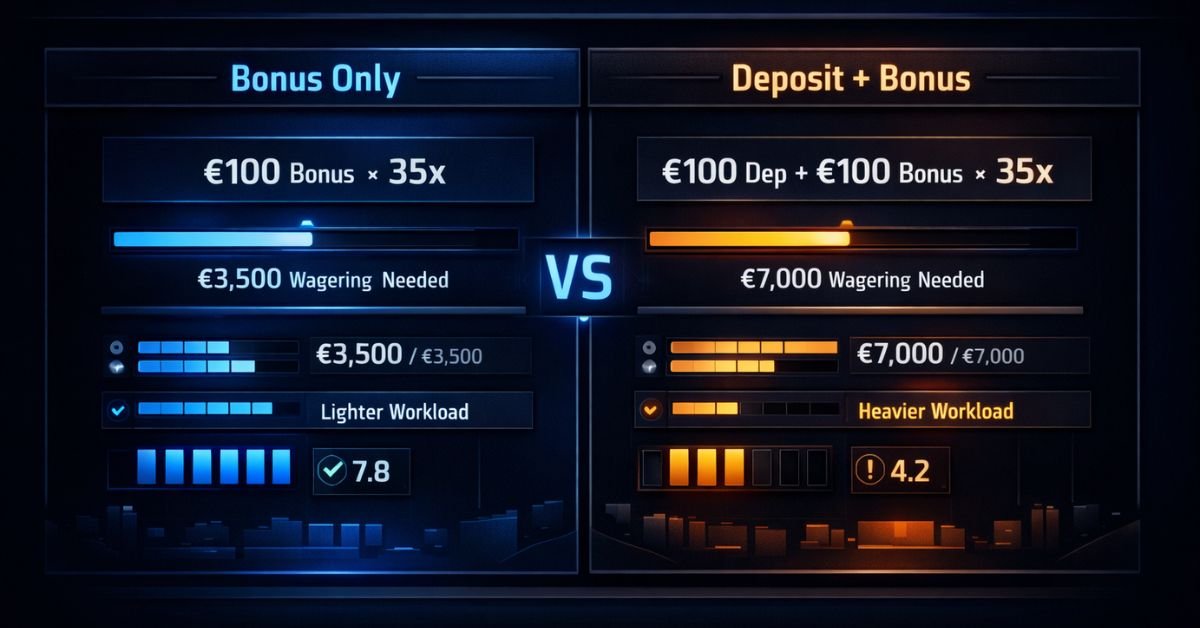
- Wagering: 35x bonus only
In that case, the total required wagering is:
€100 × 35 = €3,500
Your deposit is still part of your playable balance, but the rollover base is tied only to the bonus amount itself.
This is usually the more player-friendly structure because the workload is lighter than deposit-and-bonus wagering at the same multiplier. That does not mean every bonus-only offer is automatically good. It does mean the base is cleaner and easier to justify.
Bonus-only wagering is easier to work with because:
- the total required wagering is lower
- the player can clear the bonus faster
- expiry pressure becomes less severe
- the house edge has less volume to work through
- the bonus has a better chance of feeling usable
That is why, when all else is equal, bonus-only wagering is usually the better structure.
Why Players Like Bonus-Only Wagering
It feels fairer because the casino is applying the requirement to the promotional value it gave you, not to the money you deposited yourself. That does not make the casino generous. It just makes the deal less restrictive than the common alternative.
In practical terms, if you are choosing between two similar offers and one uses bonus-only wagering while the other uses deposit and bonus, the bonus-only structure usually deserves more serious attention.
What Deposit-and-Bonus Wagering Means
Deposit-and-bonus wagering means the multiplier applies to the combined value of your deposit and the bonus.
Example:
- Deposit: €100
- Bonus: €100
- Wagering: 35x deposit + bonus
Total required wagering becomes:
(€100 + €100) × 35 = €7,000
That is double the workload of the bonus-only version above.
This is where a lot of players get caught. They see the same headline and the same multiplier, but they do not realise the real rollover demand is much heavier because the base itself is larger.
Deposit-and-bonus wagering is more restrictive because:
- the total wagering target rises sharply
- the player spends longer under bonus conditions
- expiry windows become more punishing
- max-bet rules have more time to create friction
- the bonus becomes harder to clear before variance erodes value
This structure is common enough that many players treat it as normal. It may be common, but it is still a worse structure than bonus-only when all else is equal.
Why Casinos Like Deposit-and-Bonus Wagering
Because it drives more total play volume. That is the core reason. It increases the amount of wagering expected before the player can satisfy the bonus conditions. From the casino’s perspective, that means more action. From the player’s perspective, it means more friction.
Why the Math Changes So Much
The easiest way to understand this is to ignore the marketing and look at the workload.
Let’s compare identical-looking offers:
- Deposit: €100
- Bonus: €100
- Multiplier: 35x
Now split it by base:
- 35x bonus only = €3,500 total wagering
- 35x deposit + bonus = €7,000 total wagering
That is not a small difference. It is a completely different practical bonus.
And the gap gets bigger as the deposit and bonus size grow.
Example:
- Deposit: €250
- Bonus: €250
Now:
- 35x bonus only = €8,750 wagering
- 35x deposit + bonus = €17,500 wagering
Again, double the workload.
This is why players should stop reading bonus percentages in isolation. If you only understand the multiplier, you are missing the part that changes the real burden the most.
Real Examples With 10x, 35x, and 40x
Let’s make the comparison even clearer with simple examples.
| Deposit | Bonus | Wagering Structure | Total Required Wagering |
|---|---|---|---|
| €100 | €100 | 10x bonus only | €1,000 |
| €100 | €100 | 10x deposit + bonus | €2,000 |
| €100 | €100 | 35x bonus only | €3,500 |
| €100 | €100 | 35x deposit + bonus | €7,000 |
| €100 | €100 | 40x bonus only | €4,000 |
| €100 | €100 | 40x deposit + bonus | €8,000 |
Notice the pattern: when the deposit and bonus are equal, deposit-and-bonus wagering effectively doubles the total workload at the same multiplier.
That is why bonus-only vs deposit and bonus wagering is not a technical side note. It is one of the most important practical distinctions in bonus comparison.
What This Feels Like in Practice
Suppose two casinos both advertise:
- 100% up to €500
- 35x wagering
Casino A uses bonus-only. Casino B uses deposit+bonus.
Casino A already asks for meaningful play volume. Casino B asks for a much heavier clearance workload while looking roughly identical to the casual reader.
That is exactly the kind of trap the SlotDecoded tool and related guides are meant to expose.
Which Structure Is Usually Better?
In almost every like-for-like comparison, bonus-only wagering is better.
That does not mean every bonus-only offer is worth taking. It does mean bonus-only wagering is usually:
- lighter
- cleaner
- more realistic to clear
- less exposed to expiry pressure
- less punitive when combined with other restrictions
Deposit-and-bonus wagering is usually worse because it inflates the rollover base and makes the player work through much more betting volume before the bonus conditions are satisfied.
If you are comparing two similar offers and everything else is close, the better order of preference is usually:
- Bonus only
- Deposit only / unlock-style models if clearly explained
- Deposit + bonus
That order can change if the rest of the terms differ a lot. For example, a bonus-only offer with 60x wagering and a 3-day expiry might still be worse than a deposit+bonus offer with a much lower multiplier and cleaner rules. But if the rest is similar, bonus-only wins.
Don’t compare the multiplier alone
Use the scanner to see which casinos use bonus-only wagering and which quietly apply rollover to deposit plus bonus.
Compare Wagering Base →When Bonus-Only Still Isn’t a Good Deal
Bonus-only wagering is better than deposit-and-bonus wagering, but it is not automatically a green flag.
A bonus-only offer can still be poor if it includes enough other friction.
For example:
- 60x wagering on bonus only
- a 3-day or 7-day expiry
- a sticky structure
- a tiny max-bet limit
- a harsh max cashout cap
- major game exclusions
This is why good bonus comparison always needs context. The wagering base is one of the most important terms, but it is not the only one.
The right way to think about it is this:
Bonus-only makes a bonus easier than it would otherwise be. It does not automatically make the bonus good.
What to Check Before You Claim
If you want to read this rule properly in live casino offers, use this checklist:
- Find the multiplier — 10x, 20x, 35x, 40x, etc.
- Find the wagering base — bonus only or deposit + bonus
- Calculate the total workload using the real numbers
- Check the expiry period — 3, 7, 14, or 30 days changes everything
- Check the max-bet rule — the bonus may be easy to breach
- Check sticky vs non-sticky — structure matters
- Check game contribution rates — not all wagering counts equally
- Check for bonus-buy restrictions — many offers quietly exclude them
- Check max cashout — upside may be capped
- Judge the full restriction load, not just one term
If a casino does not make the wagering base easy to find, that is already a signal. Clean offers are usually easier to understand. Murky offers tend to hide the real burden in the detail.
How the SlotDecoded Scanner Helps
The SlotDecoded Casino Bonus Terms Scanner is built to make this exact comparison easier.
Instead of making players manually decode every promotion, the tool helps surface:
- wagering requirement
- wagering base
- max-bet rules
- cashout caps
- sticky vs non-sticky structure
- time pressure
- overall clearability signals
This is important because the base is one of the easiest terms to miss and one of the most important terms to understand. Once you start comparing bonuses through that lens, a lot of “big” offers stop looking attractive.
See which offers are heavier than they look
Use the scanner to compare headline size against the real rollover base and restriction load.
Open the Scanner →Related SlotDecoded Guides
- Casino Bonus Terms Explained: How to Read an Offer Before You Deposit
- Sticky vs Non-Sticky Bonuses: The Difference That Changes Your Cashout
- Max Bet Rule Explained: Why Casinos Cancel Bonus Winnings
- What Is Max Cashout in a Casino Bonus?
- Game Contribution Rates Explained: Why 100% Slots and 0% Tables Matter
- Casino Bonus Terms Scanner
Useful External Resources
Frequently Asked Questions — Bonus Only vs Deposit and Bonus Wagering
What does bonus-only wagering mean?
Bonus-only wagering means the rollover multiplier applies only to the bonus amount. It does not apply to your deposit, which usually makes the total required wagering lower.
What does deposit and bonus wagering mean?
It means the rollover multiplier applies to the combined value of your deposit and the bonus. That usually makes the required wagering much heavier than bonus-only wagering at the same multiplier.
Which is better: bonus only or deposit and bonus wagering?
Bonus-only wagering is usually better because the workload is lighter and the bonus is easier to clear. Deposit-and-bonus wagering is generally more restrictive.
Why does the wagering base matter so much?
Because it changes the actual size of the rollover target. The same multiplier can produce a completely different workload depending on what the multiplier applies to.
Is a 35x bonus-only offer better than a 35x deposit-and-bonus offer?
Yes, almost always. If the deposit and bonus are similar in size, the deposit-and-bonus version can require roughly double the wagering volume.
Does bonus-only wagering automatically mean a bonus is good?
No. It is a better structure, but the offer can still be poor if it has a high multiplier, short expiry, sticky rules, low max-bet limit, or a harsh cashout cap.
How can I compare wagering base more easily?
The easiest way is to use a tool that surfaces the wagering base directly alongside the multiplier and other restrictions. That is what the SlotDecoded scanner is designed to help with.