
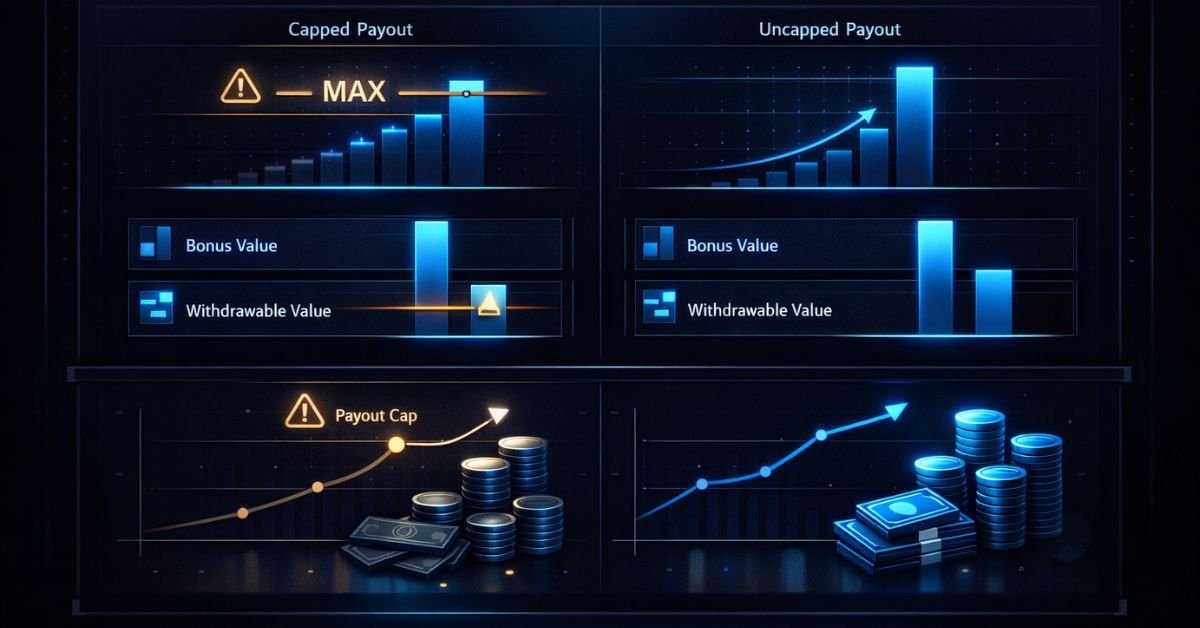
Some casino bonuses are not as valuable as they look even when you clear the wagering.
That is the part many players miss.
They focus on the welcome headline, the free spins count, the match percentage, and the rollover. They assume the difficult part is getting through the wagering requirement. But even if they do that, one more rule can quietly slash the practical value of the offer: the max cashout casino bonus cap.
This is one of the most important bonus terms players underestimate. A max cashout rule limits how much you can actually withdraw from bonus-related winnings. That means a session can go well, the balance can grow, the rollover can be completed, and the player can still discover that the operator only allows a capped amount to leave the account.
That is why max cashout is not a small detail. It changes how much upside the bonus really offers. It also changes how you should compare one promotion against another.
This guide explains what max cashout really means, why casinos use it, how it affects bonus value, where players misunderstand it, how it interacts with free spins and welcome offers, and how to judge whether a payout cap is reasonable or simply another way to make a bonus look bigger than it is.
If you want to compare casino promotions properly, this is one of the terms you need to understand before you deposit.
Compare capped vs uncapped bonus structures before you deposit
Use the SlotDecoded scanner to compare max cashout rules, wagering base, max bet restrictions, sticky terms, and overall bonus clearability.
Open the Bonus Terms Scanner →What Max Cashout Actually Means
A max cashout is a limit on how much you are allowed to withdraw from bonus-related winnings.
It does not usually matter what your balance reached at its peak. It does not necessarily matter that you completed the wagering. If the bonus terms say winnings are capped, the operator may only let you withdraw up to that stated amount.
That cap may be expressed as:
- a fixed amount, like €100 or €500
- a multiple of the bonus amount, like 5x the bonus
- a separate cap tied specifically to free-spin winnings
- a cap on winnings converted from a no-deposit or free-bonus offer
This is why the term matters so much. A bonus can look large and still have very limited practical upside once the cashout cap is applied.
Here is the simple version:
If an offer has a max cashout, the session upside is limited even if the player clears the bonus successfully.
That does not automatically make the bonus bad. It does mean you should stop judging it only by the headline value.
Why Casinos Use Max Cashout Limits
Casinos use cashout caps for a simple reason: they want to control bonus liability.
From the operator’s perspective, a max cashout rule does a few things:
- it limits the promotional risk on low-cost offers
- it keeps free bonuses from becoming too expensive
- it reduces the upside of highly favourable short-term variance
- it lets the casino market a generous-looking promotion while protecting itself on the payout side
This is especially common on:
- free-spin offers
- no-deposit bonuses
- small-signup rewards
- aggressive headline offers where the operator wants tighter payout control
The casino is not doing this by accident. The cap is part of the bonus design.
That is why players should not treat it like random admin detail. It is a core commercial rule that changes what the offer is really worth.
Why the Term Feels So Underestimated
Because many players mentally rank bonus terms in the wrong order.
They usually care first about:
- match percentage
- free spins
- maximum bonus size
- wagering requirement
Only later do they notice:
- cashout caps
- max-bet rules
- sticky structure
- expiry pressure
But in practical bonus value, a max cashout can be just as important as the rollover itself.
How Players Misread Payout Caps
Players usually misunderstand max cashout in one of four ways.
1) They assume clearing the rollover unlocks the full balance
This is the most common mistake. A player thinks, “If I complete the wagering, whatever is left is mine.” That is not always true. If the bonus has a withdrawal cap, the operator may still limit what can be taken out.
2) They think the cap only applies if the session gets very large
Sometimes the cap is low enough that it matters far earlier than players expect. On some promotions, the cap turns a potentially useful session into something much smaller.
3) They do not realise free-spin winnings may have a separate cap
Free spins are one of the most common places where max cashout rules quietly sit. The casino may promote the spins heavily, while the actual converted value the player can withdraw is tightly limited.
4) They confuse “max bonus amount” with “max cashout”
These are completely different things.
- Max bonus amount = how much bonus value the casino gives you
- Max cashout = how much you can actually withdraw from bonus winnings
A casino can advertise a meaningful bonus amount and still keep the withdrawable upside tightly capped.
Common Max Cashout Structures
Not every bonus uses the same type of cap. These are the common structures you should look for.
Fixed cashout cap
This is the easiest one to understand. The terms might say that maximum winnings from the bonus are limited to:
- €100
- €500
- €5,000
The player knows the ceiling, but that does not make the offer automatically fair. The key question is whether the cap is proportionate to the rest of the promotion.
Bonus-multiple cap
Some casinos set the cap as a multiple of the bonus amount, for example:
- 3x bonus amount
- 5x bonus amount
- 10x bonus amount
This is more flexible than a tiny fixed cap, but it can still be restrictive depending on the multiplier and the size of the underlying bonus.
Free-spin winnings cap
This is common and often overlooked.
A casino may award free spins, allow winnings from those spins to convert into bonus balance, and then cap the amount that can eventually be withdrawn from that path.
That means the promotional value of the free spins may be much lower than the player expects.
No-deposit or free-bonus cap
This is one of the most common places for strong caps because the player did not deposit to receive the offer. A no-deposit bonus may still be worth something, but the casino often uses the cap to contain promotional exposure tightly.
Campaign-specific capped bonuses
Some welcome pages, code-based offers, or affiliate promotions include a cap that does not apply site-wide but applies to that specific campaign. This is why you should read the promo-specific terms, not just the general bonus page.
| Cap Type | How It Works | Typical Risk |
|---|---|---|
| Fixed amount | Withdrawals limited to a stated amount | Can sharply reduce upside |
| Bonus multiple | Cap tied to the bonus size | Can still be restrictive if multiplier is low |
| Free-spin cap | Limits converted winnings from free spins | Often quietly reduces practical value |
| No-deposit cap | Limits payout from free signup-style offers | Common and often aggressive |
Why a Cashout Cap Changes the Value of a Bonus
This is the core issue.
A bonus does not just have two states — cleared or not cleared. It also has an upside structure. A max cashout changes that upside structure directly.
Imagine two offers:
- Offer A: 100% up to €200, no obvious cap
- Offer B: 100% up to €200, max cashout €100
On the surface, the bonuses look comparable. In practice, Offer B is much tighter because even a successful outcome cannot exceed the payout ceiling defined by the operator.
Now imagine a free-spin offer that sounds generous, but winnings from those spins are capped at €50 or €100 after conversion. The spins may still be worth taking if the rest of the terms are clean, but they are not as valuable as the raw promotional language makes them sound.
This is why max cashout matters so much to clearability. A capped offer has less real ceiling than an uncapped one, even if the headline looks large.
Why Players Feel Burned By This Rule
Because the restriction appears at the exact point where the player feels they succeeded.
They:
- claimed the bonus
- played through the terms
- saw the balance grow
- thought the hard part was done
Then the cap becomes the real limiter.
That feels much worse than an obvious friction term upfront because the player experiences it as a late-stage ceiling, not an early-stage warning.
Same headline. Different upside.
Use the scanner to compare whether bonuses are uncapped, tightly capped, or limited in ways that change the real value of the offer.
Compare Cashout Caps →Why Free-Spin Bonuses Often Hide Cashout Caps
This is one of the most common places where players overestimate bonus value.
Free spins sound simple. The casino gives a bundle of spins. The player hopes to win from them. But the actual path often looks like this:
- Free spins are awarded
- Winnings from the spins convert to bonus balance
- The converted balance may carry wagering
- The converted balance or final withdrawal may be capped
That means a free-spin package can have multiple layers of restriction:
- limited game or provider
- fixed coin value
- conversion rule
- wagering requirement
- max cashout cap
This is why some free-spin offers are more promotional theatre than meaningful value. They are not always useless, but they are often weaker than the top-line number suggests.
A player sees 100 free spins. The better question is:
How much of the resulting value could I actually withdraw if things go well?
If the answer is tightly capped, then the real offer is smaller than it looks.
How Max Cashout Interacts With Other Bonus Rules
A cap is rarely the only thing shaping the bonus. It usually works alongside other restrictions.
Max cashout + high wagering
This is one of the weaker combinations because the player does a lot of work for a tightly limited upside.
Max cashout + sticky bonus
This makes the bonus feel even less flexible. The player is already restricted in how the bonus behaves, and the withdrawal ceiling reduces upside further.
Max cashout + short expiry
A short expiry window creates urgency. A cashout cap reduces reward. Together they make the offer much less attractive than the headline suggests.
Max cashout + max-bet rule
This is another high-friction combination. The player has limited freedom while clearing the bonus and limited upside after clearing it.
Max cashout + game restrictions
If the games you prefer do not count fully and the final payout is capped anyway, the bonus may have very little practical edge left.
This is why max cashout should never be judged in isolation. It is one piece of the restriction stack. The full question is:
How many rules are limiting this bonus at the same time?
How to Judge Whether a Cap Is Fair or Restrictive
Not every capped bonus is worthless. The question is whether the cap is proportionate to the promotion.
A less restrictive cap usually looks like this
- the cap is clearly disclosed
- the cap is high enough that the offer still has practical upside
- the rest of the terms are relatively clean
- the cap is attached to a genuinely free or low-risk reward
A more restrictive cap usually looks like this
- the cap is low relative to the promotion headline
- the cap sits on top of heavy wagering
- the cap is attached to short-expiry or sticky structures
- the cap is easy to miss until later
In practical terms, a no-deposit bonus with a sensible cap may still be fine for what it is. But a sizeable deposit bonus with heavy rollover and a tight cashout ceiling is much harder to defend as a genuinely strong offer.
That is the distinction that matters: not whether a cap exists, but whether the full offer still leaves the player with reasonable upside.
How the SlotDecoded Scanner Helps
The SlotDecoded Casino Bonus Terms Scanner helps surface the terms that change real-world bonus value, including cashout caps.
That matters because many casino landing pages are not built to help users judge practical upside. They are built to encourage action. The scanner is meant to do the opposite: slow the comparison down and make the real mechanics easier to see.
The tool helps expose:
- whether a bonus appears capped or uncapped
- how the cap interacts with wagering
- how the cap interacts with sticky structure
- how max-bet rules and expiry stack with payout limits
- which offers look generous but are structurally tighter
That makes it easier to compare promotions by real usability instead of pure headline size.
Want to spot capped offers faster?
Use the scanner to compare max cashout, max bet, rollover base, and other bonus restrictions in one place.
Open the Scanner →Related SlotDecoded Pages
Useful External Resources
Frequently Asked Questions — Max Cashout Casino Bonus
What does max cashout mean in a casino bonus?
It means the casino limits how much you can withdraw from bonus-related winnings, even if you complete the wagering requirement successfully.
Is max cashout the same as maximum bonus amount?
No. Maximum bonus amount is how much bonus value the casino gives you. Max cashout is how much you are allowed to withdraw from the resulting bonus winnings.
Do free-spin bonuses often have a max cashout cap?
Yes. Free-spin promotions are one of the most common places where payout caps appear, especially after the winnings convert to bonus balance.
Does a max cashout make a bonus bad?
Not automatically. It depends on how tight the cap is and how many other restrictions the offer already has. But it always reduces the upside and should be treated as a meaningful term.
Can I still clear wagering and lose value because of max cashout?
Yes. That is exactly why the term matters. A player can complete the rollover and still be limited by the withdrawal cap.
What kind of bonuses are most likely to have cashout caps?
No-deposit bonuses, free-spin offers, signup rewards, and some heavily promoted welcome campaigns are the most likely places to find them.
How can I compare capped and uncapped bonuses more easily?
The easiest way is to compare the full restriction stack: max cashout, max-bet rule, wagering base, expiry, and sticky structure. That is what the SlotDecoded scanner is designed to help with.